
If you’re trying to figure out ELDT exemptions, I want to save you some time. Not every CDL applicant has to sit through Entry-Level Driver Training.
Knowing where you stand can keep you from paying for a course you never needed.
I’ll walk you through every exemption category recognized in 2026. I’ll also show you how the rules apply to permits and endorsements. And I’ll give you a simple way to check your own status before you commit to a training provider.
What Is ELDT, Quickly
Entry-Level Driver Training is a federal requirement. It took effect on February 7, 2022, and it’s still the baseline standard in 2026.
It applies to anyone getting a Class A or Class B CDL for the first time. It also applies to a Class B to Class A upgrade. And it applies to anyone seeking a school bus (S), passenger (P), or hazardous materials (H) endorsement for the first time.
Before you test in any of these categories, you need a completion certificate. That certificate has to come from an active, registered FMCSA training provider.
That’s the baseline. But the rule was never written to apply to everyone. That’s where exemptions come in.
Who Is Exempt From ELDT Requirements
Several exceptions are built into the ELDT rule. Most of them line up with existing CDL testing exceptions that were already on the books. If you’re currently excepted from taking a skills test for a Class A or Class B CDL, or for a passenger or school bus endorsement, you’re not subject to ELDT either.
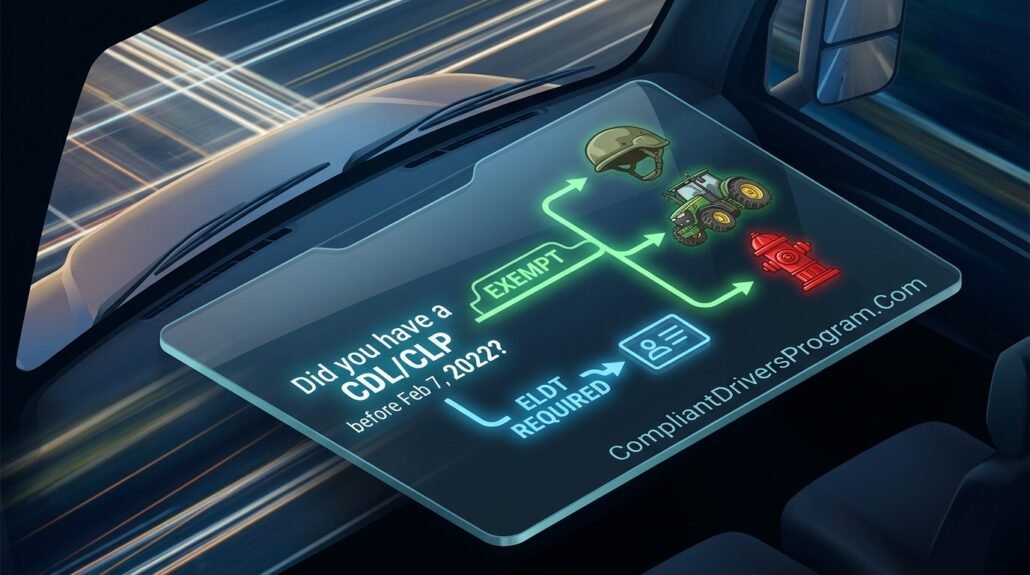
Here’s a breakdown of who that covers in 2026.
1. Drivers Licensed Before February 7, 2022
This is the most common exemption. It also trips people up the most.
The rule is not retroactive. If you held a CDL or an S, P, or H endorsement before February 7, 2022, you don’t need to complete training for that specific CDL or endorsement.
There’s a nuance worth knowing here too. If you were issued a CDL before that date, you’re not subject to ELDT even if you later re-obtain a CDL of the same class, even when your previous license isn’t currently valid.
So a lapsed pre-2022 CDL doesn’t push you into the training requirement. Not as long as you’re getting the same class back.
Where this exemption stops applying is upgrades. Held a Class B CDL before 2022 and now want a Class A? That upgrade counts as new. ELDT applies.
2. CLP Holders From Before February 7, 2022
If you obtained a commercial learner’s permit before February 7, 2022, you’re not subject to ELDT requirements, as long as you obtain a CDL before that CLP, or a renewed CLP, expires.
Miss that window? Reapply for a fresh permit later? Then the standard training requirement applies to you.
3. Military Drivers
Active-duty service members get a broad exception here. States must exempt individuals who operate commercial vehicles for military purposes, including active duty personnel, military reservists, national guard members on active duty, dual-status military technicians, and active duty Coast Guard personnel.
ELDT rides on top of the existing skills test exceptions. So this group is excused from entry-level training too.
There’s a separate provision for veterans re-entering civilian trucking. A state may, at its discretion, waive the knowledge test for current or former military service members who meet specific conditions. It may also waive the driving skills test for those with recent military commercial vehicle experience.
This waiver isn’t automatic. It needs documentation of recent military driving experience, a clean record, and state approval. Check with your state licensing agency first.
4. Farmers and Covered Farm Vehicle Drivers
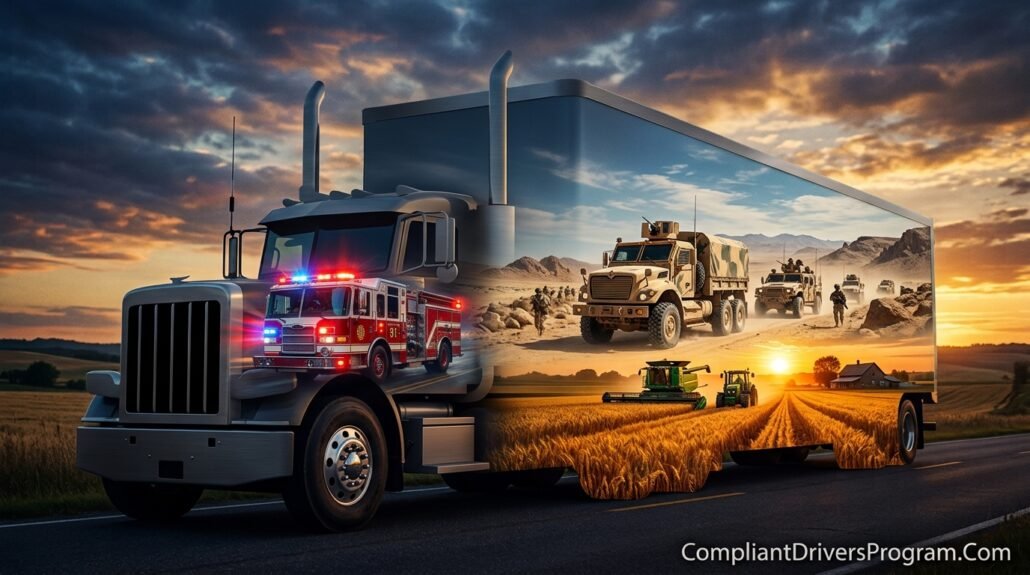
States can exempt certain agricultural drivers, and most do. A state may, at its discretion, exempt farmers, firefighters, emergency response vehicle drivers, and drivers removing snow and ice from CDL requirements. The waiver is generally limited to the driver’s home state, unless a reciprocity agreement exists with a neighboring state.
There’s a separate, broader rule too. The federal rules don’t apply at all to a driver operating a “covered farm vehicle.”
That’s different from the discretionary farmer exemption. It covers a wide range of agricultural hauling within the vehicle’s home state and nearby areas.
5. Firefighters and Emergency Response Drivers
Firefighters and other people who drive commercial vehicles necessary for the preservation of life or property, or for emergency government functions, are excepted from CDL requirements. This covers fire trucks, ladder trucks, water tenders, police SWAT vehicles, ambulances, and other emergency-response equipment.
This is a skills-test exception. So it flows through to ELDT as well. Military drivers, farmers, and firefighters who are generally excepted from CDL requirements are also excepted from the ELDT rule.
6. Drivers Under State-Specific or Restricted-CDL Exemptions
States sometimes receive federal approval for narrow, location-specific exemptions. A recent example runs through 2030: a state exemption lets certain island-based applicants take a restricted skills test and receive a restricted CDL, and drivers who receive that restricted CDL are also exempt from ELDT.
This kind of exemption is unusual. It’s tied to a specific state, a specific expiration date, and a specific restricted license.
Think one might apply to you? Your state driver licensing agency is the right place to confirm it.
Full Exemption Summary Table
| Exemption Category | Applies To | Key Limit |
|---|---|---|
| Pre-February 7, 2022 CDL or endorsement | Existing CDL/endorsement holders | Does not cover upgrades |
| Pre-February 7, 2022 CLP | CLP holders obtaining a CDL before expiration | Lost if the permit expires first |
| Active military purposes | Active duty, reserves, national guard, Coast Guard | Applies while serving in that role |
| Veteran skills/knowledge test waiver | Recent commercial vehicle military experience | Requires state approval and documentation |
| Farmers | State-discretionary | Generally home-state use only |
| Covered farm vehicles | Agricultural hauling | Broader federal carve-out |
| Firefighters/emergency response | Fire, ambulance, emergency government vehicles | Vehicle must be used for emergency function |
| State-specific restricted CDL | Location-limited grants | Time-limited, state-specific |
What Happens If Your CDL Lapses
I get asked this one a lot.
If your CDL was issued before February 7, 2022 and it lapses, you’re generally fine. As long as you’re re-obtaining the same class of license.
But let it lapse and apply for a different class? Or add an endorsement you never held before? ELDT applies to that new piece. Even though your original license predates the rule.
Record-keeping matters here. Keep a copy of your original CDL issue date and any renewal history. If a state examiner questions your exemption status, that paperwork settles it fast.
How to Confirm You’re Actually Exempt
Don’t assume. Confirm. Here’s how I’d approach it:
- Check your CDL or CLP issue date. Before February 7, 2022? You likely qualify under the grandfather clause.
- Identify what you’re applying for. A same-class renewal is treated differently than an upgrade or a new endorsement.
- Ask your state licensing agency directly. State-discretionary exemptions, like the farmer or firefighter waivers, aren’t uniform across every state.
- Review the ELDT requirements that would otherwise apply to you. That way you know exactly what you’d be skipping.
- Verify any training provider before you pay for anything. If you do need training, confirm the school is active and in good standing first.
If You’re Not Exempt
None of the categories above apply to you? That’s fine. Most first-time CDL applicants aren’t exempt.
You’ll need to complete both the theory and behind-the-wheel portions of ELDT. That has to go through a registered provider, before you can test.
Start with the ELDT theory training requirements first. That way you know what the classroom portion actually covers, before you enroll anywhere.
2026 Compliance Notes
Heading into 2026, oversight of training providers has tightened. Several providers have been removed from the active registry for failing curriculum or record-keeping standards.
Expect more rigorous auditing this year. It’s worth verifying that your chosen training school is currently active before you enroll, and checking again before you test. A school that was in good standing six months ago may not be today.
Exemption status hasn’t changed under this push. But it’s a reminder: if you do need training, the provider you pick has to stay in good standing the whole way through.
FAQs
No. If your CDL was issued before February 7, 2022, you can typically re-obtain the same class without ELDT, even if it lapsed. Upgrading to a different class is treated differently.
No. The farmer exemption is discretionary. Each state decides whether to apply it. Covered farm vehicles have a separate, broader carve-out that doesn’t depend on state discretion.
Generally no. Active duty personnel operating commercial vehicles for military purposes are exempt from CDL requirements entirely. That also means ELDT doesn’t apply to them.
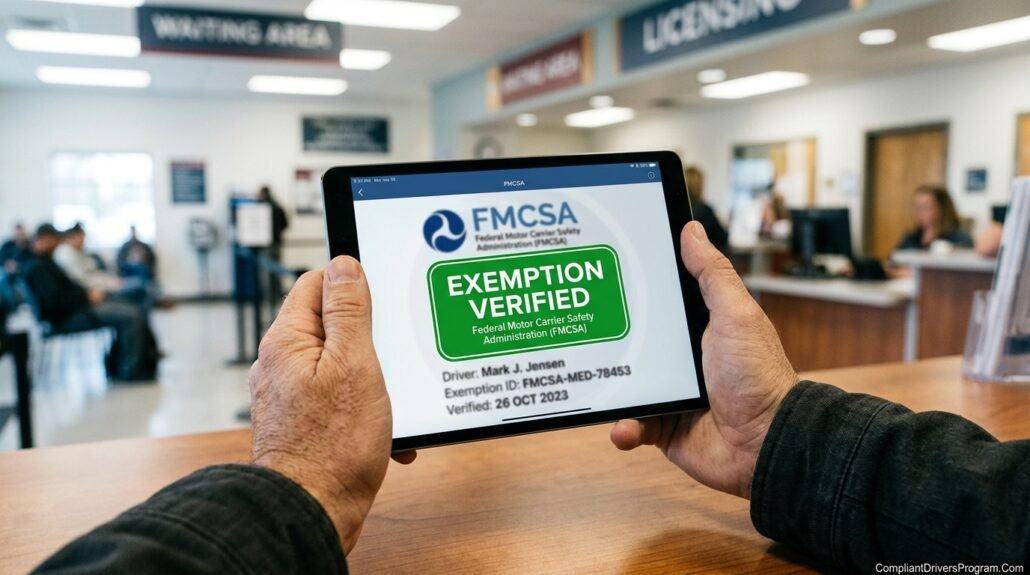
Yes. Exemptions aren’t always applied automatically at the counter. Bring documentation, like your original CDL issue date or military service records, so the examiner can verify your status.
A provider can point you toward the right category. But final confirmation should come from your state driver licensing agency, since some exemptions are state-discretionary.




![DOT Drug Test: What You Must Know in 2026 [Full Guide]](https://compliantdriversprogram.com/wp-content/uploads/2026/03/DOT-Drug-Test-150x150.jpeg)



Leave a Reply