
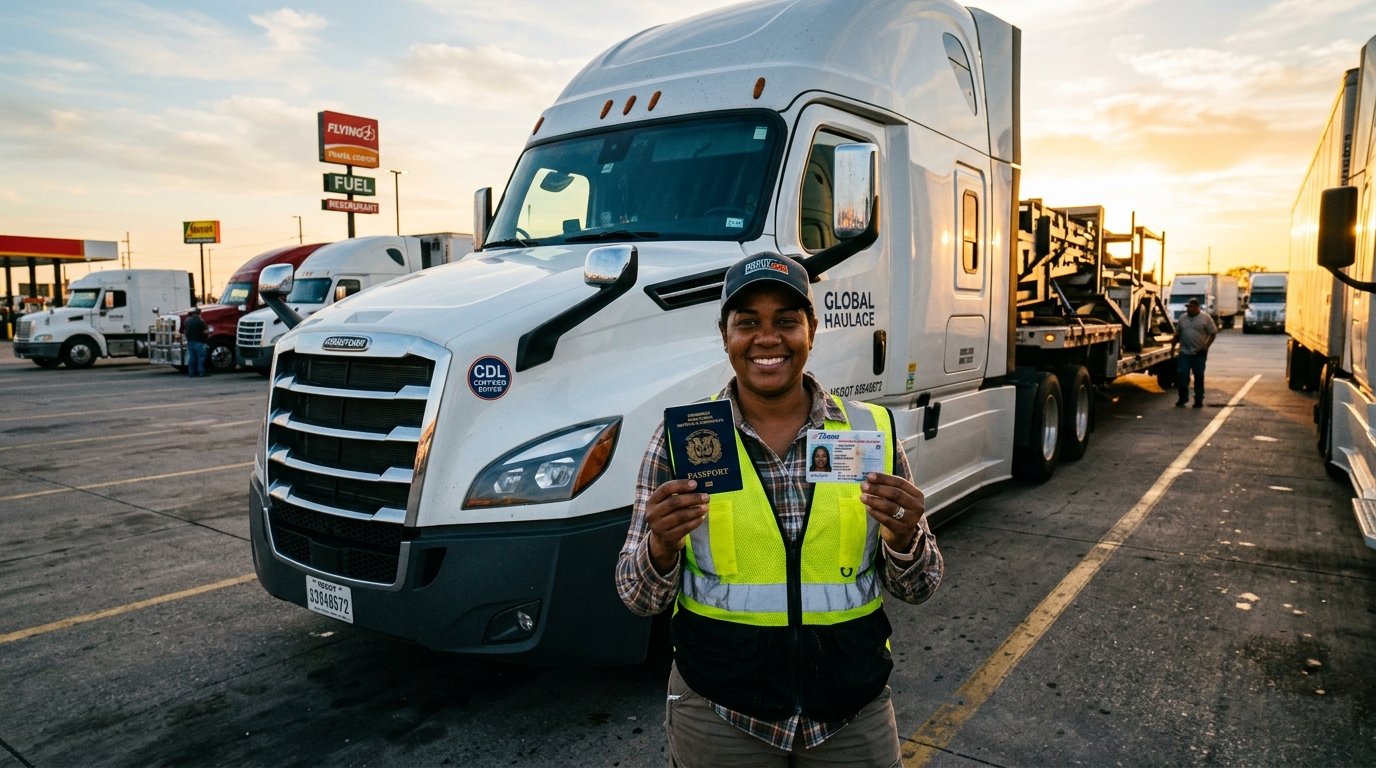
You moved to the United States with years of driving experience. Now you want to start a trucking career. Can you use your foreign license to get a CDL?
The answer depends on your immigration status, state regulations, and the type of license conversion you need. Many international drivers successfully obtain their Commercial Driver’s License each year. However, the process differs greatly from standard CDL applications.
This guide walks you through every step of foreign license to CDL conversion. You’ll learn what documents you need, which tests you must pass, and how to navigate state-specific requirements.
Key Takeaways
- Most states require foreign drivers to take the full CDL knowledge and skills tests
- You must have legal immigration status to obtain a CDL in the United States
- An international driving permit does not replace CDL requirements or testing
- Some states credit your foreign experience toward certain requirements
- Documentation needs include immigration papers, foreign license translation, and proof of residency
- The conversion timeline typically takes 2-6 weeks depending on your state
Understanding CDL Requirements for Foreign Drivers
The United States does not automatically recognize foreign commercial driving licenses. You cannot simply exchange your international commercial license for an American CDL.
Federal law requires all commercial drivers operating in the U.S. to hold a valid CDL issued by a U.S. state. This applies regardless of your driving experience abroad.
Your foreign driver experience may help in some ways. Several states consider international commercial experience when evaluating applications. Some allow you to skip certain training prerequisites if you prove substantial commercial driving history.
However, you still must pass U.S.-specific tests. The testing requirements focus on American traffic laws, road signs, and commercial vehicle regulations.
What Makes CDL Conversion Different
Regular passenger vehicle license conversion follows different rules. Many states let you exchange a foreign passenger license for a U.S. driver’s license without testing.
Commercial licenses work differently. The Federal Motor Carrier Safety Administration (FMCSA) sets strict standards. Every CDL holder must demonstrate knowledge of U.S. commercial regulations.
You face the same basic requirements as American CDL applicants. The main difference is additional documentation to verify your identity and legal status.
Eligibility Criteria You Must Meet
Not every foreign driver qualifies for CDL conversion. You must meet specific federal and state requirements before starting the process.
Immigration Status Requirements
You need legal authorization to work in the United States. Acceptable immigration documents include:
- Permanent Resident Card (Green Card)
- Employment Authorization Document (EAD)
- Valid work visa with authorization
- Refugee or asylum status documentation
Tourist visas and visitor permits do not qualify. The FMCSA requires CDL holders to have legal work authorization.
Age Requirements
You must be at least 18 years old for intrastate commercial driving. Interstate commercial driving requires you to be 21 or older.
Some states set higher minimum ages for certain endorsements. Hazmat endorsements always require drivers to be 21 or older.
Medical Requirements
All CDL applicants must pass a Department of Transportation (DOT) medical examination. This includes foreign drivers converting their licenses.
You need a valid Medical Examiner’s Certificate. The exam must be performed by a FMCSA-certified medical examiner.
Your foreign medical certifications do not transfer. You must complete a new U.S. DOT physical exam.
Residency Requirements
You must establish legal residency in the state where you apply. Most states require:
- Proof of state residency (utility bills, lease agreements)
- Social Security Number or proof of ineligibility
- State-specific residency duration (typically 30-60 days)
Check your state’s specific residency rules before applying. Each state sets its own timeline requirements.
Required Documentation and Translation
Documentation requirements for foreign license to CDL conversion exceed standard CDL applications. You need both standard and international-specific paperwork.
Essential Documents You Must Provide
Gather these documents before visiting the DMV:
Immigration and Identity
- Valid passport from your country of origin
- Immigration status documents (Green Card, EAD, or work visa)
- Social Security Card or SSA ineligibility letter
- Birth certificate or equivalent
Licensing Documents
- Original foreign driver’s license (must be current or recently expired)
- Certified translation of foreign license
- International driving record or abstract
- Proof of commercial driving experience (employment letters, logbooks)
Residency Proof
- Two forms of residency verification
- Utility bills dated within 60 days
- Lease agreement or mortgage documents
- Bank statements with current address
Medical Certification
- Valid DOT medical examiner’s certificate
- Medical examination report (Form MCSA-5875)
Translation Requirements
Your foreign license must be translated into English by a certified translator. The translation must include:
- All information exactly as shown on original license
- Translator’s certification statement
- Translator’s contact information and credentials
- Notarization (required in most states)
Do not use informal translations or online translation tools. States require professional certified translations from licensed translators.
Some DMV offices maintain lists of approved translation services. Contact your local DMV to verify their specific translation requirements.
Driving Record Certification
Many states request your international driving history. Contact your home country’s licensing authority to obtain:
- Official driving record abstract
- Certification of license validity period
- Record of any violations or suspensions
- Proof of commercial driving experience
This documentation helps establish your driving history. Some states may waive certain requirements based on clean foreign driving records.
The Foreign License to CDL Conversion Process
The foreign license to CDL conversion process follows specific steps. Missing any step delays your application significantly.
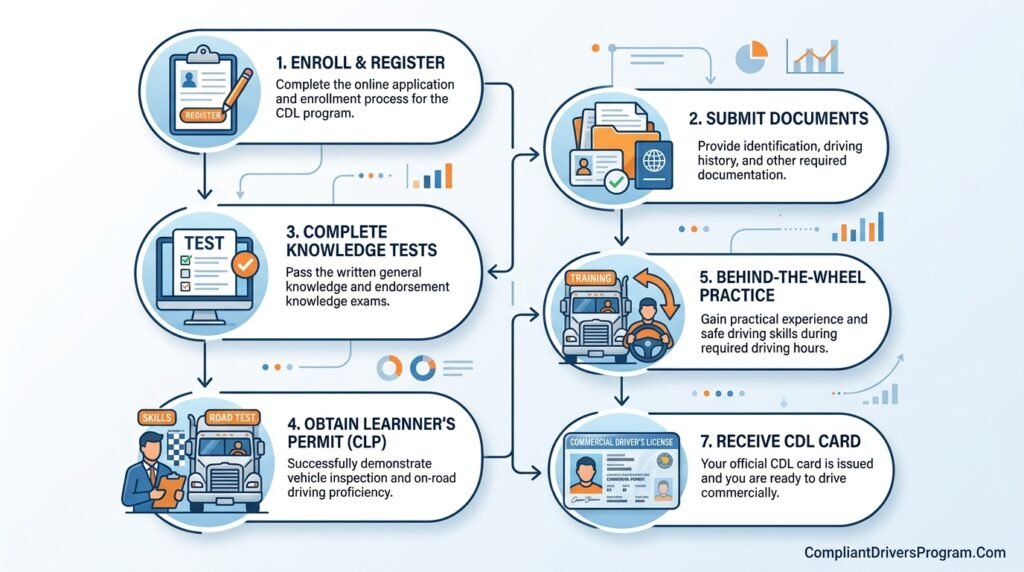
Step 1: Research Your State Requirements
Start by visiting your state DMV website. Look for commercial driver licensing sections specific to international applicants.
Call the commercial driver license division directly. Ask about:
- State-specific requirements for foreign applicants
- Accepted immigration documents
- Translation service recommendations
- Appointment scheduling
Not all DMV locations handle CDL applications. Identify the offices that process commercial licenses in your area.
Step 2: Gather All Required Documents
Collect every document listed in the previous section. Make copies of everything before your DMV visit.
Organize documents in a folder with clear labels. This speeds up the application process and prevents missing paperwork.
Verify all documents are current. Expired passports or immigration documents halt the process immediately.
Step 3: Complete CDL Self-Certification
You must declare your type of commercial driving operation. The four categories are:
- Non-Excepted Interstate (NI)
- Excepted Interstate (EI)
- Non-Excepted Intrastate (NA)
- Excepted Intrastate (EA)
Most commercial drivers select Non-Excepted Interstate. This allows you to drive commercially across state lines.
Understanding CDL self-certification categories helps you choose correctly. Your certification type affects medical requirements and driving privileges.
Step 4: Pass the Knowledge Tests
You must pass written knowledge tests before scheduling skills tests. Required tests include:
General Knowledge Test
- Covers basic commercial driving rules
- Required for all CDL applicants
- 50 questions, 80% passing score
Endorsement Tests (if applicable)
- Air brakes
- Combination vehicles
- Tanker vehicles
- Hazardous materials
- Passenger transport
- School bus
Study the current CDL manual for your state. The tests focus on U.S.-specific regulations that differ from international rules.
Your foreign experience does not exempt you from knowledge testing. Every applicant takes the same exams.
Step 5: Obtain Your Commercial Learner’s Permit (CLP)
After passing knowledge tests, you receive a Commercial Learner’s Permit. The CLP allows you to practice driving commercial vehicles under supervision.
Federal regulations require you to hold a CLP for at least 14 days before taking skills tests. Some states extend this to 30 days.
Use this period to practice with a qualified CDL holder. Focus on U.S.-specific driving practices and pre-trip inspection procedures.
Step 6: Schedule and Pass Skills Tests
The skills test has three parts:
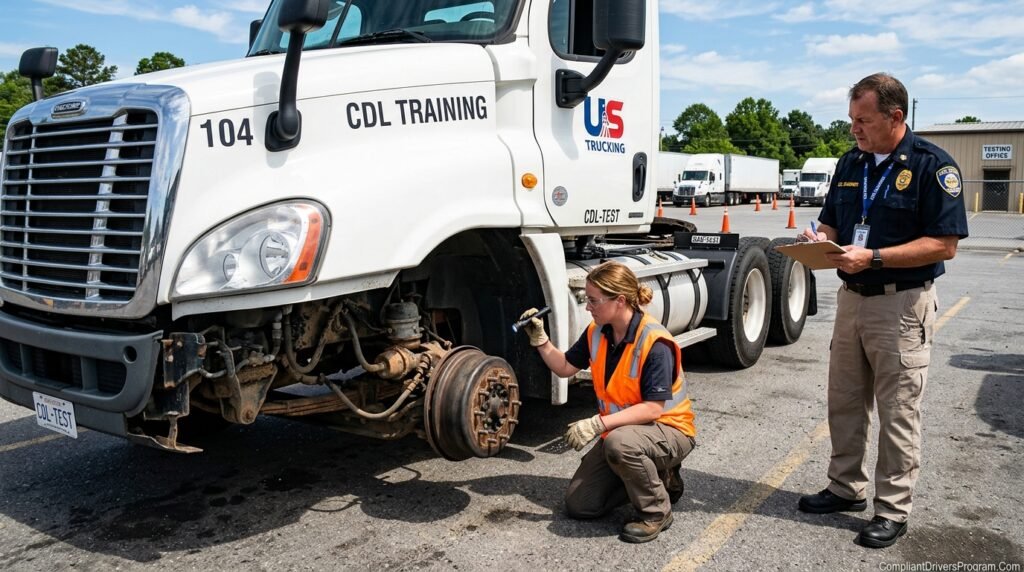
Pre-Trip Inspection
You demonstrate knowledge of vehicle components and safety checks.
Basic Vehicle Control
You perform maneuvers like straight-line backing, offset backing, and parallel parking.
Road Test
You drive in traffic while an examiner evaluates your skills.
All three sections must be passed in the same class of CDL vehicle you want to operate.
Many foreign drivers struggle with U.S.-specific road rules. Consider professional CDL training to learn American driving practices.
Step 7: Receive Your CDL
After passing all tests, you receive your Commercial Driver’s License. The DMV processes your application and issues the physical card.
Processing times vary by state. Most states issue CDLs within 7-14 business days.
Your new CDL replaces your foreign commercial license for U.S. operations. Keep your foreign license as a backup identification document.
State-Specific Conversion Rules
Each state handles foreign license to CDL conversion differently. Some states offer more favorable terms than others.
States with Streamlined Processes
California
California accepts foreign commercial experience documentation. The state allows expedited processing for experienced international drivers with clean records.
Texas
Texas CDL programs recognize international commercial experience. The state provides Spanish-language testing options for knowledge exams.
Florida
Florida offers comprehensive guidance for international CDL applicants. The state maintains dedicated staff for foreign license conversions.
States with Strict Requirements
New York
New York CDL requirements include extensive documentation verification. The state requires additional proof of commercial driving history.
Illinois
Illinois mandates extended residency verification. International applicants face longer processing times.
Pennsylvania
Pennsylvania requires notarized affidavits for all foreign documents. The state performs thorough background checks on international applicants.
Understanding CDL State Reciprocity
Once you obtain a CDL in one state, CDL state reciprocity rules apply. You can drive commercially in all 50 states with a valid CDL from any state.
However, if you transfer CDL to another state, you must surrender your original license. You cannot hold CDLs from multiple states simultaneously.
Testing Requirements You Cannot Skip
Many foreign drivers ask if their experience exempts them from testing. The answer is no. Federal law requires specific tests regardless of international experience.
Knowledge Tests Are Mandatory
Every CDL applicant takes written knowledge exams. Your years of commercial driving abroad do not waive this requirement.
The tests cover U.S.-specific regulations including:
- Hours of Service (HOS) rules
- American road signs and markings
- U.S. traffic laws
- FMCSA safety regulations
- Inspection requirements
These rules often differ significantly from your home country’s regulations. Study thoroughly even if you have decades of experience.
Skills Tests Cannot Be Waived
You must demonstrate practical driving skills in a commercial vehicle. No state waives skills testing for foreign commercial drivers.
The skills test vehicle must match your desired CDL class:
- Class A CDL: Combination vehicle weighing 26,001+ pounds
- Class B CDL: Single vehicle weighing 26,001+ pounds
- Class C CDL: Vehicles designed for 16+ passengers or hazmat
Find CDL testing locations near you to schedule your skills exam.
Understanding the Difference Between CDL Classes
Choosing the right CDL class affects your testing and career options. Review the differences between Class A vs Class B CDL before deciding.
Most international drivers seeking maximum employment flexibility choose Class A. This license type allows you to operate the widest range of commercial vehicles.
Endorsement Testing Requirements
Specialized endorsements require additional knowledge tests. Common endorsements include:
Hazardous Materials (H)
Required for transporting hazardous materials requiring hazmat placards. Includes TSA background check.
Tank Vehicles (N)
Needed for liquid or gas tanks exceeding 1,000 gallons.
Doubles/Triples (T)
Required for pulling multiple trailers.
Passenger (P)
Mandatory for vehicles designed to carry 16+ passengers.
Each endorsement adds testing time and complexity. Only pursue endorsements you actually need for employment.
Timeline and Cost Breakdown
Understanding the timeline and costs helps you plan your license conversion properly.
Expected Timeline
Week 1-2: Document Preparation
- Gather immigration documents
- Obtain certified translations
- Request international driving records
- Complete DOT medical exam
Week 2-3: DMV Application
- Submit initial application
- Pass knowledge tests
- Receive Commercial Learner’s Permit
Week 3-5: Practice Period
- Hold CLP for required duration (14-30 days)
- Practice driving and maneuvers
- Study for skills test
Week 5-6: Skills Testing
- Schedule skills test appointment
- Pass all three test sections
- Receive temporary CDL
Week 7-8: License Issuance
- DMV processes final application
- Physical CDL card arrives by mail
Total timeline: 6-8 weeks for most applicants. Complex immigration situations may extend this period.
Cost Breakdown
Testing and Licensing Fees
- Knowledge tests: $10-$50 (varies by state)
- Commercial Learner’s Permit: $15-$60
- Skills test fee: $50-$150
- CDL issuance: $40-$120
- Endorsement fees: $10-$30 each
Total state fees: $125-$410
Additional Costs
- DOT medical exam: $75-$150
- Document translation: $50-$150 per document
- International driving record: $25-$100
- Training (if needed): $2,000-$5,000
- Practice vehicle rental: $100-$300 per day
Total estimated cost: $375-$6,110
Budget for the higher end if you need professional CDL training. Many international drivers benefit from formal instruction in U.S. driving practices.
Ways to Reduce Costs
Consider these money-saving strategies:
Use employer-sponsored training
Many trucking companies offer paid CDL training programs. They cover training costs in exchange for employment commitments.
Rent practice vehicles wisely
Schedule concentrated practice sessions rather than daily rentals. Master each maneuver before test day.
Study independently
Free CDL study materials are available online and at libraries. Avoid expensive test prep courses unless you struggle with written tests.
Choose your state carefully
If you live near state borders, compare costs and requirements. Some states charge significantly less than others.
Common Challenges and Solutions
International drivers face unique obstacles during foreign license to CDL conversion. Knowing these challenges helps you prepare solutions.
Challenge 1: Immigration Document Confusion
Many DMV employees rarely process foreign CDL applications. They may provide incorrect information about acceptable immigration documents.
Solution: Print the FMCSA guidelines on acceptable immigration documents. Bring these to your DMV appointment. Politely ask to speak with a supervisor if staff refuse valid documents.
Call ahead to confirm which DMV locations have experience with international CDL applicants. Some offices specialize in these cases.
Challenge 2: Translation Delays
Certified translation services may take weeks. This delays your entire application timeline.
Solution: Start translation processes immediately. Don’t wait until you’re ready to visit the DMV. Order translations for all foreign documents simultaneously.
Ask your state DMV for recommended translation services. These providers understand DMV requirements and formatting standards.
Challenge 3: Driving Test Differences
U.S. commercial driving practices differ from other countries. International drivers often fail initial skills tests due to unfamiliar procedures.
Solution: Invest in professional CDL training. Even experienced foreign drivers benefit from instruction on American driving standards.
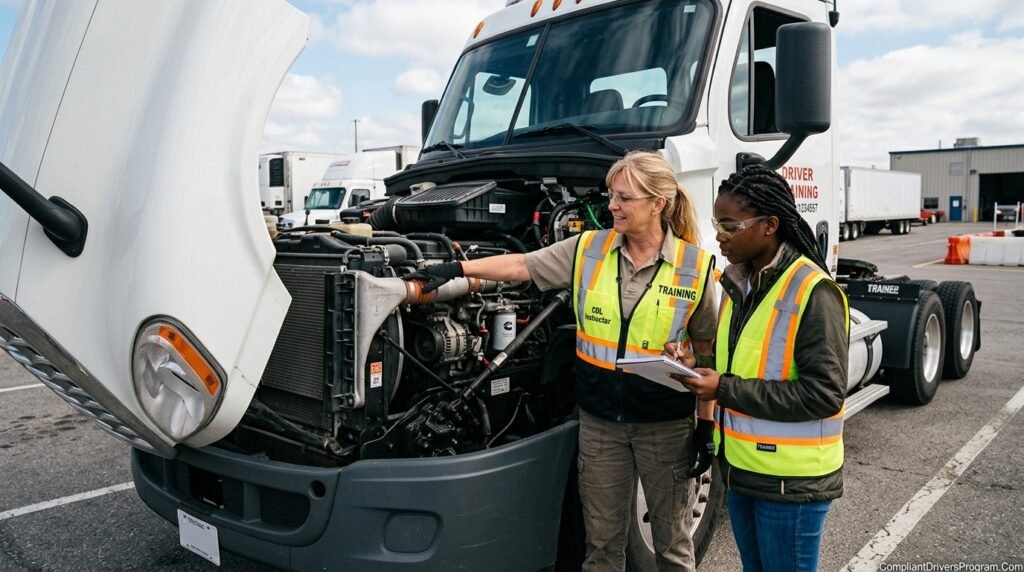
Focus especially on:
- Pre-trip inspection terminology and procedures
- Right-side lane usage and passing rules
- Railroad crossing protocols
- U.S.-specific traffic signs and markings
Challenge 4: Limited Practice Vehicle Access
You need access to a commercial vehicle matching your desired CDL class. Finding practice vehicles challenges many applicants.
Solution: Contact local CDL schools about vehicle rental options. Many schools rent vehicles to external test candidates.
Network with trucking companies in your area. Some allow prospective employees to practice with company vehicles before hiring.
Ask about IFTA permit requirements if you plan to practice across state lines. Understanding commercial vehicle permits prevents legal issues.
Challenge 5: Knowledge Test Cultural Differences
U.S. CDL tests include questions based on American road culture and practices. These differ significantly from international norms.
Solution: Study beyond the basic manual. Watch videos of American commercial driving. Pay attention to practices that seem obvious to U.S. drivers but differ from your experience.
Join online forums for CDL students. Ask questions about confusing concepts. Many experienced drivers explain the reasoning behind U.S. regulations.
Challenge 6: Employment Without U.S. Experience
Many trucking companies hesitate to hire drivers without American commercial experience. Your foreign experience may not count toward job requirements.
Solution: Target companies that specifically recruit international drivers. These employers understand the value of foreign commercial experience.
Consider starting with local delivery routes. These positions often accept new CDL holders more readily than long-haul positions.
Build your U.S. driving record quickly. Six months of clean American driving history significantly improves employment prospects.
Additional Permit Considerations for Commercial Drivers
Beyond your CDL, commercial driving may require additional permits. Understanding these requirements prevents compliance issues.
Trip Permits for Interstate Operations
If you plan to operate commercially across state lines, learn about trip permits for trucks. These temporary permits allow vehicle operation in states where you’re not registered.
Oversize Load Authorization
Specialized hauling requires extra permits. Review oversize load permit requirements if you’ll transport large cargo.
Maintaining Your CDL Status
After conversion, understand CDL renewal requirements. Most states require renewal every 4-8 years.
Never let your CDL expire. If it does, learn the expired CDL reinstatement process immediately. Expired CDLs create employment and legal complications.
Frequently Asked Questions
No. An international driving permit CDL does not exempt you from U.S. testing requirements. The IDP simply translates your foreign license for tourism purposes. It does not replace the need for a U.S. Commercial Driver’s License. You must complete the full CDL application process including all knowledge and skills tests.
Yes. Federal regulations require all CDL applicants to pass U.S. knowledge and skills tests regardless of foreign commercial experience. Your international commercial license may help demonstrate experience to potential employers, but it does not waive testing requirements. Some states may consider your foreign experience when evaluating applications, but testing remains mandatory.
The typical foreign license to CDL conversion process takes 6-8 weeks from start to finish. This includes time for document gathering, translation, permit holding periods, and skills testing. Complex immigration situations or documentation delays can extend this timeline. Start the process early if you need your CDL by a specific date.
Requirements vary by state. Some states issue CDLs to applicants with proof of Social Security Number ineligibility. Others require a valid SSN for all CDL applications. Contact your state DMV to verify their specific requirements. Most states require at least proof that you applied for an SSN if eligible.
Your foreign license remains valid as an identification document. However, you cannot use it for commercial driving in the United States. Some states may ask to see your foreign license during the application process for verification purposes. Keep it in a safe place as backup identification but rely on your U.S. CDL for all commercial driving.
States with large immigrant populations typically have more streamlined processes. California, Texas, and Florida maintain dedicated resources for international applicants. These states offer multilingual support and staff experienced with foreign document verification. However, “easiest” depends on your specific situation and documentation. Research the specific requirements in states where you legally reside.
Conclusion
Converting your foreign license to CDL requires patience and preparation. You cannot simply exchange your international commercial license. Every applicant must pass U.S. knowledge and skills tests.
Start by verifying your immigration status and eligibility. Gather all required documentation including certified translations. Research your specific state’s requirements since rules vary significantly.
Budget 6-8 weeks for the complete process. Plan for costs between $375 and $6,110 depending on whether you need professional training.
Your foreign experience as a commercial driver provides valuable skills. However, you must learn U.S.-specific regulations and driving practices. Take the testing requirements seriously even if you have decades of international experience.
Once you obtain your U.S. CDL, new career opportunities open across the American trucking industry. Your combination of international experience and U.S. licensing makes you a valuable asset to employers.
Ready to start your license conversion? Contact your state DMV commercial license division today. Ask specifically about requirements for international applicants. The sooner you begin, the sooner you’ll be driving commercially in the United States.
Foreign License Conversion Guide




![DOT Drug Test: What You Must Know in 2026 [Full Guide]](https://compliantdriversprogram.com/wp-content/uploads/2026/03/DOT-Drug-Test-150x150.jpeg)



Leave a Reply