

If your truck crosses state lines, you probably need an IFTA permit. That’s the everyday name for the IFTA license and decals that let you report fuel tax to every state through one account. Add IRP registration and a few state-level fuel permits, and the paperwork gets confusing fast.
I’ll walk you through it in plain language. We’ll cover who qualifies, how to apply, when to file in 2027 and which records you must keep. I’ll also show you where IFTA stops and state-specific permits begin.
The rules below follow IFTA, Inc., IRP, Inc., the IRS and FMCSA as published. Tax rates and fees change often, so confirm the numbers with your base jurisdiction before you file.
Quick answer: An IFTA permit is the license and decal set your base jurisdiction issues. You need it if your truck crosses state lines and weighs over 26,000 lbs or has three or more axles. IRP is a separate apportioned registration. A few states also require their own fuel or mileage permits.
What Is an IFTA Permit?
Strictly speaking, there is no document called an “IFTA permit.” People use the phrase for two things you receive from your base jurisdiction:
- An IFTA license with your account number
- Two decals for each qualified truck, one for each side of the cab
The International Fuel Tax Agreement is a pact between the lower 48 U.S. states and ten Canadian provinces. Before it existed, a carrier had to file a fuel tax return in every state it entered. Now you file one quarterly return with your base jurisdiction. That jurisdiction splits the tax among the others. You can read the agreement on the IFTA, Inc. website.
Which fuels does IFTA cover?
IFTA applies to fuel that powers a qualified vehicle. That includes diesel, gasoline, propane, compressed natural gas and liquefied natural gas. Ethanol and methanol blends count too.
Federal excise tax is a different matter. It sits inside the pump price and does not go on your IFTA return. The IRS lists the current federal rates in Publication 510.
Who Needs an IFTA Permit and IRP Registration?
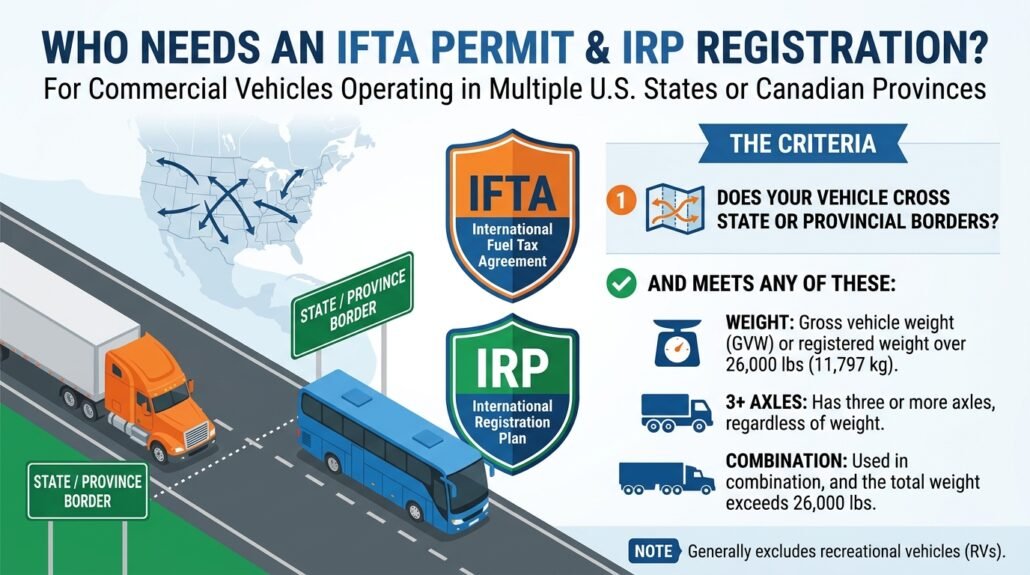
Both programs use the same “qualified motor vehicle” test. A vehicle qualifies when it meets one of these conditions:
- It has two axles and a gross or registered gross weight over 26,000 lbs (11,797 kg)
- It has three or more axles, whatever the weight
- It runs in a combination whose weight exceeds 26,000 lbs
It must also operate in more than one member jurisdiction. Recreational vehicles are excluded. IFTA, Inc. publishes the full definition in its Articles of Agreement.
| Your situation | IFTA and IRP needed? |
|---|---|
| Two-axle truck at 26,000 lbs or less, interstate | No |
| Two-axle truck over 26,000 lbs, interstate | Yes |
| Any truck with three or more axles, interstate | Yes |
| Tractor-trailer combination over 26,000 lbs | Yes |
| Truck that stays inside one state | No, but state rules apply |
| Recreational vehicle | Excluded |
Do box trucks need an IFTA permit?
It depends on weight. Many box trucks are rated at exactly 26,000 lbs. That sits at the line and does not exceed it. Once the gross or registered weight goes over 26,000 lbs, you need both IFTA and IRP.
Weight isn’t the only box truck question. If you’re setting up one, our guide on getting a DOT number for a box truck explains the federal registration side.
IFTA vs IRP vs Fuel Permits: What’s the Difference?
New carriers mix these up all the time. They solve different problems.
| Feature | IFTA | IRP | State fuel or mileage permits |
|---|---|---|---|
| What it covers | Fuel tax reporting | Registration fees | State-specific taxes or temporary use |
| Issued by | Base jurisdiction | Base jurisdiction | The individual state |
| What you carry | License and two decals | Cab card and apportioned plate | Permit or account proof |
| How often | Quarterly returns, annual renewal | Annual renewal | Varies by state |
| Calculated from | Miles and gallons | Miles by jurisdiction and weight | Weight, miles or time |
“Fuel permit” isn’t one official document. Depending on who you ask, it means your IFTA license, a state weight-distance tax account or a short-term trip permit. I cover each below.
What You Need Before You Apply
Your base jurisdiction will ask for proof that your business is legitimate. Get these ready first:
- USDOT number. FMCSA requires one for commercial vehicles in interstate commerce rated at 10,001 lbs or more. You register through FMCSA’s registration pages.
- Operating authority. For-hire carriers hauling regulated freight across state lines also need motor carrier authority.
- Business details. You need your legal name, address and EIN.
- Insurance. Bring proof of coverage that meets your operation’s requirements.
- UCR registration. Interstate carriers register annually through the Unified Carrier Registration plan.
- Form 2290 proof. You need this if your truck weighs 55,000 lbs or more (details below).
- Vehicle data. Collect the VIN, axle count, weight, title or lease for each truck.
Starting from zero? Our walkthrough on trucking authority shows the order of steps. Also remember the MCS-150 update. FMCSA requires carriers to update their registration information every 24 months.
How to Get an IFTA License Step by Step
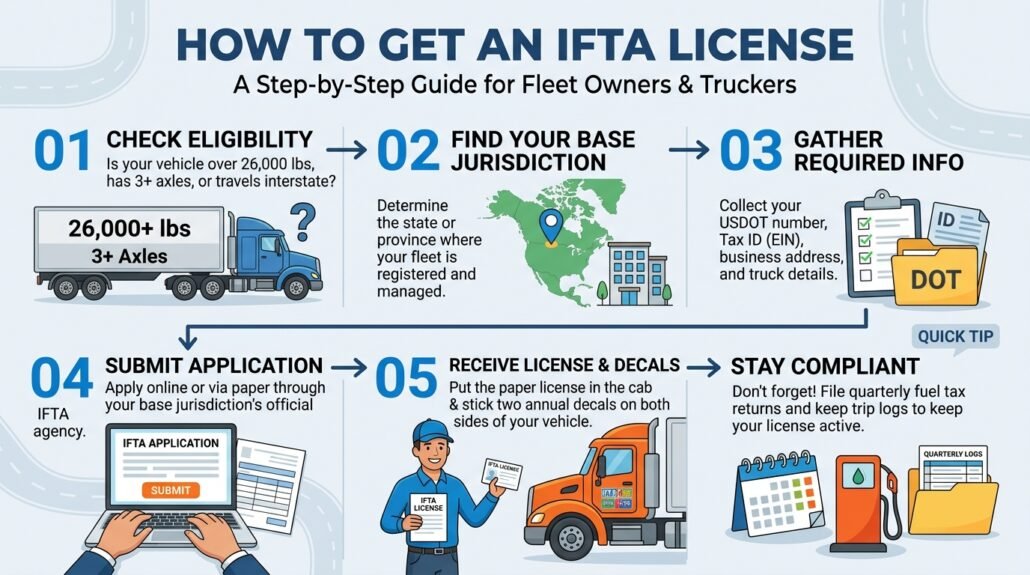
The process is simple once your paperwork is ready.
Step 1: Confirm your base jurisdiction
Your base jurisdiction is where you keep your operational records. It’s also where you manage the fleet and where some of your miles accrue. For most small carriers it’s the state where the business is located. You file with this one jurisdiction, even when you drive through twenty others.
Step 2: Submit the application
Each base jurisdiction runs its own application. Some use online portals and some still use paper forms. Fees differ. A number of jurisdictions charge nothing for the license or decals, while others charge small fees. Ask your agency for the current schedule.
If you need to run before your license arrives, some base jurisdictions issue temporary IFTA authority. These are usually short, often around 30 days. Ask whether yours offers it.
Step 3: Display your decals
Place one decal on each side of the cab, on the exterior. Decals run on the calendar year. Many jurisdictions give a short grace period into January, but plan to have the new set on by January 1.
Step 4: Build your record system
Set this up before you drive your first load. Rebuilding mileage by jurisdiction after the quarter ends is painful. A GPS or ELD that logs miles by state saves hours later.
How Does IRP Registration Work?
IRP stands for the International Registration Plan. It’s a reciprocity agreement among U.S. states, the District of Columbia and Canadian provinces. You register once with your base jurisdiction and pay fees in proportion to the miles you drive in each jurisdiction. IRP, Inc. maintains the plan.
Documents you’ll usually need
Your base jurisdiction publishes its own list. Expect to provide:
- The IRP application and mileage schedule
- Proof of ownership or lease
- Your USDOT number
- Proof of operating authority if it applies
- Insurance information
- Stamped Form 2290 Schedule 1 for heavy vehicles
- A power of attorney if an agent files for you
How apportioned fees are calculated
The logic is straightforward. Each jurisdiction’s share of your total miles sets the share of its fee you pay.
- Report your miles by jurisdiction for the preceding year.
- Divide each jurisdiction’s miles by your total fleet miles.
- Apply that percentage to the jurisdiction’s fee for your registered weight.
- Add up the results for your total bill.
IRP defines the preceding year as the 12 months ending June 30 before your registration year. New fleets with no history submit estimated miles.
Plates and cab cards
You receive an apportioned plate and a cab card. The cab card lists the jurisdictions you’re registered in and the weight for each. Keep it in the truck. Officers check it at roadside inspections.
Adding jurisdictions or trucks mid-year
Business changes. You can add trucks or jurisdictions during the year. Your base jurisdiction charges supplemental fees for the remaining months. Request the change before the truck rolls into the new state.
Form 2290 and the Heavy Vehicle Use Tax
IRP offices ask for proof that you’ve paid the federal Heavy Highway Vehicle Use Tax. You file IRS Form 2290 for trucks with a taxable gross weight of 55,000 lbs or more.
| Item | Rule |
|---|---|
| Tax period | July 1 to June 30 |
| Due date | Last day of the month after first use |
| Base tax | $100 at 55,000 lbs |
| Added tax | $22 per extra 1,000 lbs |
| Maximum | $550 at 75,000 lbs and above |
For example, a truck first used in July pays by August 31. A truck in service for the period that began July 1, 2026 uses that period’s return through June 30, 2027. The next period starts July 1, 2027. The IRS requires e-filing when you report 25 or more vehicles. Check the IRS page for current instructions.
State Fuel and Mileage Permits Outside IFTA
IFTA handles fuel tax among member jurisdictions. A few states run other programs on top of it. Here are the ones carriers meet most often:
| State | Program | Who it generally affects |
|---|---|---|
| Kentucky | Weight-distance tax (KYU) | Heavy trucks above 59,999 lbs |
| New Mexico | Weight-distance tax permit | Trucks over 26,000 lbs |
| New York | Highway Use Tax | Trucks over 18,000 lbs GVW |
| Oregon | Weight-mile tax | Trucks over 26,000 lbs |
Thresholds and procedures change. Confirm them with the state’s tax or transportation agency before you enter. Missing one of these accounts can bring fines even when your IFTA return is perfect.
Some states also sell short-term fuel trip permits to carriers without an IFTA license. They suit one-off runs, not regular routes. Our guide to trip permits for trucks explains when temporary permits make sense and when they cost more than a full license.
IFTA Filing Deadlines for 2027
IFTA returns are due on a fixed quarterly schedule. If the due date lands on a weekend or holiday, the deadline moves to the next business day. Here is how 2027 falls on the calendar:
| Return | Period | Standard date | 2027 due date |
|---|---|---|---|
| Q4 2026 | Oct–Dec 2026 | Jan 31 | Mon, Feb 1, 2027 |
| Q1 2027 | Jan–Mar | Apr 30 | Fri, Apr 30, 2027 |
| Q2 2027 | Apr–Jun | Jul 31 | Mon, Aug 2, 2027 |
| Q3 2027 | Jul–Sep | Oct 31 | Mon, Nov 1, 2027 |
| Q4 2027 | Oct–Dec | Jan 31 | Mon, Jan 31, 2028 |
Don’t wait for the last day. Portals slow down near deadlines, and you want time to fix errors.
File even if the truck sat idle. A licensed carrier submits a return for every quarter, and a zero-activity return takes only a few minutes.
How Does the IFTA Fuel Tax Calculation Work?
The math looks scary but follows four steps.
- Find your fleet MPG. Divide total miles by total gallons for all qualified trucks.
- Find taxable gallons per jurisdiction. Divide the miles in that jurisdiction by your fleet MPG.
- Subtract tax-paid gallons. Use the gallons you bought in that jurisdiction.
- Multiply by the tax rate. A positive result is tax you owe. A negative one is a credit.
Here’s an illustration. Say one truck drove 30,000 miles and bought 5,000 gallons in the quarter. That gives 6.0 MPG. The rates below are made up for the example. Use the real published rates when you file.
| Jurisdiction | Miles | Taxable gallons | Gallons bought | Net gallons | Sample rate | Tax or credit |
|---|---|---|---|---|---|---|
| State A | 12,000 | 2,000 | 2,600 | −600 | $0.20 | −$120.00 |
| State B | 9,000 | 1,500 | 1,400 | +100 | $0.47 | +$47.00 |
| State C | 6,000 | 1,000 | 600 | +400 | $0.74 | +$296.00 |
| State D | 3,000 | 500 | 400 | +100 | $0.50 | +$50.00 |
| Total | 30,000 | 5,000 | 5,000 | +$273.00 |
Notice that State A produced a credit because the driver bought more fuel there than the miles justified. That’s normal. The credit offsets what you owe elsewhere.
Rates change every quarter, and a few jurisdictions add surcharges to the base rate. Your filing portal or IFTA, Inc. publishes the current rate table.
What Records Must You Keep?
Keep IFTA records for four years from the later of the return’s due date or its filing date. Auditors will ask for them.
Fuel records should show:
- Purchase date
- Seller’s name and address
- Gallons purchased
- Fuel type
- Price per gallon or total price
- Vehicle unit number or VIN
Mileage records should show:
- Trip dates
- Origin and destination
- Route
- Odometer readings at the start and end
- Total miles and miles by jurisdiction
- Vehicle unit number or VIN
Some jurisdictions accept fuel card statements only when they carry every required detail. Ask yours before you throw receipts away.
Penalties, Audits and Common Mistakes
IFTA’s model rules set a minimum penalty for late or missing returns. It’s $50 or 10% of the net tax due, whichever is greater. Interest also builds on unpaid tax, and the rate depends on your base jurisdiction. Repeated failures can cost you your license.
Your base jurisdiction audits on behalf of all member jurisdictions. So you face one audit, not fifty. Auditors compare mileage records to fuel receipts and look for gaps.
Here are the mistakes I see most:
- Filing late because no trucks ran
- Mixing up gallons bought with gallons used
- Missing receipts for one or two states
- Letting decals expire in January
- Skipping state-specific accounts such as Kentucky or New Mexico
Do IFTA and IRP Replace Oversize Permits?
No. IFTA and IRP cover fuel tax and registration only. They don’t authorize you to move wide, long or heavy freight. For that you need an oversize load permit from each state you cross. Treat these as separate costs when you price a job.
Pros and Cons: Filing Yourself vs Hiring a Service
| Pros | Cons | |
|---|---|---|
| Do it yourself | Lower cost; you understand your numbers; full control | Takes time each quarter; mistakes bring penalties |
| Use a filing service | Saves hours; spots errors; handles renewals | Monthly or per-return fees; you still supply accurate records |
My view is simple. A one-truck owner-operator can handle quarterly returns with a good ELD report. A fleet of several trucks usually benefits from software or a service. In both cases the quality of your records matters most.
Practical Tips for 2027
- Pull mileage by jurisdiction from your ELD or GPS every month, not every quarter.
- Compare gallons bought with miles driven each month. A strange MPG often means a missing receipt.
- Save itemized receipts and not only card totals.
- Put every filing date on your calendar with a reminder two weeks ahead.
- Order next year’s decals as soon as your base jurisdiction opens renewals.
- Cancel the license properly if you sell all your qualified trucks.
Frequently Asked Questions
In everyday talk, yes. Officially, your base jurisdiction issues an IFTA license plus decals. Truckers shorten that to “IFTA permit.”
You do if both are IFTA member jurisdictions and your truck is a qualified motor vehicle. Distance doesn’t matter. Crossing one border is enough. Alaska and Hawaii aren’t members.
Four times a year. The standard dates are April 30, July 31, October 31 and January 31, moved to the next business day when they fall on a weekend. You file even when you have zero miles.
You face a penalty of at least $50 or 10% of the net tax due, whichever is greater. Interest adds to the bill. Repeated late filings can lead to license suspension or revocation.
Usually yes. They’re separate programs. IFTA covers fuel tax and IRP covers registration. A qualified truck running interstate normally needs both.
Final Thoughts
IFTA, IRP and state fuel permits each do a different job. Get the USDOT number and authority in place first. Then apply for your IFTA license and IRP registration through your base jurisdiction. Finally, check for state programs like Kentucky’s or Oregon’s before you enter.
Good records make everything else easy. Track miles and fuel monthly, and your quarterly return becomes a short task.











Leave a Reply