
![DOT Drug Test: What You Must Know in 2026 [Full Guide]](https://compliantdriversprogram.com/wp-content/uploads/2026/03/DOT-Drug-Test.jpeg)
One failed drug test can end your driving career overnight. Every year, thousands of commercial drivers lose their CDL privileges because they didn’t understand DOT drug test rules. This guide makes sure that doesn’t happen to you.
Whether you’re a new CDL applicant or a veteran truck driver, you need to know how DOT drug testing works. This article covers everything — from the 5-panel urine test to what happens after a positive result.
You’ll learn which drugs DOT screens for, how the testing process works, and how to protect your career if something goes wrong. This guide reflects the current 2026 DOT drug testing requirements.
📌 Key Takeaways
- A DOT drug test is a federally mandated urine test required for all safety-sensitive transportation workers.
- The test screens for 5 drug categories: marijuana, cocaine, opioids, amphetamines, and PCP.
- There are 6 types of DOT drug tests: pre-employment, random, post-accident, reasonable suspicion, return-to-duty, and follow-up.
- Failing or refusing a DOT drug test removes you from safety-sensitive duties immediately.
- All violations are reported to the FMCSA Clearinghouse.
What Is a DOT Drug Test?
A DOT drug test is a federally required drug screening for workers in safety-sensitive transportation jobs. The Department of Transportation (DOT) mandates these tests under 49 CFR Part 40.
The test uses a urine sample to check for five categories of controlled substances. A trained collector gathers your specimen at an approved collection site. Then a SAMHSA-certified laboratory analyzes it.
This isn’t optional. If you hold a commercial driver’s license and perform safety-sensitive functions, you must comply. Refusal to take the test carries the same consequences as a positive result.
The DOT drug screening program exists to keep roads safe. It protects you, your employer, and every other person on the highway.
Who Must Complete a DOT Drug Screening?
DOT drug testing doesn’t apply just to truck drivers. It covers safety-sensitive employees across six DOT agencies:
- FMCSA — Commercial truck and bus drivers with a CDL
- FAA — Pilots, flight attendants, aircraft maintenance personnel
- FTA — Public transit operators and maintenance workers
- FRA — Railroad workers in safety-sensitive positions
- PHMSA — Pipeline workers handling hazardous materials
- USCG — Crew members on commercial vessels
For CDL holders specifically, the FMCSA drug test rules apply any time you perform safety-sensitive work. This includes driving, loading hazardous materials, or performing vehicle inspections.
Even owner-operators must follow these rules. You can learn more about overall DOT regulations for truck drivers on our site.
Your employer is responsible for making sure you get tested. But you are responsible for showing up and providing a valid specimen.
DOT Drug Testing Requirements for 2026
The core DOT drug testing requirements have stayed largely consistent. But staying current matters. Here’s what applies in 2026.
The 5-Panel Urine Test Breakdown
The standard DOT test is a 5-panel drug test. It screens for these five drug categories:
| Drug Category | Specific Substances Detected |
|---|---|
| Marijuana | THC (including edibles and CBD products containing THC) |
| Cocaine | Cocaine and its metabolites |
| Opioids | Codeine, morphine, heroin, hydrocodone, hydromorphone, oxycodone, oxymorphone |
| Amphetamines | Amphetamine, methamphetamine, MDMA (ecstasy), MDA |
| Phencyclidine | PCP (angel dust) |
Notice the opioid panel is expanded. It goes beyond basic opiates to include prescription painkillers like hydrocodone and oxycodone.
For a deeper look at each substance and its cutoff levels, read our complete DOT 5 panel drug test guide.
Cutoff Levels and Detection Windows
Each substance has an initial screening cutoff and a confirmation cutoff level. If your sample falls below the cutoff, it reports as negative — even if trace amounts exist.
Initial screening cutoff levels (immunoassay):
- Marijuana (THC): 50 ng/mL
- Cocaine: 150 ng/mL
- Opioids (codeine/morphine): 2,000 ng/mL
- Opioids (hydrocodone/oxycodone group): 300 ng/mL
- Amphetamines: 500 ng/mL
- PCP: 25 ng/mL
- MDMA: 500 ng/mL
Detection windows vary by substance and individual metabolism. Most drugs appear in urine for 2–4 days after use. Marijuana can stay detectable much longer — sometimes 30 days or more for heavy users.
⚠️ Important: Marijuana remains illegal under DOT testing rules regardless of state laws. Even if your state allows recreational or medical marijuana, a positive THC result will fail your CDL drug test.
6 Types of DOT Drug Tests Every Driver Should Know
DOT regulations require testing in six specific situations. Each has its own rules and timing requirements.
Pre-Employment Testing
You must pass a drug test before performing any safety-sensitive function for a new employer. No exceptions. Your employer cannot let you drive until they receive a verified negative result.
This applies to new hires and transfers into safety-sensitive roles. For CDL drivers, learn exactly what to expect in our pre-employment drug test for CDL guide.
Random Testing
Your employer must place all safety-sensitive employees in a random testing pool. A scientifically valid method selects drivers for testing throughout the year.
FMCSA requires a minimum annual random testing rate. [VERIFY: Confirm whether the 2026 FMCSA minimum random drug testing rate remains at 50% or has been adjusted.] Once selected, you must report to the collection site promptly. Delays can count as a refusal.
Post-Accident Testing
After certain accidents, DOT requires drug testing. You must test if:
- A fatality occurred
- You received a citation and the accident involved a tow-away vehicle or bodily injury requiring off-scene medical treatment
You must complete the test within 32 hours of the accident. If you can’t provide a urine sample in that window, your employer must document why and still attempt collection.
Reasonable Suspicion Testing
A trained supervisor who observes signs of drug use can order a reasonable suspicion test. Signs include unusual appearance, behavior, speech patterns, or body odors consistent with substance use.
The supervisor must document their observations in writing. At least one supervisor making the determination must have completed the required DOT-approved training.
Return-to-Duty Testing
After a DOT drug test violation, you can’t return to safety-sensitive duties until you complete a Substance Abuse Professional (SAP) evaluation and pass a return-to-duty test.
This test must show a verified negative result. The DOT SAP program outlines every step of this process.
Follow-Up Testing
After returning to duty, you face a minimum of six directly observed follow-up tests in the first 12 months. The SAP determines the exact schedule, which can extend up to 60 months.
These tests are unannounced. You won’t know when they’re coming.
How a DOT Drug Test Works Step by Step
Understanding the testing process removes surprises. Here’s exactly what happens from start to finish.
- You receive notice. Your employer tells you to report for testing. For random tests, you must go to the collection site immediately.
- You arrive at the collection site. Bring a valid photo ID. The collector verifies your identity and explains the process.
- You provide a urine specimen. You’ll use a secure restroom. The collector checks the temperature of your sample within four minutes to confirm it’s fresh.
- The collector splits the sample. Your urine goes into two bottles — Bottle A (primary) and Bottle B (split). Both are sealed and labeled in your presence.
- You sign the Custody and Control Form (CCF). This federal form tracks your sample from collection to final result. You verify all information and sign.
- The lab analyzes Bottle A. A SAMHSA-certified lab performs an initial immunoassay screen. If it’s positive, they run a confirmation test using gas chromatography-mass spectrometry (GC-MS).
- The MRO reviews results. The Medical Review Officer — a licensed physician — reviews all non-negative results. They may contact you to ask about legitimate prescriptions.
- Your employer receives the final result. The MRO reports the verified result to your employer’s Designated Employer Representative (DER).
The entire process – from collection to result – typically takes 1–3 business days for negative results. Non-negative results take longer because the MRO must complete the DOT medical review.
![DOT drug test process flowchart showing each step from notification to MRO verified result"]](https://compliantdriversprogram.com/wp-content/uploads/2026/03/Flowchart-showing-the-DOT-drug-test-process-from-employer-notification-to-MRO-final-review-1024x572.jpeg)
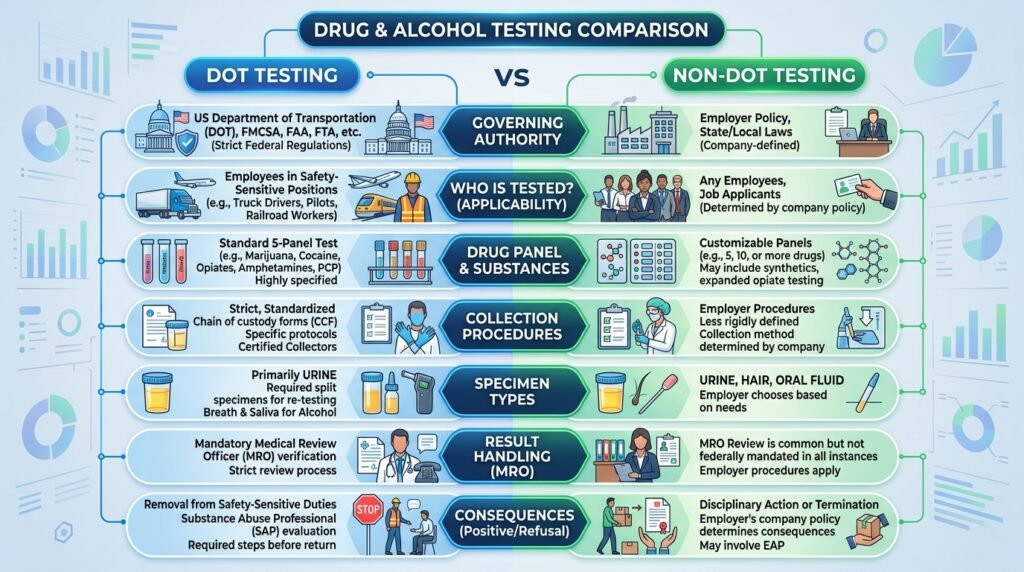
DOT vs Non-DOT Drug Testing: Key Differences
Many employers run both DOT and non-DOT drug testing programs. They are not the same thing. Confusing them can create serious compliance problems.
A non-DOT drug test follows employer or state rules instead of federal regulations. Here’s how they compare:
| Feature | DOT Drug Test | Non-DOT Drug Test |
|---|---|---|
| Regulated by | Federal DOT (49 CFR Part 40) | Employer policy or state law |
| Required for | Safety-sensitive transportation workers | Any employee the employer chooses |
| Drug panel | Standard 5-panel (set by DOT) | 5, 7, 10, or 12-panel options |
| Specimen type | Urine (oral fluid pending lab certification) | Urine, hair, saliva, or blood |
| MRO review | Required for all results | Often not required |
| Federal form (CCF) | Required | Not used |
| Reported to Clearinghouse | Yes (for CDL holders) | No |
| Consequences of failure | Federal – removal from duties, SAP process | Varies by employer policy |
The non-DOT drug test meaning is simple: it’s any workplace drug test that doesn’t fall under DOT regulations. Employers often use non-DOT screens for positions that aren’t safety-sensitive.
Note: DOT and non-DOT drug tests must be conducted as completely separate events. An employer cannot combine them on the same form or treat them as one test.
If your employer requires both, you’ll complete the DOT drug test first. The non-DOT test happens after and uses entirely different paperwork. This separation protects both the employer and the employee under federal law.
What Happens If You Fail a DOT Drug Test?
Failing a DOT drug test triggers a strict chain of events. None of them are optional.
Here’s the sequence after a positive result:
- The MRO verifies the result as positive and reports it to your employer.
- Your employer immediately removes you from all safety-sensitive duties.
- The violation gets reported to the FMCSA Clearinghouse for CDL holders.
- Your employer provides you a list of qualified Substance Abuse Professionals (SAPs).
- You must complete a SAP evaluation and follow the SAP’s recommended treatment or education program.
- After completing treatment, the SAP authorizes a return-to-duty test.
- You must pass the return-to-duty CDL drug test with a verified negative result.
- You enter a follow-up testing program for at least 12 months.
Failing doesn’t automatically revoke your CDL. But you can’t use it for safety-sensitive work until you complete the entire return-to-duty process. Most employers will terminate you. Finding a new employer with a violation on your Clearinghouse record is extremely difficult.
Learn more about every step in our detailed DOT SAP program guide.
What Counts as a Refusal to Test?
A refusal is just as serious as a positive result. DOT treats them identically. Here’s what counts as a refusal:
- Failing to show up for a test after being notified
- Not providing enough urine without a valid medical reason
- Tampering with or substituting your specimen
- Refusing to cooperate with any part of the collection process
- Leaving the collection site before completing the process
- Possessing a device designed to alter your sample
If the lab reports your specimen as substituted or invalid, the MRO will investigate. If no legitimate medical explanation exists, it becomes a refusal – with the same consequences as a positive DOT drug test.
Understanding the MRO and Your Test Results
The Medical Review Officer (MRO) is a critical safeguard in the DOT drug testing process. This licensed physician with specialized knowledge reviews every lab result before it reaches your employer.
If your test comes back positive, the MRO contacts you directly. This is called the verification interview. During this call, you can explain if you have a legitimate prescription for a detected substance.
For example, say your doctor prescribed hydrocodone after surgery. You’d provide that prescription information to the MRO. The MRO then decides whether to verify the result as positive or negative based on the medical evidence.
The MRO also handles results that come back as dilute, substituted, or invalid. Each category triggers different next steps.
MRO result categories:
- Verified Negative — You passed. No substances confirmed.
- Verified Positive — A substance was confirmed with no valid medical explanation.
- Refusal (Substituted/Invalid) — The specimen was tampered with or could not be properly tested.
- Test Cancelled — A procedural problem occurred. A retest is required.
How Long Do DOT Drug Test Results Take?
Most negative results come back within 24–72 hours. The lab processes them quickly because no confirmation testing is needed.
Positive results take longer. The confirmation test, MRO review, and verification interview can add 3–5 additional business days. In some cases, the total time for DOT drug test results may stretch beyond a week.
If you’re waiting on results for pre-employment, plan for a 1–5 business day window. Your employer will notify you when they receive the final verified result from the MRO.
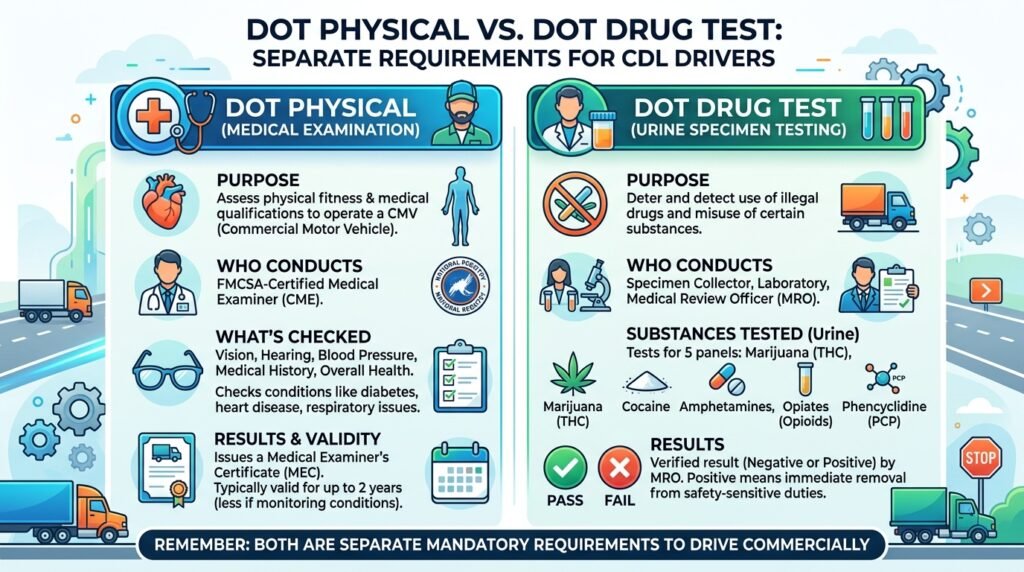
Does a DOT Physical Include a Drug Test?
This question comes up constantly. The short answer: no, a DOT physical exam does not automatically include a drug test.
The DOT physical exam and the DOT drug screening are two completely separate processes. The DOT physical checks your overall health and fitness to drive safely. The drug test checks your urine for controlled substances.
However, your employer can — and often does — schedule both on the same day. Many CDL drivers complete their DOT physical and pre-employment drug test at the same appointment for convenience.
Don’t confuse the two. Passing your DOT physical doesn’t mean you’ve been drug tested. And completing a drug test doesn’t satisfy your physical exam requirement.
Frequently Asked Questions
The DOT drug test screens for five categories: marijuana (THC), cocaine, opioids (including hydrocodone, oxycodone, and heroin), amphetamines (including MDMA/ecstasy), and PCP. This is a standardized 5-panel test. Employers cannot add or remove substances from the DOT drug panel.
A DOT drug test is a federally mandated urine drug screening required for safety-sensitive transportation employees. It follows strict rules under 49 CFR Part 40{target=”_blank”} and is always reviewed by a Medical Review Officer before results go to your employer.
A non-DOT drug test is any workplace drug screening that doesn’t follow federal DOT regulations. Employers set their own rules for a non-DOT drug screen test, can choose different drug panels, and may use hair or saliva specimens. Results are not reported to the FMCSA Clearinghouse.
The urine test detects recent drug use — typically 2–4 days for most substances. However, marijuana can be detected for up to 30 days or longer in heavy users. The test measures current impairment risk, not your lifetime drug history.
It checks for marijuana, cocaine, opioids, amphetamines, and PCP. The expanded opioid panel includes prescription painkillers like hydrocodone and oxycodone — not just illegal street drugs. Even with a valid prescription, the MRO must verify your medical documentation.
No. The DOT physical exam and the DOT drug screening are separate requirements. However, many employers and clinics schedule both on the same day. You need to pass each one independently to remain compliant.
Prices vary by location and provider. Many occupational health clinics and third-party testing networks offer competitive rates. Your employer typically covers the cost for required tests. For owner-operators, [VERIFY: typical cost range is often cited as $40–$100+ at a collection site — confirm current pricing]. Always confirm the site uses a SAMHSA-certified lab. You can find approved testing locations through the DOT Office of Drug and Alcohol Policy and Compliance (ODAPC) website.
Conclusion
A DOT drug test is a non-negotiable part of working in safety-sensitive transportation. The rules are strict. The consequences of failing or refusing are serious. But the process is straightforward when you understand it.
Here’s a quick recap of what you need to remember:
- The test screens for five drug categories using a urine sample.
- Six testing situations exist — from pre-employment to follow-up.
- The MRO reviews every result before your employer sees it.
- A positive result or refusal triggers the SAP process and Clearinghouse reporting.
- DOT and non-DOT drug tests are completely separate processes.
Stay informed. Stay compliant. Protect your CDL career by understanding your DOT drug test obligations.
If you’re already dealing with a violation, start with our DOT SAP program guide to understand your next steps. If you’re an employer building a compliant program, review our DOT compliance for trucking resource.





![DOT Drug Test: What You Must Know in 2026 [Full Guide]](https://compliantdriversprogram.com/wp-content/uploads/2026/03/DOT-Drug-Test-150x150.jpeg)



Leave a Reply