
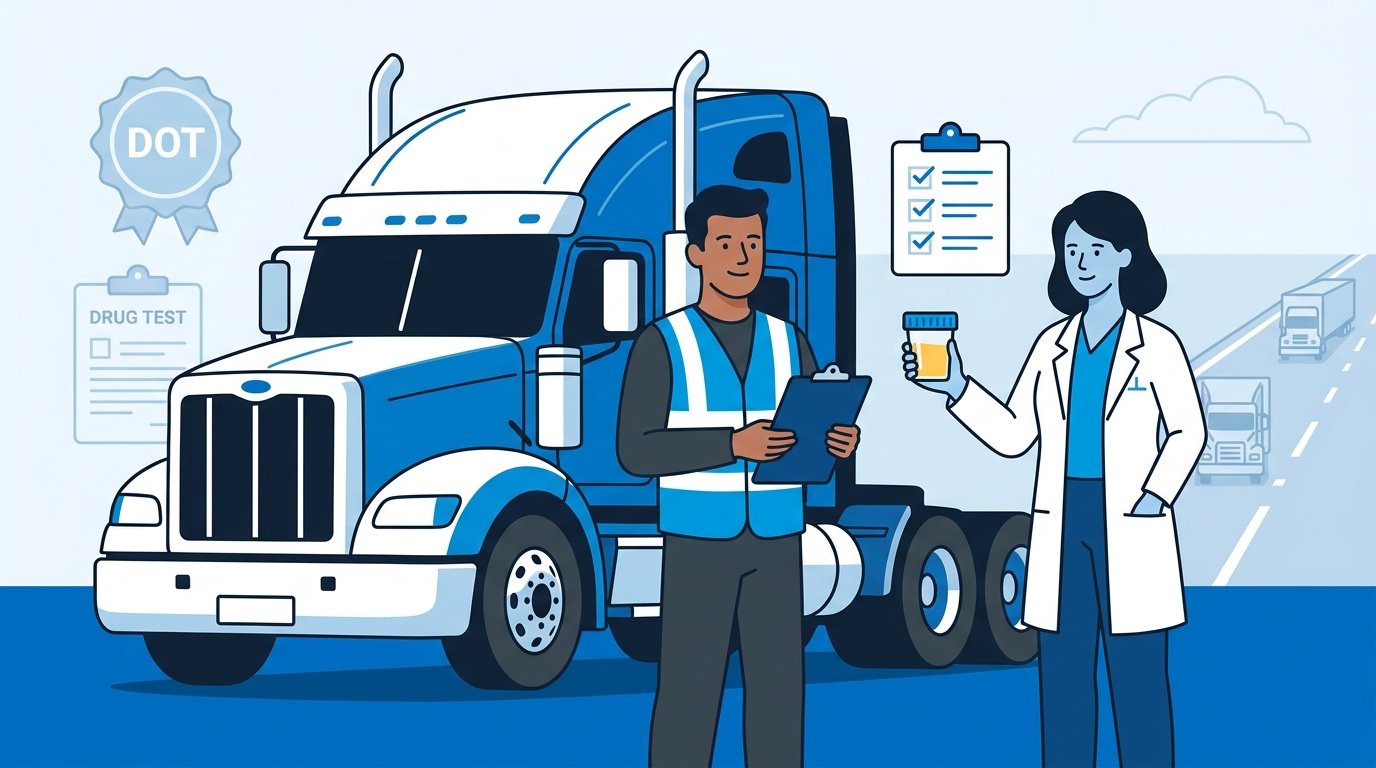
You just landed a conditional job offer for a CDL driving position. Before you touch the steering wheel, one step stands in your way – the pre employment drug test. CDL drivers face some of the toughest drug testing rules in any industry. Miss this step or fail it, and that job offer vanishes instantly.
This guide covers everything about the pre employment drug test for CDL drivers. You’ll learn what substances get tested, how the process works, and what happens if you don’t pass. Whether you’re a first-time CDL applicant or switching carriers, this information applies to you.
The Department of Transportation (DOT) requires every CDL driver to pass a DOT drug test before performing safety-sensitive duties. These rules exist under 49 CFR Part 40 and are enforced by the Federal Motor Carrier Safety Administration (FMCSA).
✅ Key Takeaways
- Every CDL driver must pass a pre-employment drug test before driving commercially.
- The DOT uses a standard 5 panel drug test that screens for five substance categories.
- Pre-employment is just one of six types of DOT drug tests CDL drivers may face.
- A failed test gets reported to the FMCSA Clearinghouse and blocks you from driving.
- You can return to duty after completing a DOT SAP program and follow-up testing.
What Is a Pre Employment Drug Test for CDL Drivers?
A pre-employment drug test is a mandatory urine screening required by DOT regulations. Every CDL driver must pass this DOT drug screening before an employer allows them to perform safety-sensitive functions.
Safety-sensitive functions include driving a commercial motor vehicle, loading or unloading cargo, and inspecting equipment. The test must happen after a conditional job offer but before the driver starts work.
This isn’t optional. Federal law under 49 CFR Part 40 requires it for every DOT-regulated position. Motor carriers who skip this step face heavy fines and penalties.
Why Does the DOT Require This Test?
CDL drivers operate vehicles that weigh 26,001 pounds or more. Some haul hazardous materials across state lines. A driver under the influence of drugs puts everyone on the road at serious risk.
The DOT substance testing program exists to keep highways safe. According to the FMCSA’s drug and alcohol testing program, substance misuse among drivers remains a top safety concern. Pre-employment testing catches drug use before a driver ever takes the wheel.
Who Must Complete Pre-Employment Drug Screening?
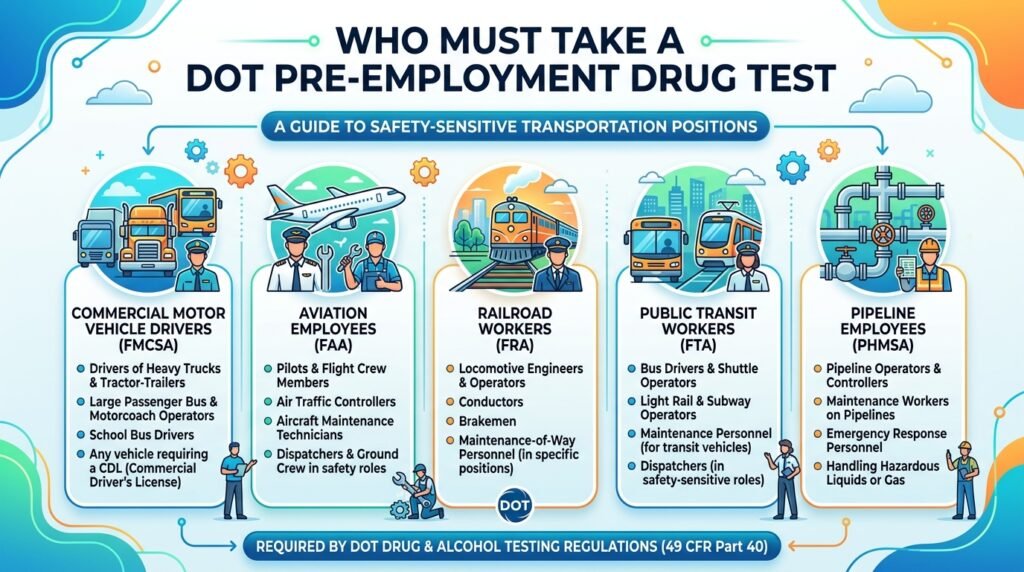
Not everyone needs a DOT drug test. This regulated drug test applies to specific safety-sensitive roles:
- CDL holders driving commercial motor vehicles (CMVs)
- Bus drivers in public transit operations
- Pipeline workers and railroad employees
- Aviation workers in safety-sensitive positions
- Maritime workers under the U.S. Coast Guard
This article focuses on CDL drivers under FMCSA rules. If you hold or plan to earn a CDL, this test is a permanent part of your career.
How the CDL Pre Employment Drug Test Process Works
The pre employment drug test follows a strict federal protocol. The DOT leaves zero room for shortcuts or workarounds. Here’s exactly what happens from start to finish.
From Job Offer to Specimen Collection
The process follows seven clear steps:
- You receive a conditional job offer. The employer makes the offer pending a successful drug test.
- The employer orders the test. They schedule it at a DOT-certified collection site.
- You receive a testing notification. You must report to the site quickly – usually within 24 hours.
- You provide a urine specimen. Urine is the only specimen type allowed for DOT drug testing.
- The lab analyzes your sample. A SAMHSA-certified laboratory processes the test.
- A Medical Review Officer (MRO) reviews results. The MRO contacts you if anything needs clarification.
- Results go to the employer. The employer receives either a verified negative or verified positive result.
You cannot start driving until the employer gets a verified negative result. No exceptions apply.
What Happens at the Testing Facility
When you arrive at the collection site, a trained collector guides you through the process. Here’s what to expect:
- You show a valid photo ID.
- You empty your pockets and secure personal items.
- You wash your hands before providing the sample.
- The collector may add blue dye to the toilet water to prevent tampering.
- You provide at least 45 mL of urine.
- The collector checks the sample’s temperature within four minutes.
- The sample is split into two bottles – Bottle A and Bottle B.
- Both bottles are sealed, labeled, and shipped to the lab in a tamper-evident bag.
The entire process takes about 20–30 minutes. The collector follows federal workplace drug testing standards set by SAMHSA’s workplace guidelines.
⚠️ Important: Refusing to take the test counts the same as a failed result. This includes not showing up, tampering with the sample, or failing to provide enough urine without a valid medical reason.
Understanding the DOT 5 Panel Drug Test
The DOT uses a 5 panel drug test for all regulated screenings. You may hear it called a DOT substance test or a Department of Transportation drug test. It screens for five drug categories – nothing more, nothing less.
Substances Included in the Standard Panel
Here’s what the DOT 5 panel drug test screens for:
| Drug Category | Common Examples | Approximate Detection Window |
|---|---|---|
| Marijuana (THC) | Cannabis, edibles, THC products | Up to 30 days (heavy use) |
| Cocaine | Crack, powder cocaine | 2–4 days |
| Opioids | Heroin, codeine, morphine, oxycodone, hydrocodone | 2–4 days |
| Amphetamines | Methamphetamine, MDMA (ecstasy) | 2–3 days |
| Phencyclidine (PCP) | Angel dust | Up to 14 days |
Verified March 2026: Detection windows unchanged – vary by metabolism, frequency, body fat, hydration. General estimates accurate per DOT 5-panel standards (THC up to 30 days heavy use; cocaine/opioids 2-4 days
Even in states where marijuana is legal for recreational or medical use, the DOT still tests for THC. Federal rules override state laws for all CDL drivers. A medical marijuana card does not protect you from a positive result.
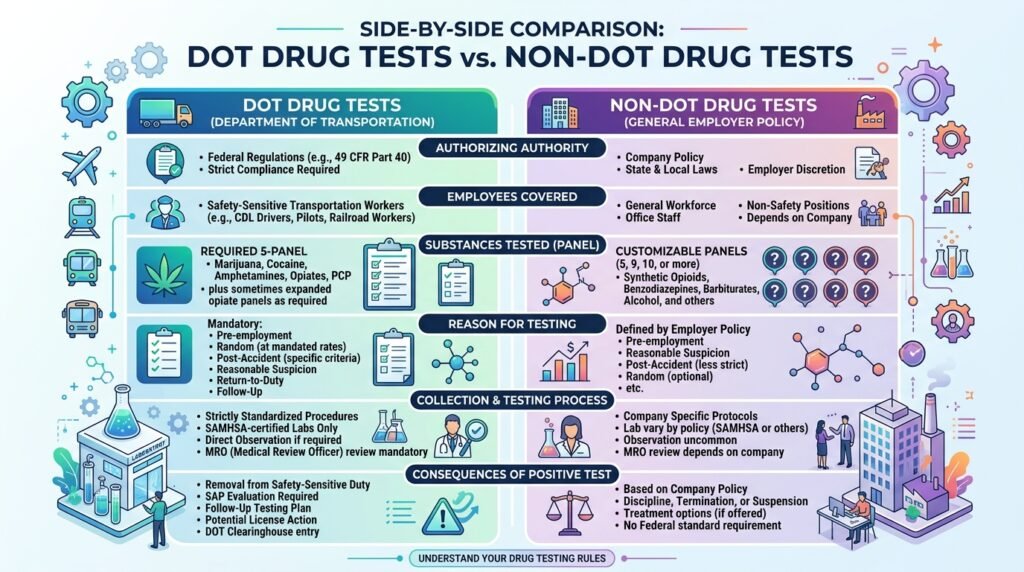
DOT vs. Non-DOT Drug Tests
Many drivers mix up DOT and non-DOT drug tests. They work very differently.
| Feature | DOT Drug Test | Non-DOT Drug Test |
|---|---|---|
| Regulated by | Federal DOT / 49 CFR Part 40 | Employer policy |
| Panel | Strict 5-panel only | 5, 7, 10, or 12 panel |
| Specimen type | Urine only | Urine, hair, saliva, or blood |
| Lab certification | SAMHSA-certified required | Any certified lab |
| MRO review | Required | Optional |
| Consequences of failure | Reported to FMCSA Clearinghouse | Employer-specific action |
| Substances tested | Fixed by federal law | Chosen by employer |
A non-DOT test may include additional substances like benzodiazepines, barbiturates, or synthetic opioids. A DOT drug screening always follows the same federal standard no matter what state you’re in or what company you work for.
5 Types of DOT Drug Tests Every CDL Driver Should Know
The pre employment drug test is just the starting point. CDL drivers face several CDL drug testing types throughout their careers. The DOT mandates six testing categories total. Understanding each one keeps you prepared and compliant.
Random Drug Testing DOT Requirements
Random drug testing is exactly what it sounds like. Your employer selects you with no advance warning for a DOT drug test. You have zero time to prepare.
Here’s how DOT random drug testing requirements work:
- Employers must test at least 50% of their driver pool annually for drugs. Verified March 2026: FMCSA minimum annual random drug testing rate remains 50% for CDL drivers (unchanged since 2020)
- A scientifically valid random selection method picks drivers.
- Every driver has an equal chance of selection each time.
- Once notified, you must report to the collection site immediately.
- You can be selected multiple times in one year – or not at all.
Random drug testing DOT rules serve as one of the strongest deterrents against substance use. You never know when your name will come up, so sobriety must be constant.
Reasonable Suspicion Testing
A reasonable suspicion test happens when a trained supervisor observes signs of drug or alcohol use. These signs might include:
- Slurred speech or unsteady movement
- The smell of alcohol or marijuana
- Erratic, unusual, or aggressive behavior
- Physical symptoms like bloodshot eyes or dilated pupils
The supervisor must have completed DOT-approved training to make this determination. They document their specific observations before ordering the test. You cannot refuse a reasonable suspicion test – doing so counts as a positive result.
Post-Accident Drug Testing
After certain qualifying accidents, DOT rules require a post-accident drug test. This doesn’t apply to every minor incident. It kicks in when:
- A fatality occurs – testing is always required, regardless of fault.
- A driver receives a citation AND someone needs medical treatment away from the scene.
- A driver receives a citation AND a vehicle gets towed from the scene.
Post accident testing must happen within 32 hours for drugs and 8 hours for alcohol. If the test doesn’t happen within these windows, the employer must explain why in writing.
Return-to-Duty Testing
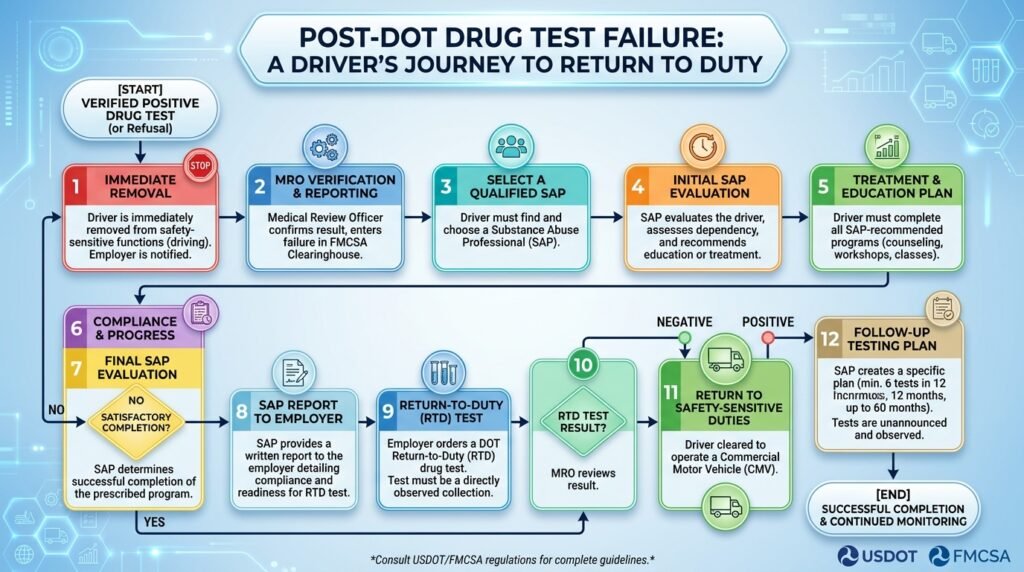
If you fail any DOT drug test, you can’t simply start driving again the next day. You must first complete a return to duty process.
This involves:
- Working with a DOT Substance Abuse Professional (SAP)
- Completing the SAP’s recommended treatment or education program
- Passing a return-to-duty drug test with a directly observed collection
- Getting final clearance from the SAP
Learn the full process in our DOT SAP program guide.
Follow-Up Testing
After you return to duty, you enter a follow up testing phase. The SAP designs a testing plan just for you.
Key details:
- At least 6 directly observed tests in the first 12 months
- Follow up testing can continue for up to 60 months (5 years)
- All tests are unannounced – you won’t know when they’re coming
- The SAP determines exact testing frequency based on your situation and progress
Testing Frequency and Important Timelines
CDL drug testing follows strict deadlines. Missing even one can cost you your job – or your CDL.
Here are the key timelines every CDL driver needs to know:
| Test Type | Timeline Requirement |
|---|---|
| Pre-employment | Must pass before performing any safety-sensitive duty |
| Random | Report to collection site immediately after notification |
| Post-accident (drugs) | Within 32 hours of the qualifying accident |
| Post-accident (alcohol) | Within 8 hours of the qualifying accident |
| Reasonable suspicion | As soon as possible after supervisor observation |
| Return to duty | Must pass before returning to safety-sensitive work |
| Follow up | Minimum 6 tests in first 12 months; up to 60 months total |
Testing frequency for random selection means the odds reset every cycle. You could be picked once, twice, or zero times in any given year. The selection process is truly random.
One more timeline matters greatly. Before hiring any CDL driver, employers must query the FMCSA Clearinghouse to check for any unresolved drug or alcohol violations. This query happens alongside your pre employment drug test and can reveal past violations from other employers.
What Happens If You Fail a CDL Pre Employment Drug Test
A failed CDL pre employment drug test carries serious consequences. This isn’t like failing a screening at a retail job. Federal rules activate immediately and follow you across the entire trucking industry.
Immediate Consequences of a Failed Test
When you fail a pre employment drug test CDL screening, the following events unfold:
- The employer withdraws the job offer immediately. They cannot let you drive.
- The MRO verifies the positive result and reports it.
- You are removed from all safety-sensitive functions on the spot.
- The violation is entered into the FMCSA Drug & Alcohol Clearinghouse.
Every other motor carrier in the country will see this violation when they run a Clearinghouse query on you. Hiding a failure by switching companies is no longer possible.
FMCSA Clearinghouse Reporting
Since January 2020, all DOT drug and alcohol violations must be reported to the FMCSA Clearinghouse. This is a centralized federal database.
Here’s what happens after a failure:
- The MRO reports the violation directly to the Clearinghouse.
- The violation stays active on your record until you complete the full return-to-duty process.
- Every prospective employer must check the Clearinghouse before hiring you.
- Annual queries by your current employer will also reveal the violation.
The Clearinghouse was created to close loopholes. Before it existed, a driver could fail a test with one carrier and get hired at another without anyone knowing. Those days are over.
The Return-to-Duty Path Through a DOT SAP
Failing a drug test doesn’t end your career permanently. You can get back behind the wheel. But the process requires time, effort, and money.
Here’s the path back:
- Find a DOT-qualified SAP. This is a licensed professional trained to evaluate substance use.
- Complete the SAP’s initial evaluation. The SAP determines what treatment or education you need.
- Finish the recommended program. This could include counseling sessions, education courses, or an inpatient treatment program.
- Get a follow-up evaluation from the SAP. The SAP confirms you’ve met all their recommendations.
- Pass a return-to-duty test. This is a directly observed urine collection – stricter than a standard test.
- Begin follow-up testing. The SAP sets the schedule – at least 6 unannounced tests in the first 12 months.
Our detailed DOT SAP program guide walks you through every step with costs and timelines.
⚠️ Warning: Some drivers try to beat the system with synthetic urine or detox products. DOT collectors are specifically trained to spot tampering. Getting caught counts as a refusal – which carries the exact same consequences as a verified positive result.
How Employers Stay Compliant with DOT Drug Testing Rules
Employers carry a heavy burden when it comes to DOT drug testing compliance. If you’re an owner-operator or fleet manager, these obligations apply directly to you.
Every motor carrier must:
- Maintain a written DOT drug and alcohol testing policy and distribute it to all drivers
- Use a SAMHSA-certified laboratory and a qualified MRO for every test
- Keep testing records for required retention periods (typically 5 years for positive results)
- Report all violations to the FMCSA Clearinghouse promptly
- Query the Clearinghouse for each new hire (full query) and annually for current drivers (limited query)
- Train supervisors on reasonable suspicion detection – at least 60 minutes on drug indicators and 60 minutes on alcohol indicators
Penalties for non-compliance are steep. Fines can reach up to $16,000 per violation or more. Verified March 2026: FMCSA civil penalties range $1,000-$16,864 per drug testing violation (adjusted for inflation from 2025 base) Repeated violations can put a carrier’s operating authority at risk.
Small carriers and owner-operators often join a consortium or third-party administrator (C/TPA) to manage their testing program. A C/TPA handles random selection pools, scheduling, record-keeping, and Clearinghouse reporting. It’s the most cost-effective way to stay compliant with DOT regulations.
7 Tips to Prepare for Your Pre Employment Drug Test
You have a CDL job offer in hand, and the drug test is next. Here’s how to walk in with confidence:
- Know what’s being tested. The DOT 5 panel drug test screens for marijuana, cocaine, opioids, amphetamines, and PCP. There are no surprise additions.
- Disclose your prescriptions early. If you take prescription medications, bring your prescription bottles or pharmacy printout. The MRO will contact you if your sample flags a prescribed substance.
- Stay hydrated – but don’t overdo it. Drink normal amounts of water. An excessively diluted sample may require a costly retest and raise suspicion.
- Arrive on time. Showing up late – or not showing up at all – can be treated as a refusal. This counts the same as a positive result.
- Bring valid photo ID. You need government-issued identification. A driver’s license, passport, or military ID all work.
- Don’t try to cheat. Tampering attempts are more detectable than most people think. Collectors check temperature, color, and consistency. A caught attempt equals a refusal on your permanent record.
- Know your rights. If your result comes back positive, you can request a split-specimen test of Bottle B. This second analysis goes to a different SAMHSA-certified lab for independent verification.
Frequently Asked Questions
A DOT 5 panel drug test is the standard drug screening required by the Department of Transportation for all regulated employees. It tests for five drug categories: marijuana (THC), cocaine, opioids (including heroin, codeine, morphine, oxycodone, and hydrocodone), amphetamines (including methamphetamine and MDMA), and phencyclidine (PCP). Every DOT-regulated test – including the pre employment drug test for CDL drivers – uses this exact same five-panel format. The panel cannot be modified by any employer.
A 5 panel non-DOT drug test screens for the same five drug categories as the DOT version. However, it follows employer-specific policies instead of federal regulations. Non-DOT tests may use different specimen types like hair follicle or oral fluid. They don’t require MRO review, and results are never reported to the FMCSA Clearinghouse. Many private-sector employers use this format for general workplace screening.
Most DOT pre-employment drug test results come back within 24–72 hours for negative results. If the initial immunoassay screen is non-negative, confirmatory testing using gas chromatography-mass spectrometry (GC-MS) may extend the timeline to 5 business days. The MRO may also need additional time to contact you about valid prescriptions before reporting the final result.
Technically, yes – you can refuse. But a refusal carries the same weight as a verified positive result under DOT rules. The refusal gets reported to the FMCSA Clearinghouse. You will not get the job, and future employers will see the refusal on your record. You would need to complete the full SAP return-to-duty process before driving commercially again.
Some CBD products contain trace amounts of THC that could trigger a positive marijuana result. The DOT does not accept CBD use as a valid medical explanation for a positive test. If you choose to use CBD products, you accept the risk entirely. Based on available information, there is no “safe” threshold that guarantees you’ll pass. DOT CBD guidance unchanged – CBD products can cause positive THC results; not accepted as medical explanation for CDL drivers. No safe threshold exists.
The urine test detects recent use – typically within the past few days to a few weeks depending on the substance and usage patterns. However, the FMCSA Clearinghouse maintains violation records indefinitely until you complete the full return-to-duty process. Additionally, previous employers must report your drug and alcohol testing history going back 3 years as part of the DOT hiring process.
Conclusion
The pre employment drug test CDL requirement protects everyone on the road. It keeps dangerous substances away from the drivers of 80,000-pound trucks. Every CDL driver must clear this screening before operating a commercial vehicle – and there are no shortcuts around it.
You now understand how the process works from start to finish. You know what the DOT 5 panel drug test screens for, the six types of DOT drug tests you may face, and exactly what happens if you fail. You also know the timelines, your employer’s obligations, and how to prepare.
Your next step is straightforward. If you have a job offer, show up for your DOT drug screening on time, sober, and with confidence. If you’ve had a previous violation, explore the DOT SAP program to begin your return to duty journey.
Stay compliant. Stay safe. Protect your CDL career.
Testing Type Guide




![DOT Drug Test: What You Must Know in 2026 [Full Guide]](https://compliantdriversprogram.com/wp-content/uploads/2026/03/DOT-Drug-Test-150x150.jpeg)



Leave a Reply