
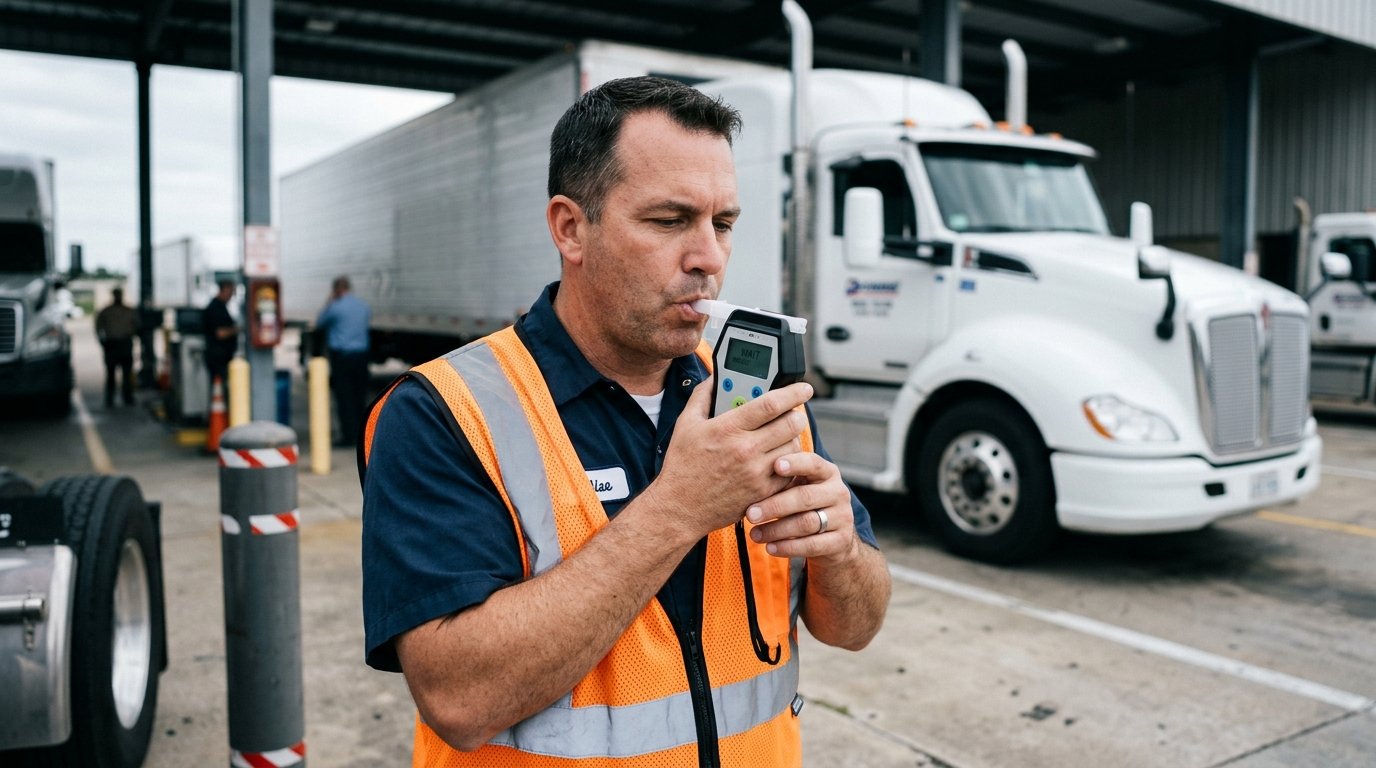
One failed alcohol test can end your trucking career overnight. A BAC of just 0.04, half the legal limit for regular drivers, triggers serious consequences for CDL holders. Yet thousands of commercial drivers face DOT alcohol testing each year without fully understanding the rules.
This guide breaks down everything you need to know. You’ll learn the BAC limits, test types, when testing happens, and what a failed test means for your CDL. Whether you drive a semi, bus, or hazmat vehicle, these rules apply to you.
If you also need to understand the drug screening side of compliance, start with our DOT Drug Test guide for the full picture.
📌 Key Takeaways
- The DOT BAC limit for CDL drivers is 0.04 – half the standard legal limit.
- A result between 0.02 and 0.039 still removes you from duty for 24 hours.
- DOT uses breath alcohol tests (not urine) to screen for alcohol.
- Failing a DOT alcohol test goes on your FMCSA Clearinghouse record for 5 years.
- You must complete a SAP program before returning to any safety-sensitive work.
What Is DOT Alcohol Testing?
DOT alcohol testing is a federally required screening process. The Department of Transportation mandates it for every employee in a safety-sensitive role. This includes commercial truck drivers, bus operators, pilots, and pipeline workers.
The Federal Motor Carrier Safety Administration (FMCSA) enforces these rules for CDL holders. The regulations come from 49 CFR Part 40 and 49 CFR Part 382. They set strict standards for when, how, and why alcohol testing happens.
The goal is simple: keep impaired drivers off public roads. Alcohol slows reaction time and clouds judgment. For someone controlling an 80,000-pound truck, that’s a deadly combination.
Who Must Follow DOT Alcohol Testing Rules?
These rules apply to anyone performing safety-sensitive functions under DOT authority:
- CDL truck drivers (Class A, B, and C)
- Bus and transit operators
- Hazmat transporters
- Pipeline workers
- Railroad employees
- Aviation personnel
- Maritime workers
If you hold a CDL and operate a commercial motor vehicle (CMV), you fall under these rules. It doesn’t matter if you work for a major fleet or run your own truck as an owner-operator.
BAC Limits Every CDL Driver Must Know
The BAC limit for CDL holders is much stricter than the standard for regular motorists. Here’s exactly how the numbers break down.
The 0.04 BAC Threshold – A Positive Test
A BAC of 0.04 or higher counts as a positive DOT alcohol test. This is the official federal cutoff.
Compare that to the 0.08 limit for non-commercial drivers in most states. CDL holders face a standard that’s twice as strict. Commercial vehicles are heavier, longer, and harder to stop. The margin for error is razor-thin.
At a 0.04 BAC level, you face:
- Immediate removal from all safety-sensitive duties
- A violation recorded in the FMCSA Clearinghouse
- Mandatory SAP (Substance Abuse Professional) evaluation
- Possible CDL disqualification
| BAC Level | Classification | Consequence |
|---|---|---|
| 0.00 | Negative | No action required |
| 0.02–0.039 | Below positive threshold | 24-hour removal from duty |
| 0.04+ | Positive result | Full DOT violation process |
What Happens at a 0.02 BAC Result?
A 0.02 result doesn’t count as a positive test. But it’s far from a free pass.
Under 49 CFR Part 382, a BAC between 0.02 and 0.039 triggers a 24-hour removal from safety-sensitive duties. You can’t drive, load hazmat, or perform any covered function during that time.
This result doesn’t get reported to the Clearinghouse. Your employer handles it internally. But repeated 0.02 results raise red flags with any carrier.
⚠️ Important: Even a 0.02 result shows alcohol in your system during work hours. Many carriers treat this as a serious policy violation, even though DOT doesn’t classify it as “positive.”
Types of DOT Alcohol Tests
DOT doesn’t use urine tests for alcohol screening. This surprises many drivers. Here’s what they actually use.
DOT Breath Alcohol Test
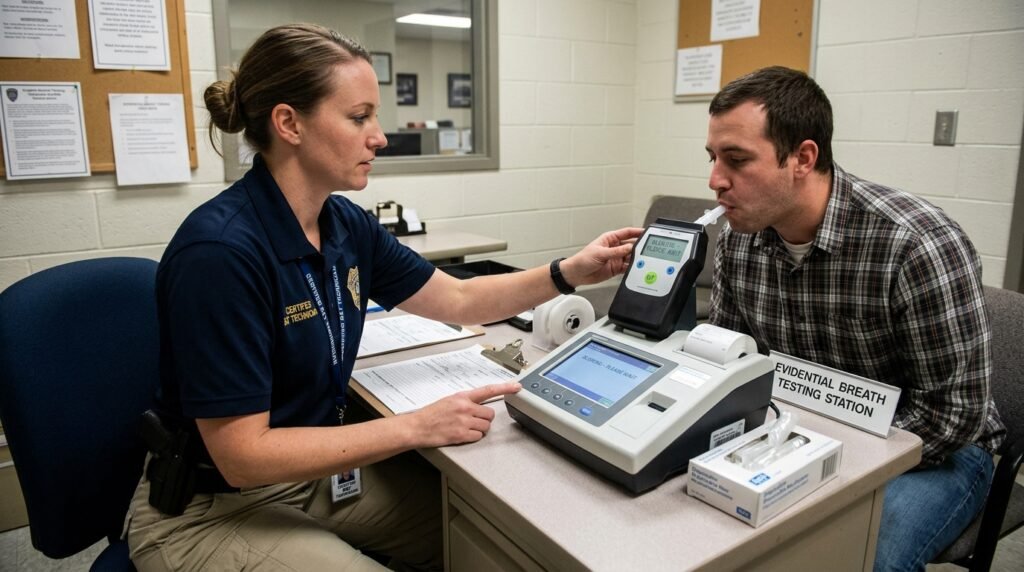
The DOT breath alcohol test is the primary and most common method. A trained Breath Alcohol Technician (BAT) conducts it using an approved Evidential Breath Testing (EBT) device.
The process works in two steps:
- Screening test: You blow into the testing device. If the result is below 0.02, you pass. The test is complete.
- Confirmation test: If the screening shows 0.02 or higher, you wait 15–20 minutes. Then you take a second, confirmed test on an EBT device. This second result determines the official outcome.
The waiting period matters. It allows mouth alcohol from mouthwash, food, or recent drinks to dissipate. This prevents false readings.
Saliva Screening Tests
DOT also permits saliva (oral fluid) screening tests as an initial screen. These use an Alcohol Screening Device (ASD) approved by NHTSA.
However, a saliva test can only serve as a first step. If it registers 0.02 or above, you still need a confirmation test on an EBT device. A saliva test alone cannot produce a final, reportable result.
When Does DOT Require Alcohol Testing?
DOT mandates alcohol testing in six specific situations. Understanding each one keeps you prepared and out of trouble.
Pre-Employment Alcohol Testing
Pre-employment alcohol screening is allowed but not required by FMCSA. Many carriers skip the alcohol portion before hire, though a DOT drug test is always mandatory.
If your employer’s policy includes a pre-employment alcohol screen, you must comply. Refusing equals a refusal to test, which carries the same penalties as a positive result.
Before hiring you, your new employer must also query the FMCSA Clearinghouse for any prior drug or alcohol violations on your record.
Random Alcohol Testing
Each year, FMCSA requires carriers to randomly test a minimum percentage of their driver pool for alcohol. The 2026 minimum random alcohol testing rate, historically set at 10% of covered employees. Confirm the current FMCSA-published rate.
Random selection must be scientifically valid. You can’t predict when your name comes up. That’s the entire point of the program.
Key rule: Random alcohol breath tests can only happen just before, during, or right after you perform safety-sensitive functions. Your employer cannot test you on your day off while you’re at home.
Reasonable Suspicion Testing
A trained supervisor who observes signs of alcohol use can order a reasonable suspicion test. Signs that justify this decision include:
- Slurred speech
- Smell of alcohol on breath or person
- Unsteady movement or walking
- Sudden behavioral changes
- Poor coordination or motor control
The supervisor must complete DOT-required training, at least 60 minutes focused on recognizing alcohol misuse signs. They must document their specific observations before or shortly after directing you to test.
Post-Accident Alcohol Testing
After certain qualifying accidents, DOT requires an alcohol test. The rule applies when:
- A fatality occurs – testing is required for all surviving CMV drivers involved.
- A citation is issued AND the accident involves a towed vehicle or an injured person requiring off-scene medical treatment.
You must complete the alcohol test within 2 hours of the accident. If testing doesn’t happen within 8 hours, the carrier must stop trying and document the reason for the delay.
⚠️ Warning: Do not consume alcohol for 8 hours after an accident, or until you complete the post-accident test, whichever comes first. Drinking before the test creates a presumption of impairment under federal rules.
This is one of the most critical DOT regulations for truck drivers to know inside and out. Missing the testing window creates major compliance problems for both you and your carrier.
Return-to-Duty Testing
If you’ve violated DOT alcohol rules and completed the SAP process, you must pass a return-to-duty alcohol test before you can drive again. The result must show a BAC below 0.02.
This test happens only after you finish all SAP-recommended treatment and education. Your SAP decides when you’re ready.
Follow-Up Testing
After returning to duty, you face a minimum of 6 follow-up tests in 12 months. Your SAP sets the exact schedule and frequency. Follow-up testing can continue for up to 60 months total.
These tests are unannounced. You won’t know when they’re coming. This structure ensures ongoing accountability.
What Happens If a CDL Driver Fails an Alcohol Test
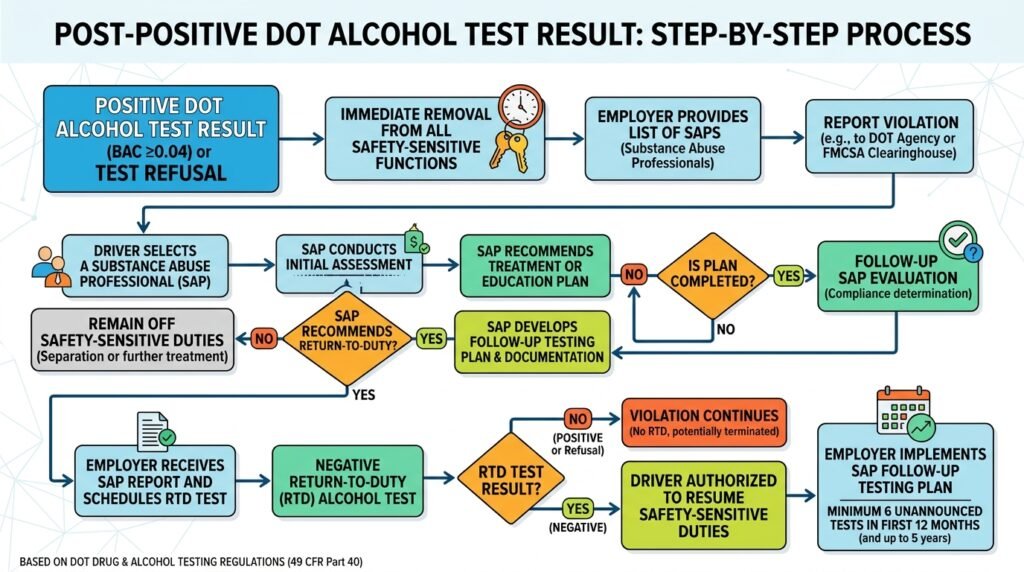
A failed DOT alcohol test triggers a chain of serious consequences. No exceptions. No shortcuts. Here’s the step-by-step process.
Step 1: Immediate Removal from Duty
Your employer removes you from all safety-sensitive functions on the spot. You cannot drive a CMV, handle hazmat, or perform any covered duties.
This happens the moment the confirmed test result shows 0.04 or higher. There’s no grace period. There’s no option for a retest.
Step 2: FMCSA Clearinghouse Reporting
Your employer must report the violation to the FMCSA Clearinghouse. Within 24 hours, or by the close of the next business day if the violation occurs after business hours
This creates a permanent record visible to every future employer who runs a pre-employment query. The violation stays in the Clearinghouse for 5 years from the date it occurred.
Step 3: SAP Evaluation and Treatment
You must see a Substance Abuse Professional (SAP) before returning to any safety-sensitive job. The SAP process includes:
- A face-to-face clinical evaluation
- A recommended course of treatment, education, or both
- A follow-up evaluation after completing the recommendations
- A written return-to-duty recommendation once you’re cleared
This process takes weeks to months, depending on the SAP’s recommendations. You typically pay for it out of pocket, unless your employer’s policy covers the cost.
Our DOT SAP Program guide walks you through every step of this process in detail.
Step 4: Return-to-Duty and Follow-Up
After SAP clearance, you take a return-to-duty alcohol test. You must blow below 0.02. Then unannounced follow-up testing begins, at least 6 tests over the next 12 months.
Career Impact: CDL Disqualifications
A DOT alcohol violation can trigger CDL disqualifications under federal and state law. Driving a CMV with a BAC of 0.04 or higher leads to:
- First offense: At least a 1-year CDL disqualification
- Second offense: Lifetime CDL disqualification
- Hazmat involvement: Enhanced penalties apply
If alcohol involvement also leads to criminal DUI charges, the consequences stack. Read our guide on DUI with a CDL to see how criminal charges affect your commercial license.
Consortium DOT Drug & Alcohol Testing for Owner-Operators
If you’re an owner-operator, every DOT alcohol testing rule still applies to you. Being self-employed doesn’t exempt you from compliance.
The challenge? You still need a testing program, a random selection pool, and a Designated Employer Representative (DER). That’s where consortium DOT drug & alcohol testing for owner-operators comes in.
A consortium is a group of small employers and independent drivers who pool resources. They share the infrastructure needed to meet DOT drug and alcohol testing requirements. Here’s what a typical consortium provides:
- Random testing pool – Your name goes into a pool with other drivers for random selection
- Program management – The consortium handles scheduling, paperwork, and record-keeping
- Collection sites – Access to approved testing locations nationwide
- MRO services – A Medical Review Officer reviews all drug test results
- Clearinghouse reporting – Required reports are filed on your behalf
- Annual compliance updates – Keeps your program aligned with current FMCSA rules
Joining a consortium is the most cost-effective path for owner-operators to maintain DOT compliance for trucking. Membership costs vary. $99–$249 per year depending on the provider, driver count, and included services like Clearinghouse support and random pool management
💡 Tip: Verify that your consortium is registered with the FMCSA Clearinghouse. Not all are. An unregistered consortium means your compliance records may not transfer or report properly.
DOT Alcohol Test vs. Non-DOT Alcohol Test
During your career, you might encounter both DOT and non-DOT alcohol tests. They serve different purposes and follow different rules.
| Feature | DOT Alcohol Test | Non-DOT Alcohol Test |
|---|---|---|
| Governing Authority | Federal (FMCSA / DOT) | Company policy or state law |
| BAC Limit | 0.04 (positive) / 0.02 (removal) | Varies (often 0.00 or 0.08) |
| Testing Method | EBT device (breath test) | Breath, blood, urine, or saliva |
| Who Conducts It | Certified BAT or STT | Varies by employer |
| Result Reporting | FMCSA Clearinghouse | Internal company records only |
| Regulations | 49 CFR Part 40 & Part 382 | Employer policy / state laws |
| Consequences of Failure | Federal violation, SAP required | Determined by employer |
A non-DOT alcohol test follows your employer’s internal policies or state regulations. It does not follow federal DOT procedures. Results do not get reported to the FMCSA Clearinghouse.
However, many carriers run both types. Failing a non-DOT test can still result in termination. Your employer may also flag concerns through other internal channels.
CDL Alcohol Rules and Pre-Duty Prohibition
DOT rules around alcohol extend far beyond just testing. FMCSA sets clear CDL alcohol rules that govern when you can and cannot drink – period.
The 4-Hour Pre-Duty Alcohol Prohibition
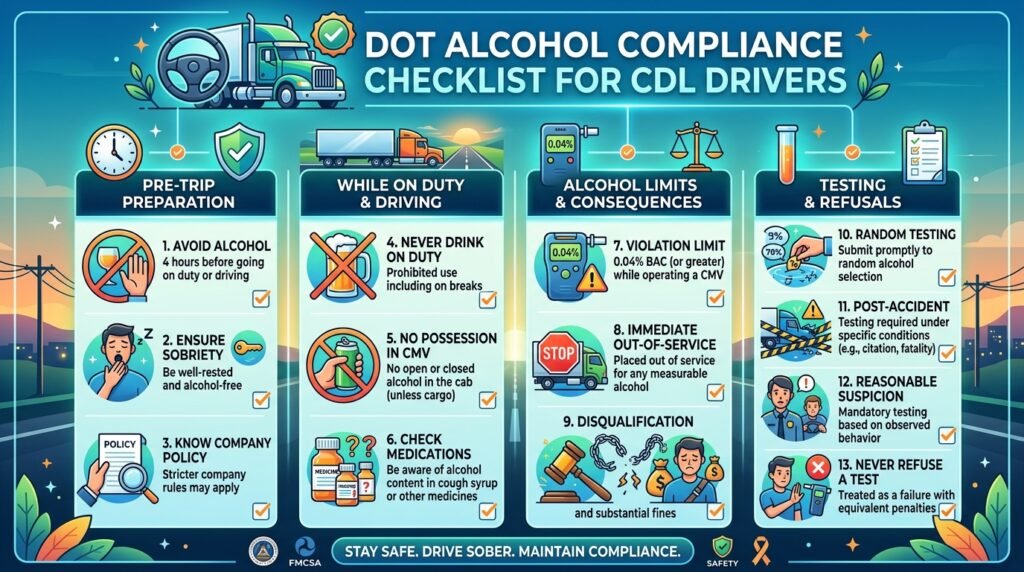
Under 49 CFR § 392.5, you must not use alcohol within 4 hours before driving or performing any safety-sensitive function.
This is a hard, non-negotiable rule. Even if your BAC drops below 0.02 by the time your shift starts, drinking within that 4-hour window violates federal regulations.
Here’s how the math works in practice:
- Shift starts at 6:00 AM → No alcohol after 2:00 AM
- Shift starts at 2:00 PM → No alcohol after 10:00 AM
- You’re on call → No alcohol once you receive a dispatch notice
On-Duty and In-Vehicle Prohibitions
CDL drivers also face these additional restrictions:
- No alcohol possession in the cab: unless it’s a shipped product and you’re not the consumer
- No use while on duty: even during breaks if you’re technically in on-duty status
- No use after an accident: until testing is complete or 8 hours have passed
Breaking any of these rules, even without a breath test, creates a CDL violation. Carriers and law enforcement can report violations based on direct observation alone.
Penalties for Violating CDL Alcohol Rules
Penalties extend well beyond losing your current job. The consequences ripple through your entire career:
- 24-hour out-of-service order (minimum) for any detected alcohol at 0.02+
- CDL disqualification for driving at 0.04+ BAC
- Criminal DUI charges if caught by law enforcement
- CDL license suspension through your state DMV
- Higher insurance rates – you may need high-risk auto insurance or SR-22 insurance
- Clearinghouse record that follows you for 5 years
How to Stay Compliant with DOT Alcohol Testing Requirements
Meeting DOT alcohol testing requirements isn’t complicated. It just demands discipline and awareness. Follow these steps to protect your CDL and career.
- Respect the 4-hour rule. Stop drinking at least 4 hours before your shift. Build in extra buffer time for safety.
- Understand your rights during testing. You can ask for a confirmation test and request copies of documentation. But you cannot refuse. Refusal equals a positive result.
- Keep your Clearinghouse profile current. Register at clearinghouse.fmcsa.dot.gov and provide consent for employer queries.
- Stay enrolled in a random testing program. Owner-operators must join a consortium. There are no exceptions.
- Watch for alcohol in everyday products. Some over-the-counter items contain alcohol. Mouthwash, cold medicine, and cough syrups can affect breath test results. Tell the BAT about anything you’ve recently used.
- Report to the collection site promptly. When selected for random testing, report immediately. Unnecessary delays can count as a refusal.
- Know your company’s specific policy. Many carriers enforce stricter standards than the DOT minimum. Understand the rules your employer sets.
💡 Pro Tip: If you use alcohol-based mouthwash before a test and get a 0.02 screening result, the 15–20 minute waiting period before the confirmation test usually clears the mouth alcohol. Don’t panic, but switch to alcohol-free mouthwash before work shifts going forward.
Frequently Asked Questions
No. DOT does not use urine tests to detect alcohol. DOT drug and alcohol testing uses breath testing (EBT devices) for alcohol screening. Urine testing is reserved for the DOT 5-panel drug test, which screens for marijuana, cocaine, opiates, amphetamines, and PCP. A breath alcohol test delivers immediate, on-the-spot results and is the only approved final method under 49 CFR Part 40.
The DOT physical exam for your medical card does not include an alcohol breath test or blood alcohol screening. However, the medical examiner may note signs of chronic alcohol abuse during the exam. If they suspect a problem, they can refer you for further clinical evaluation. The DOT physical and DOT alcohol testing are separate processes with completely different purposes.
A non-DOT alcohol test is any alcohol screening that falls outside federal DOT regulations. Employers may use these tests under company policy or state law. Non-DOT tests can use breath, blood, urine, or saliva methods. Results are not reported to the FMCSA Clearinghouse. However, failing a non-DOT test can still lead to termination. The procedures, cutoff levels, and consequences follow the employer’s internal rules, not the federal DOT alcohol testing rules.
The DOT alcohol test limit is 0.04 BAC. Any confirmed result at or above this level counts as a positive test and triggers the full violation process. A result between 0.02 and 0.039 requires a 24-hour removal from duty but is not classified as a positive result under federal regulations. These 0.04 limit standards apply to all CDL holders performing safety-sensitive functions.
Technically, yes, but the consequences are identical to a positive test result. A refusal gets reported to the FMCSA Clearinghouse immediately. You’ll face removal from duty, mandatory SAP evaluation, and every other penalty associated with a failed test. Refusal includes failing to appear, leaving before the test is complete, not providing an adequate breath sample without a valid medical explanation, or refusing to cooperate with the testing process.
A DOT alcohol violation stays in the FMCSA Clearinghouse for 5 years from the date of the violation. It remains visible to every employer who runs a pre-employment or annual query during that period. The violation status changes from “unresolved” to “resolved” once you complete the SAP process and pass a return-to-duty test. However, the record itself does not disappear until the full 5-year period expires.
Conclusion
DOT alcohol testing exists to protect everyone on the road, and that includes you. The rules are strict because the stakes are life-and-death. A 0.04 BAC limit, mandatory breath testing, and Clearinghouse reporting create a system that leaves no room for impaired driving.
Here’s what to remember: know the 0.04 and 0.02 thresholds, respect the 4-hour pre-duty rule, and stay enrolled in a compliant random testing program. If you’re an owner-operator, join a consortium for DOT drug and alcohol testing coverage. These basic steps keep your CDL active and your career on track.
If you’ve already faced a violation, act now. Start the SAP process immediately. Every day without action is another day you can’t get behind the wheel.
Check the FMCSA’s official Drug and Alcohol Testing page for the latest regulatory updates to DOT alcohol testing rules.
Based on available information at the time of writing. Rates, rules, and procedures may change. Always verify on official FMCSA and DOT sources for the most current requirements.
Last updated: March 19, 2026
BAC Limit Info Guide






![DOT Drug Test: What You Must Know in 2026 [Full Guide]](https://compliantdriversprogram.com/wp-content/uploads/2026/03/DOT-Drug-Test-150x150.jpeg)



Leave a Reply