
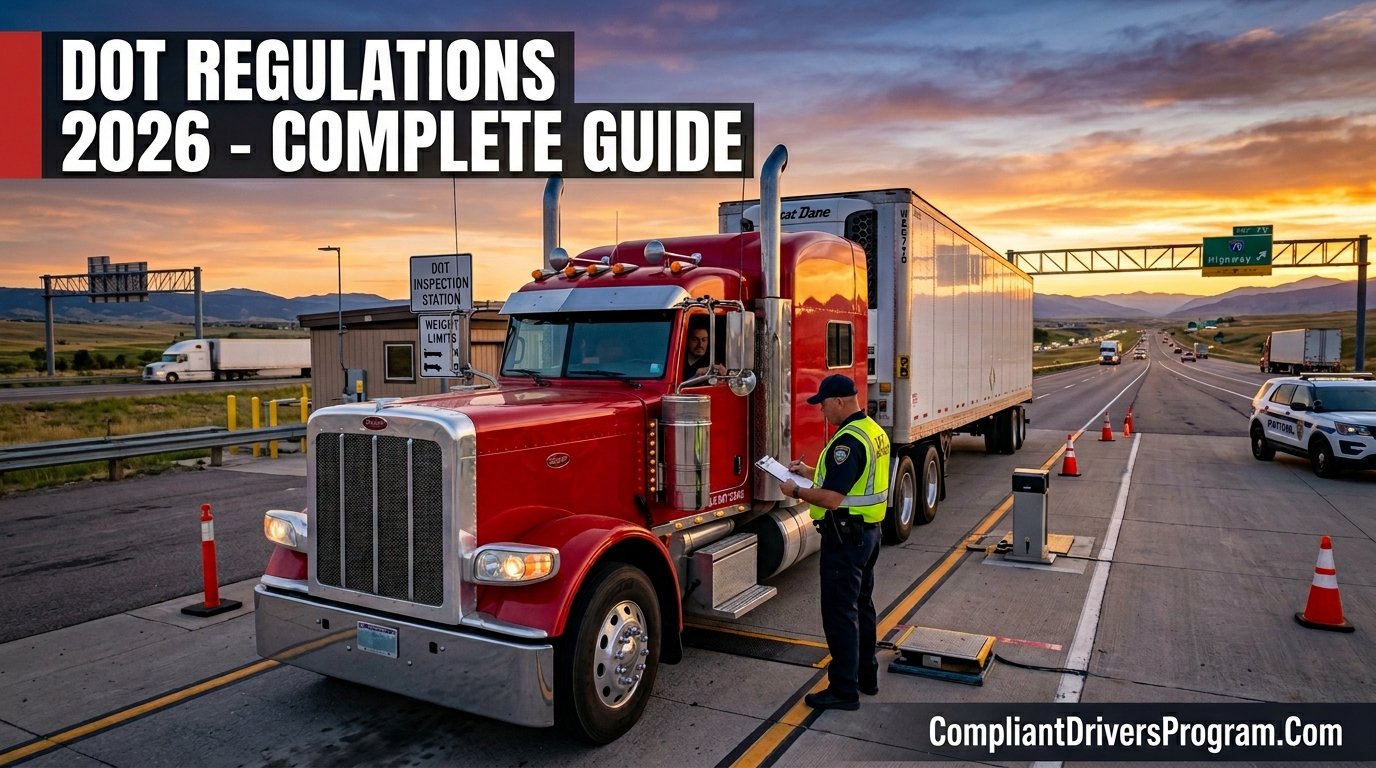
Every DOT Regulation Truck Drivers Must Know in 2026 (Don’t Get Fined)
A single missed rule can cost you $16,000 or shut down your entire operation overnight. That’s not an exaggeration. The Federal Motor Carrier Safety Administration handed out over 50,000 violations last year alone. Most drivers and carriers got hit because they didn’t fully understand the DOT regulations truck drivers must follow every single day.
Here’s the good news. You don’t need a law degree to stay compliant. You just need a clear, honest breakdown of what’s required. That’s exactly what this guide gives you. We’ll walk through every major federal trucking regulation, penalty, and rule change you need to know for 2026. By the end, you’ll know exactly where you stand and what to fix first.
What Are DOT Regulations and Why Do They Exist?
Let’s start with the basics. DOT trucking rules are federal laws created by the U.S. Department of Transportation. They exist to keep roads safe for everyone. These rules cover everything from how long you can drive to what condition your truck must be in.
The agency that enforces most of these rules is the FMCSA. That stands for the Federal Motor Carrier Safety Administration. When people ask what are FMCSA regulations, they’re really asking about the specific safety regulations that govern commercial motor vehicles and the people who drive them.
These aren’t suggestions or guidelines you can ignore. They carry real legal requirements with real consequences. Violating them can mean fines, license suspensions, or even criminal charges in serious cases. The FMCSA updates these transportation laws regularly, so what worked last year might not cut it today.
Pro Tip: Bookmark the FMCSA official website and check for rule updates at least once a quarter. Changes can drop with very little warning.
| Compliance Area | Status | Points |
|---|
Hours of Service: The Rules That Control Your Clock
If there’s one area of DOT regulations truck drivers deal with daily, it’s Hours of Service. These HOS rules limit how long you can drive and when you must rest. The FMCSA designed them to fight fatigue-related crashes, which still cause hundreds of deaths each year.
Here’s a quick rundown of the core HOS rules for property-carrying drivers in 2026. You can drive a maximum of 11 hours after 10 consecutive hours off duty. Your total on-duty window is 14 hours, and that clock doesn’t pause for breaks or stops. Once it starts, it runs straight through.
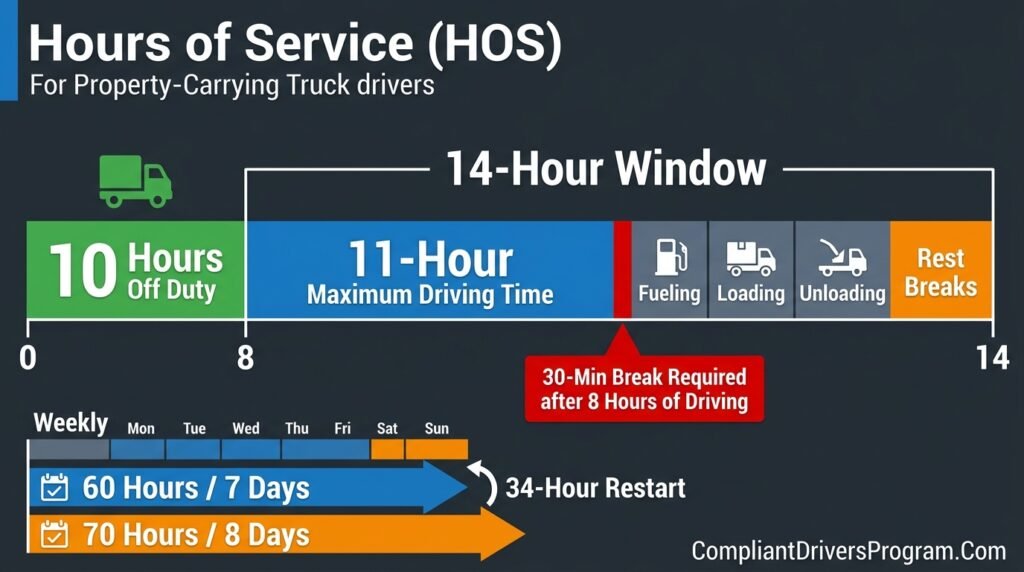
You also must take a mandatory 30-minute break after 8 cumulative hours of driving. The 14 hour rule explained in detail shows why this window trips up so many drivers. Most people don’t realize that loading time, fueling, and paperwork all count against that 14-hour limit even though you’re not behind the wheel.
There’s also a weekly cap. You can’t drive after accumulating 60 hours on duty in 7 days, or 70 hours in 8 days. The good news is you can reset that clock using the 34 hour restart rule. You just need 34 consecutive hours off duty, and your weekly clock goes back to zero.
Drivers who use a sleeper berth get some flexibility too. The sleeper berth rules let you split your required 10-hour off-duty period into two chunks. One period must be at least 7 hours in the sleeper, and the other must be at least 2 hours. This split gives long-haul drivers more control over their schedules.
For a deeper breakdown of every HOS detail, check out the full guide on FMCSA Hours of Service rules. Getting this right is the single best way to avoid the most common DOT rules for commercial drivers violations.
ELD Mandate: Your Driving Record Goes Digital
Gone are the days of paper logbooks. The ELD mandate requires almost every commercial driver to use an Electronic Logging Device. This device plugs into your truck’s engine and automatically records driving time, engine hours, miles driven, and location data.
The purpose is simple. ELDs make it nearly impossible to falsify your hours. Before this rule, some drivers kept two logbooks or fudged their numbers. The FMCSA wanted accurate data, and ELDs deliver exactly that. This is one of the compliance rules that changed the industry forever.
Here’s something most people miss. Your ELD must be registered on the FMCSA’s list of approved devices. Not every device on the market qualifies. If a roadside inspector finds you’re using a non-certified ELD, they’ll treat it the same as having no log at all. That’s an automatic violation.
You also need to know how to handle ELD malfunctions. If your device breaks down, you have 8 days to get it repaired or replaced. During that time, you must keep paper logs. Failing to carry backup paper logs during a malfunction is another common violation that catches drivers off guard.
Drug and Alcohol Testing: Zero Tolerance on the Road
This is one area where the FMCSA shows absolutely no flexibility. Every commercial driver must pass DOT drug and alcohol tests at multiple points during their career. Pre-employment testing is required before you ever turn the key. Random testing happens throughout the year, and your employer must test at least 50% of their drivers annually for drugs and 10% for alcohol.
The substances tested include marijuana, cocaine, opiates, amphetamines, and PCP. Even in states where marijuana is legal for recreational use, a positive test ends your driving career until you complete a return-to-duty process. Federal law overrides state law here, and the federal motor carrier rules are crystal clear on this point.
Here’s the thing most drivers don’t fully grasp. Every positive test, refusal to test, or violation goes into the FMCSA Clearinghouse. This is a national database that every employer must check before hiring you. A single violation stays in that database for 5 years. You can’t hide it, and you can’t talk your way around it.
For everything you need to know about the testing process, read the full DOT drug test guide. Understanding this process protects your license, your livelihood, and your reputation.
Pro Tip: Always request a split specimen test if you believe your results might be wrong. You have 72 hours after notification to make this request, and it could save your career.
CDL Requirements: Getting and Keeping Your License
You can’t drive a commercial vehicle without a Commercial Driver’s License. That’s a non-negotiable part of DOT regulations truck drivers face before they ever start working. The CDL process involves written knowledge tests, a skills test with a pre-trip inspection, and meeting specific medical standards.
There are three CDL classes. Class A covers combination vehicles over 26,001 pounds. Class B covers single vehicles over 26,001 pounds. And Class C covers vehicles carrying hazardous materials or 16 or more passengers. Most long-haul truckers need a Class A license to operate tractor-trailers.
Getting your CDL is just the beginning. Keeping it means staying violation-free and renewing on time. The full CDL license requirements page covers everything from endorsements to medical card renewals. Certain CDL violations can disqualify you from driving for 60 days, one year, or even permanently depending on severity.
Your medical certificate is a critical piece of this puzzle. Most drivers need a DOT physical every 24 months. Drivers with certain conditions like high blood pressure or diabetes might need annual exams. If your medical card expires, your CDL becomes invalid that same day. There’s no grace period.
Vehicle Inspection and Maintenance Standards
Your truck must be in safe operating condition every time it hits the road. The FMCSA requires drivers to complete a pre-trip inspection before every trip and a post-trip inspection at the end. This isn’t busywork. Inspectors take this seriously, and mechanical violations are among the top reasons trucks get placed out of service.
What should you check? Brakes, tires, lights, mirrors, coupling devices, steering, windshield wipers, horn, and emergency equipment. You must document this inspection in a Driver Vehicle Inspection Report. If you find a defect, you must note it and make sure it gets fixed before driving.
During roadside inspections, DOT officers follow specific procedures. There are six different DOT inspection levels, and each one checks different things. A Level I inspection is the most thorough. It covers both the driver and the vehicle from top to bottom. A Level III inspection focuses only on the driver’s credentials and logs.
Every inspection result feeds into your carrier’s CSA score. This score determines how often regulators target your company for audits and interventions. Bad inspections raise your score, which leads to more scrutiny, more inspections, and eventually enforcement actions. It’s a cycle you want to avoid.
Insurance Requirements for Motor Carriers
Every motor carrier must carry minimum levels of insurance before operating on public roads. This is one of the federal trucking regulations that applies to both the carrier and the vehicle. The exact amount depends on what you haul and how much it weighs.
For general freight carriers operating vehicles over 10,001 pounds, the minimum liability coverage is $750,000. If you haul hazardous materials, that minimum jumps to $1,000,000 or even $5,000,000 depending on the type of hazmat. These aren’t optional guidelines. They’re hard legal requirements enforced by the FMCSA.
Many new carriers underestimate what trucking insurance requirements actually cost. Premiums depend on your driving record, cargo type, routes, and experience. A new carrier with no history might pay $12,000 to $20,000 per year per truck. That number drops as you build a clean safety record.
You also need cargo insurance and sometimes bobtail insurance if you operate without a trailer. Your insurance provider must file proof of coverage directly with the FMCSA. If your coverage lapses even for one day, your operating authority becomes inactive. You literally cannot legally haul freight without active insurance on file.
DOT Fines and Penalties: What Non-Compliance Actually Costs
Let’s talk money, because the penalties for violating dot rules and regulations for truck drivers are steep. A single HOS violation can cost between $1,000 and $16,000 per offense. If the FMCSA considers the violation willful or repeated, penalties climb even higher. Some carriers have faced fines exceeding $100,000 for pattern violations.
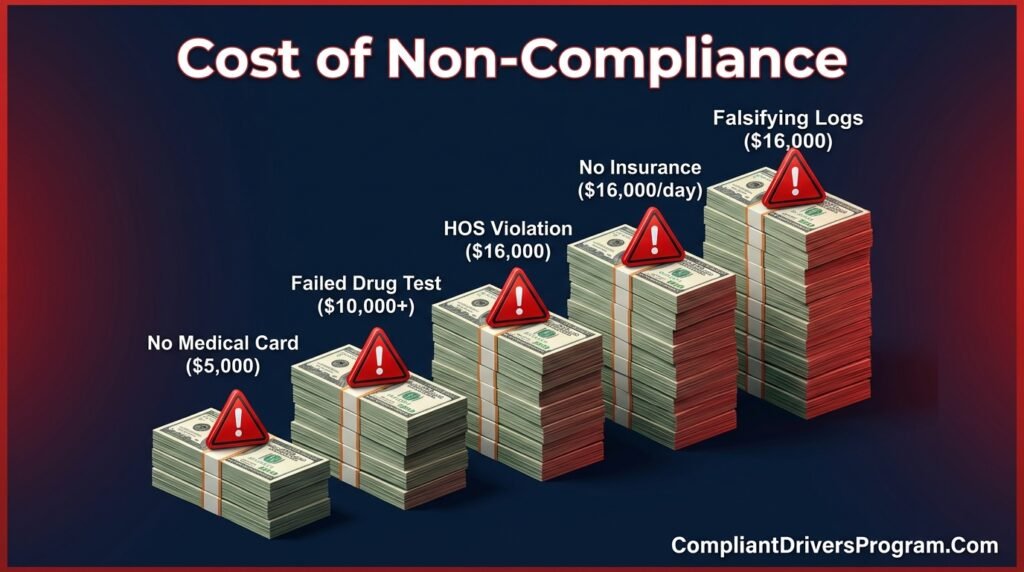
The FMCSA fines and penalties structure covers dozens of violation categories. Driving without a valid medical certificate can run $2,500 or more. Operating without proper insurance triggers fines up to $16,000 per day. Falsifying log records carries penalties up to $16,000 per offense plus potential criminal prosecution.
Here’s something that might surprise you. Drivers and carriers face separate penalties for the same violation. If a driver violates HOS rules, both the driver and the carrier can be fined individually. The carrier might face additional penalties for failing to monitor compliance. Our complete DOT fines guide breaks down every penalty category with exact dollar amounts.
Beyond fines, the FMCSA can issue out-of-service orders. This means your truck stops right where it sits until you fix the problem. For drivers, an OOS order means you can’t drive any commercial vehicle for a set period. For carriers, it can mean your entire fleet gets parked. The financial damage from lost revenue often exceeds the fine itself.
Understanding DOT compliance for trucking is the best insurance policy against these costs. Prevention always costs less than the penalty.
DOT Audits: What Happens When They Come Knocking
A DOT audit can happen at any time, and it’s exactly as stressful as it sounds. The FMCSA conducts compliance reviews to determine whether carriers follow all safety regulations. These audits examine your driver files, maintenance records, drug testing program, insurance documentation, and HOS compliance.
New carriers face a mandatory New Entrant Safety Audit within their first 18 months of operation. This audit reviews your safety management practices and determines whether you receive a satisfactory rating. Failing this audit can result in losing your operating authority entirely. That means your DOT number gets deactivated and you can’t operate.
Speaking of DOT numbers, keeping yours active requires ongoing compliance. The DOT number guide explains the situations that trigger deactivation and how to prevent it. You must update your registration information every two years through the biennial update process. Missing this update alone can lead to deactivation.
During an audit, investigators look at a minimum of the previous 12 months of records. They pull random driver files and check every detail. Missing documents, incomplete drug testing records, or gaps in maintenance logs all count as violations. The key to surviving an audit is staying organized every single day, not scrambling to get things together when you get the notice.
DOT Regulations Comparison: Driver vs. Carrier Responsibilities
| Regulation Area | Driver Responsibility | Carrier Responsibility | Penalty Range |
|---|---|---|---|
| Hours of Service | Follow all HOS limits daily | Monitor and enforce HOS compliance | $1,000 – $16,000 per violation |
| Drug Testing | Submit to all required tests | Maintain testing program and records | $5,000 – $10,000+ per violation |
| Vehicle Inspection | Complete pre/post trip inspections | Ensure proper maintenance and repairs | $1,000 – $16,000 per defect |
| ELD Compliance | Operate ELD correctly daily | Provide certified ELD equipment | $1,000 – $16,000 per violation |
| Medical Certificate | Maintain valid DOT medical card | Verify medical card is current | $2,500 – $5,000+ per violation |
| CDL Requirements | Hold valid CDL with proper class | Verify CDL before allowing driver to operate | $2,500 – $10,000+ per violation |
| Insurance | Carry proof of insurance in vehicle | Maintain required minimum coverage | Up to $16,000 per day without coverage |
Changes Coming to Trucking Laws in 2026
The trucking laws 2026 landscape includes several updates drivers and carriers need to watch closely. The FMCSA has been reviewing speed limiter requirements for heavy commercial vehicles. If this rule passes, trucks over 26,000 pounds would need electronic speed limiters set at a maximum speed determined by the agency.
The Clearinghouse requirements continue expanding too. Starting in late 2024, employers lost the ability to use the previous manual query process. Now every hiring decision requires a full electronic Clearinghouse query. This affects every driver regulations process from hiring to annual reviews.
The FMCSA also continues tightening rules around broker and carrier transparency. New requirements around freight contracts and payment timelines aim to protect owner-operators from predatory practices. These compliance rules focus on financial safety alongside physical safety.
The FMCSA regulations page stays updated with proposed and final rules. Checking this resource quarterly keeps you ahead of changes that could affect your operation. Don’t wait until a rule takes effect to learn about it. By then, you’re already behind.
Practical Steps to Stay Compliant Every Day
Staying on top of every DOT regulation feels overwhelming at first. But it gets easier when you build simple systems. Start by creating a compliance calendar that tracks every renewal date. This includes medical cards, CDL renewals, insurance policies, vehicle inspections, drug testing dates, and biennial updates.
Next, organize your files digitally and physically. Keep driver qualification files complete with applications, MVR reports, road test certificates, medical cards, and training records. Missing even one document during an audit creates a violation. A simple filing system prevents this headache.
Train your drivers regularly on the federal trucking regulations list that affects them daily. Monthly safety meetings don’t need to be long, but they need to happen. Cover one topic per meeting and document attendance. This shows auditors that you take compliance seriously and invest in your team.
Finally, run your own internal audits twice a year. Pull random driver files, check maintenance records, and review ELD data before the FMCSA does it for you. Finding problems yourself costs nothing. Letting an auditor find them costs thousands. Taking a proactive approach to DOT regulations for truck drivers 2026 separates successful carriers from those who struggle.
Pro Tip: Assign one person in your organization as the compliance officer. Even if it’s a small operation, having one person own this responsibility prevents things from falling through the cracks.
FAQ Section
A: The main rules cover Hours of Service limits, ELD requirements, drug and alcohol testing, CDL qualifications, vehicle inspections, insurance minimums, and medical fitness standards.
A: The FMCSA reviews and updates driver regulations continuously. Major changes typically happen every 1-2 years, with minor adjustments occurring more frequently through guidance documents.
A: Individual violations can reach $16,000 per offense. Pattern violations or willful non-compliance can result in penalties exceeding $100,000 and criminal prosecution.
A: Yes. Every motor carrier, regardless of size, must follow all FMCSA regulations. Owner-operators face the same rules, audits, and penalties as large fleet operations.
A: You’ll receive an immediate out-of-service order. The violation goes into the FMCSA Clearinghouse, and you must complete a return-to-duty process with a Substance Abuse Professional before driving again.
A: Visit the FMCSA’s Safety Measurement System website. Enter your DOT number to see your current scores across all seven BASIC categories.
A: Yes. Certain violations like using a CMV during a felony, leaving the scene of a fatal accident, or multiple serious traffic violations can result in permanent CDL disqualification.
Your Next Move
Knowing the DOT regulations truck drivers face is only half the battle. Acting on that knowledge is what keeps you on the road and out of trouble.
- Build a compliance calendar and track every important deadline
- Review your driver files and fix any gaps before an auditor finds them
- Stay current on trucking laws 2026 changes by checking FMCSA updates quarterly
- Invest in proper training so every driver understands their daily responsibilities
Pick the weakest area of your compliance program right now and fix it this week. Don’t wait for an audit notice or a roadside violation to force your hand. The carriers who thrive in this industry are the ones who treat compliance as a daily habit, not a yearly scramble.
This article provides general information about federal trucking regulations. Consult a qualified transportation attorney or compliance professional for guidance specific to your operation.







![DOT Drug Test: What You Must Know in 2026 [Full Guide]](https://compliantdriversprogram.com/wp-content/uploads/2026/03/DOT-Drug-Test-150x150.jpeg)



Leave a Reply