
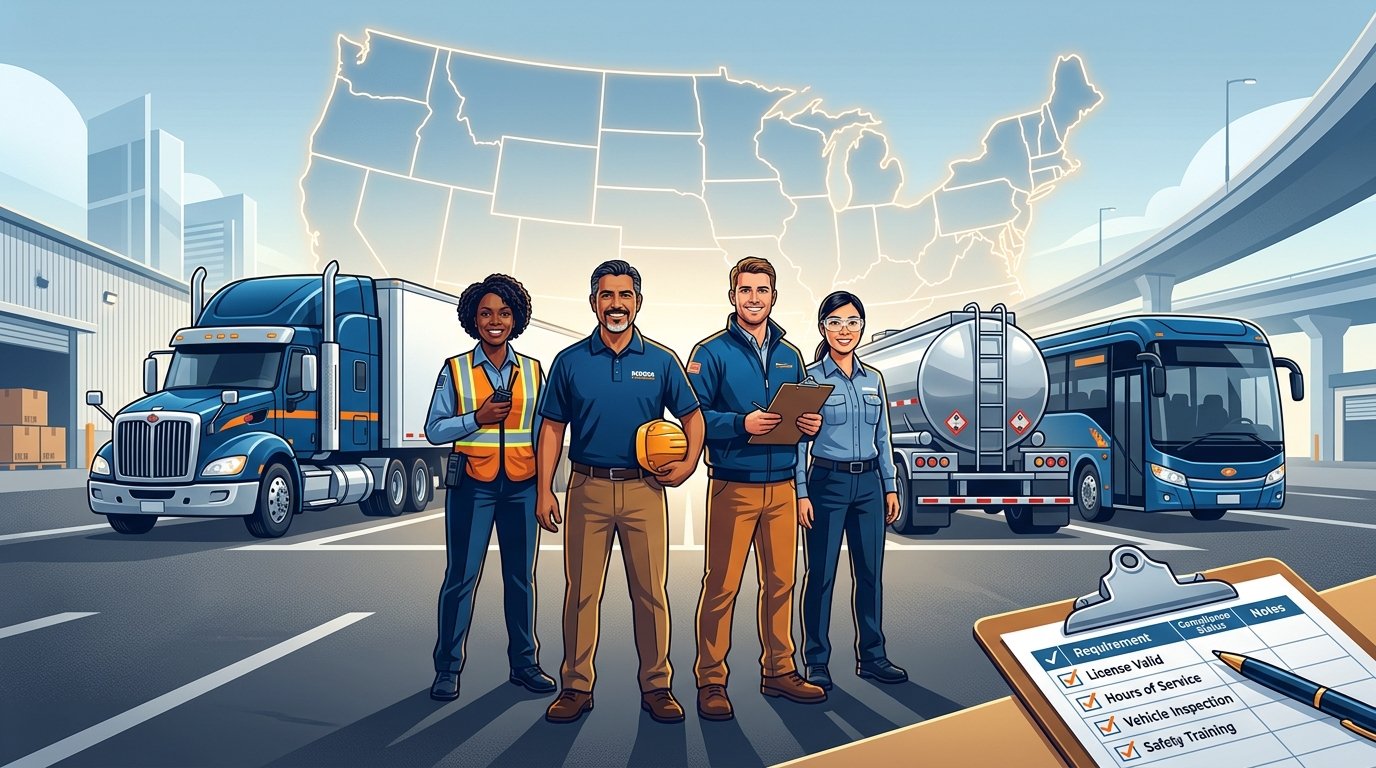
Over 3.5 million truck drivers keep America moving every day. But before you can sit behind the wheel of a big rig, you need a commercial driver’s license. The tricky part? CDL license requirements by state can vary quite a bit.
Some states let you drive at 18. Others make you wait until 21. Fees, tests, and documentation differ too. This guide breaks down everything you need to know about CDL requirements by state in 2026. Whether you live in Texas, Florida, New York, or any other state, you will find the answers here.
This article is for anyone who wants to earn a CDL. First-time applicants, career changers, and even current permit holders will benefit. Let us dig into the details state by state.
Key Takeaways
- Every state requires a written knowledge test, skills test, and DOT physical to earn a CDL.
- The federal minimum age limit for interstate CDL driving is 21, but many states allow intrastate driving at 18.
- You must meet specific residency, medical, and background eligibility requirements before applying.
- CDL requirements by state differ in fees, endorsement options, and training hour mandates.
- The FMCSA’s Entry Level Driver Training (ELDT) rule applies nationwide as of 2026.
What Is a CDL and Who Needs One
A CDL stands for commercial driver’s license. You need one to operate large or heavy vehicles for work. This includes semis, buses, tanker trucks, and vehicles carrying hazardous materials.
Federal law says you need a CDL if your vehicle meets certain weight requirements. Specifically, you need one for any single vehicle over 26,001 pounds. You also need one for combination vehicles where the towed unit weighs over 10,000 pounds.
But weight is not the only trigger. You also need a CDL to carry 16 or more passengers (including the driver). Hauling hazardous materials in reportable quantities also requires one.
If you are wondering whether your job requires a CDL, check our full guide on types of CDL licenses for a complete breakdown of Class A, Class B, and Class C licenses.
Federal CDL Requirements That Apply Everywhere
Before we look at state CDL requirements, you should know the federal baseline. The FMCSA (Federal Motor Carrier Safety Administration) sets minimum standards every state must follow.
Here are the federal requirements that apply no matter where you live:
- You must be at least 18 years old to drive intrastate (within your state).
- You must be at least 21 years old to drive interstate (across state lines).
- You must pass a DOT physical exam and receive a valid medical certificate.
- You must pass a knowledge test and a three-part skills test.
- You must provide proof of citizenship or lawful permanent residency.
- You must complete ELDT (Entry Level Driver Training) from a registered provider.
- You must not have any active CDL disqualifications on your record.
States can add extra rules on top of these. But they cannot go below these minimums. Think of federal rules as the floor, not the ceiling.
The FMCSA keeps an updated list of regulations on their official website that you should bookmark.
CDL License Requirements by State 2026 Comparison Table
This table gives you a quick snapshot of how CDL requirements compare across several major states. Fees and details can change, so always verify with your state DMV.
| State | Min. Age (Intrastate) | Min. Age (Interstate) | CDL Fee (Approx.) | ELDT Required | Permit Required First |
|---|---|---|---|---|---|
| Texas | 18 | 21 | $97 (Class A CDL license) | Yes | Yes |
| Florida | 18 | 21 | $75 (CDL license) | Yes | Yes |
| New York | 18 | 21 | $164.50 (CDL license) | Yes | Yes |
| Michigan | 18 | 21 | $25 (standard CDL license) | Yes | Yes |
| California | 18 | 21 | $85 (Class A/B CDL license) | Yes | Yes |
| Ohio | 18 | 21 | $46.50 (CDL license) | Yes | Yes |
| Pennsylvania | 18 | 21 | $151.50 (CDL license) | Yes | Yes |
| Illinois | 18 | 21 | $60 (CDL license) | Yes | Yes |
| Georgia | 18 | 21 | $32 (CDL license) | Yes | Yes |
| North Carolina | 18 | 21 | $107.50 (CDL license) | Yes | Yes |
Important: Fees listed are approximate and may change. Visit your state DMV website for the most current pricing.
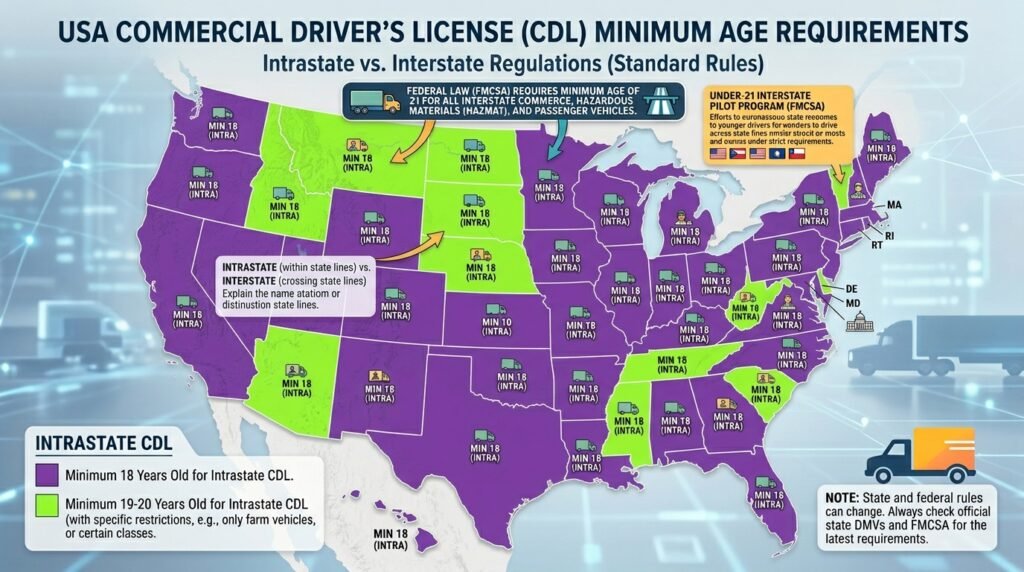
Age Requirements Across All 50 States
Age is one of the first things people ask about. The rules are straightforward but have some nuances you need to understand.
Federal Age Rules
The federal government sets two age thresholds:
- 18 years old: You can get a CDL and drive commercially within your home state only (intrastate).
- 21 years old: You can drive across state lines (interstate) and haul hazardous materials.
State-Specific Age Variations
Most states follow the federal minimum of 18 for intrastate driving. However, some states have extra restrictions for younger drivers. For example, certain states limit 18 to 20-year-old CDL holders to specific vehicle types.
A few key points about CDL age requirements by state:
- Texas allows intrastate CDL driving at 18 with no special restrictions beyond federal rules.
- New York permits CDL holders at 18 for intrastate but restricts some endorsements until 21.
- Florida follows the federal standard at 18 for intrastate.
- Michigan also allows 18-year-olds to drive intrastate commercially.
FMCSA Under-21 Apprenticeship Program
Starting in recent years, the FMCSA introduced a pilot apprenticeship program. This program allows certain drivers between 18 and 20 to cross state lines under strict supervision. The program is still limited and has specific eligibility criteria.
Check the FMCSA apprenticeship program page for the latest details on this program in 2026.
Documentation and Eligibility You Need
Gathering the right documentation is a step many applicants underestimate. Missing even one document can delay your application by weeks.
Identity and Residency Documents
Every state requires you to prove who you are and where you live. At minimum, you will need:
- Proof of identity: Valid US passport, birth certificate, or permanent resident card
- Social Security card: Original card or W-2 with your full SSN
- Proof of residency: Two documents showing your current address (utility bill, bank statement, lease agreement)
- Current driver’s license: Your existing non-commercial license must be valid and in good standing
Additional Eligibility Requirements
Beyond documents, you must meet these eligibility standards:
- No revoked or suspended license in any state
- No active CDL held in another state (you can only hold one CDL at a time)
- Clean record regarding CDL disqualifications such as DUI, felony drug convictions, or leaving the scene of an accident
- Self-certification of driving type (interstate, intrastate, or exempt)
Non-Citizen Applicants
Lawful permanent residents can apply for a CDL. You will need your permanent resident card (Green Card) as proof of legal status. Some visa holders may also qualify depending on their visa category and state rules.
Medical and Vision Test Standards
Your health matters when you drive a 40-ton vehicle. Federal law requires every CDL applicant to pass a DOT physical performed by a certified medical examiner.
What the DOT Physical Covers
The DOT physical is more thorough than a regular checkup. The examiner will test:
- Vision: You need at least 20/40 in each eye (with or without correction). You also need a 70-degree field of vision in each eye. This vision test is non-negotiable.
- Hearing: You must hear a forced whisper at 5 feet or pass an audiometric test.
- Blood pressure: Your readings must fall within acceptable ranges. High blood pressure may limit your certificate length.
- Blood sugar: Tested to screen for diabetes. Insulin-dependent diabetics need a federal exemption.
- General physical health: Heart, lungs, nervous system, and musculoskeletal system are all evaluated.
Learn more about what to expect in our detailed DOT physical exam guide.
Medical Certificate Duration
If you pass, you receive a Medical Examiner’s Certificate (MEC). Most certificates last 2 years. Some conditions reduce this to 1 year. You must keep your certificate current as long as you hold a CDL.
State Variations in Medical Requirements
Most states follow the federal medical standards exactly. However, some states add their own requirements for specific endorsements. For example, school bus drivers may face additional health screenings in certain states.
Read our full breakdown of CDL medical requirements for state-specific details.

Knowledge Test and Skills Test Breakdown
Every CDL applicant must pass both a written knowledge test and a hands-on skills test. These tests prove you understand the rules and can actually drive the vehicle safely.
The CDL Knowledge Test
The knowledge test is a written (or computer-based) exam. It covers:
- General CDL knowledge (rules of the road, vehicle inspection, basic control)
- Air brakes (if your vehicle has them)
- Combination vehicles (for Class A applicants)
- Endorsement-specific questions (HazMat, passenger, tanker, etc.)
Most states give you multiple attempts if you fail. However, you usually need to wait a set period (often 7 days) between attempts. Prepare with a CDL practice test before your exam day.
The number of questions and passing score vary by state. But most states require around 80% to pass.
The CDL Skills Test
After you pass the knowledge test and hold a CDL permit for the required period, you take the skills test. This has three parts:
- Pre-trip vehicle inspection: You walk around the vehicle and explain each component you check. This proves you can identify safety issues before driving.
- Basic vehicle control: You perform maneuvers like straight-line backing, offset backing, and parallel parking in a controlled area.
- On-road driving test: You drive on public roads while the examiner evaluates your turning, lane changes, speed management, and overall safety.
Tips to Pass on Your First Try
- Study the CDL manual for your state thoroughly.
- Practice with the actual vehicle type you will test in.
- Take multiple CDL practice tests to build confidence.
- Get enough sleep the night before your test.
- Arrive early and bring all required documents.
CDL Classes and Weight Requirements
Not all CDLs are the same. There are three classes, each based on the weight requirements of the vehicles you plan to drive.
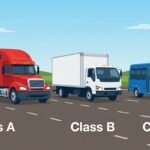
Class A CDL
- Gross combination weight rating (GCWR): 26,001 pounds or more
- Towed vehicle: Must weigh more than 10,000 pounds
- Common vehicles: Tractor-trailers, truck and trailer combos, livestock carriers, flatbeds
- Endorsements available: All endorsements
A Class A is the most versatile CDL. If you want maximum job options, this is the class to get.
Class B CDL
- Gross vehicle weight rating (GVWR): 26,001 pounds or more as a single vehicle
- Towed vehicle: Must weigh 10,000 pounds or less
- Common vehicles: Straight trucks, large buses, dump trucks, box trucks, cement mixers
- Endorsements available: Passenger, school bus, HazMat, tanker, and others
A Class B CDL is perfect for local delivery, transit, and construction jobs.
Class C CDL
- GVWR: Under 26,001 pounds
- Special condition: Must carry 16+ passengers OR haul hazardous materials
- Common vehicles: Small HazMat vehicles, large passenger vans, small buses
For a full comparison, read our guide on types of CDL licenses.
| CDL Class | Weight Threshold | Towed Vehicle Limit | Example Vehicles |
|---|---|---|---|
| Class A | 26,001+ lbs GCWR | Over 10,000 lbs | Semi trucks, tankers |
| Class B | 26,001+ lbs GVWR | Under 10,000 lbs | Buses, dump trucks |
| Class C | Under 26,001 lbs | N/A | HazMat vans, small buses |
How ELDT Training Rules Affect You in 2026
The Entry Level Driver Training (ELDT) rule changed the CDL landscape when it took full effect. In 2026, this rule is firmly in place and affects every new CDL applicant.
What Is ELDT
ELDT is a federal training mandate from the FMCSA. It requires all first-time CDL applicants and those adding certain endorsements to complete training from a provider listed on the Training Provider Registry (TPR).
Who Must Complete ELDT
You need ELDT if you are:
- Getting a Class A or Class B CDL for the first time
- Upgrading from Class B to Class A
- Adding a HazMat (H), passenger (P), or school bus (S) endorsement
What ELDT Training Includes
ELDT has two parts:
- Theory (classroom) training: Covers federal regulations, vehicle systems, safe driving practices, and trip planning.
- Behind-the-wheel (BTW) training: Includes range practice and on-road driving with a qualified instructor.
There is no set minimum hour requirement from the federal level. Instead, training must continue until you demonstrate proficiency. However, many states and training schools set their own hour minimums.
Finding a Registered Training Provider
Only schools on the FMCSA Training Provider Registry can provide ELDT. You can search the registry on the FMCSA TPR website.
We also have guides to help you find quality training near you:
State Spotlight: Texas, Florida, New York, and Michigan
Let us look at four major states in detail. These states have some of the highest CDL applicant volumes in the country.
Texas CDL Requirements
Texas is one of the busiest states for commercial driving. Here is what you need:
- Minimum age: 18 for intrastate, 21 for interstate
- Governing agency: Texas Department of Public Safety (DPS)
- Required tests: General knowledge, skills test, air brakes (if applicable)
- ELDT: Required for all new applicants
- Medical card: DOT physical required
- Special notes: Texas requires completion of an approved ELDT program before you can schedule your skills test.
For a full walkthrough, visit our Texas CDL requirements guide.
Florida CDL Requirements
Florida follows federal standards closely with a few extras:
- Minimum age: 18 for intrastate, 21 for interstate
- Governing agency: Florida Department of Highway Safety and Motor Vehicles (FLHSMV)
- Required tests: Knowledge test, skills test, vision test
- ELDT: Required
- Medical card: DOT physical required
- Special notes: Florida offers third-party skills testing at authorized locations, which can reduce wait times.
New York CDL Requirements
NY has its own process through the DMV:
- Minimum age: 18 for intrastate (with restrictions), 21 for interstate
- Governing agency: New York State DMV
- Required tests: Knowledge test, skills test, air brakes
- ELDT: Required
- Medical card: DOT physical required
- Special notes: New York requires a CDL permit for at least 14 days before you can take the road test. Some endorsements have additional waiting periods.
Read our detailed NY CDL requirements guide for step-by-step instructions.
Michigan CDL Requirements
Michigan follows federal minimums with efficient processing:
- Minimum age: 18 for intrastate, 21 for interstate
- Governing agency: Michigan Secretary of State
- Required tests: Knowledge test, skills test
- ELDT: Required
- Medical card: DOT physical required
- Special notes: Michigan offers both state-administered and third-party skills tests. The state also has specific rules for farm vehicle exemptions.
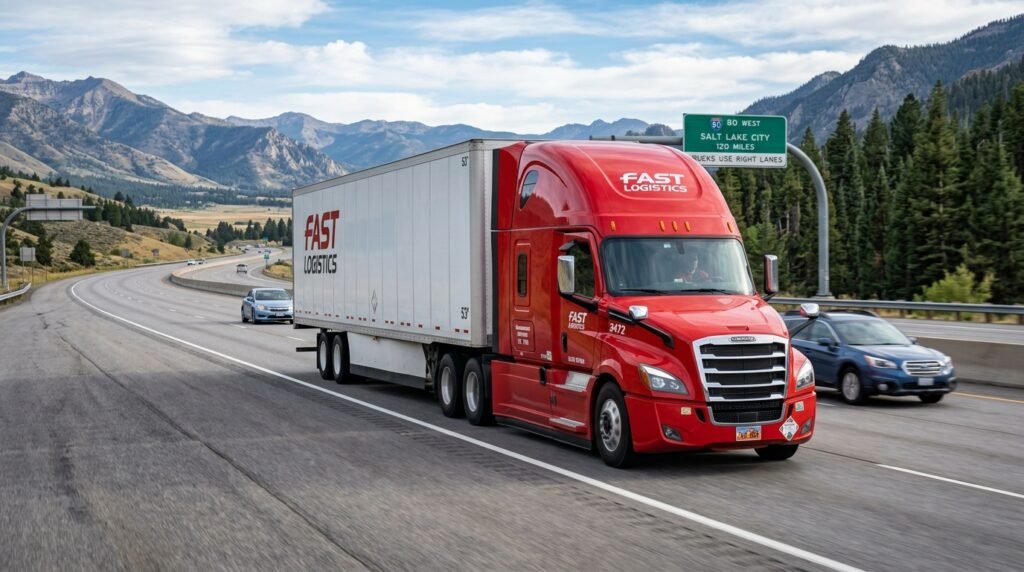
CDL Requirements Checklist
Use this CDL requirements checklist before you start your application. It applies to most states, but always confirm with your local DMV.
Before You Apply:
- Confirm you meet the minimum age requirement for your driving type
- Gather all documentation (ID, Social Security card, proof of residency)
- Check your driving record for any disqualifications
- Get your DOT physical exam and obtain your medical certificate
- Decide which CDL class and endorsements you need
Training and Testing:
- Enroll in an ELDT-approved training program
- Complete theory and behind-the-wheel training
- Study for your knowledge test using practice tests
- Apply for your CDL permit
- Pass the knowledge test at your DMV
- Practice driving with your permit for the required period
- Schedule and pass your three-part skills test
After You Pass:
- Pay your CDL fees
- Receive your CDL card
- Keep your medical certificate current
- Understand DOT regulations for truckers that apply to you
- Renew your CDL before it expires (renewal periods vary by state)
Frequently Asked Questions
A CDL is required when you operate a vehicle with a gross vehicle weight rating over 26,001 pounds. You also need one to transport 16 or more passengers or haul hazardous materials in reportable quantities. These rules apply across all states based on federal FMCSA regulations.
Driving semi trucks, large buses, tanker trucks, and any vehicle meeting federal weight requirements requires a CDL. Specific endorsements are needed for hazardous materials, double or triple trailers, and passenger transport. Even if the vehicle is under the weight threshold, carrying HazMat or large passenger loads triggers the requirement.
If you hold a valid non-commercial license, you still need to complete the full CDL process. This includes passing the knowledge test, completing ELDT training, getting a DOT physical, and passing the skills test. Your regular license shows driving experience, but it does not exempt you from any CDL steps.
The timeline varies by state and training program. Most people complete the process in 3 to 8 weeks. Intensive full-time programs can finish faster. Part-time training may take several months. The permit holding period and test scheduling can also add time.
Yes. When you move to a new state, you must transfer your CDL within a set timeframe (usually 30 to 90 days). The new state will verify your record and may require you to pass a vision test or knowledge test. You can only hold one CDL at a time across all states.
Total costs vary widely. CDL fees at the DMV typically range from $50 to $200 depending on the state. Training programs can cost anywhere from $3,000 to $10,000 or more. Add in the DOT physical ($75 to $150 on average) and study materials. Based on available information, budget between $4,000 and $11,000 total. Check your state DMV and chosen school for current pricing.
Conclusion
Getting a CDL in 2026 is a clear, structured process. But the details change depending on where you live. CDL license requirements by state cover everything from age limits and documentation to testing and training mandates.
Start by confirming your eligibility and gathering your documents. Then enroll in an ELDT-approved program and prepare for your tests. Every state requires a knowledge test, skills test, and DOT physical. No shortcuts exist.
The key is to plan ahead. Know your state’s specific CDL requirements before you show up at the DMV. Use our how to get a CDL guide for a complete step-by-step walkthrough from start to finish.
Your trucking career starts with the right preparation. Take the first step today.
State Requirements Checker



![DOT Drug Test: What You Must Know in 2026 [Full Guide]](https://compliantdriversprogram.com/wp-content/uploads/2026/03/DOT-Drug-Test-150x150.jpeg)



Leave a Reply