
Millions of trucking jobs sit open right now across America. Companies are desperate for qualified drivers. But you cannot drive a commercial truck without a commercial driver license, and the process to get a CDL can feel overwhelming if you do not know where to start.
This guide walks you through every step of the CDL process in plain language. You will learn the exact CDL license requirements, what tests to pass, and how much everything costs. Whether you want a Class A CDL for big rigs or a Class C license for specialty vehicles, this article covers it all.
This guide is for first-time applicants, career changers, and anyone ready to start a trucking career in 2026. We cover federal rules, state requirements, training paths, and proven test tips. By the end, you will know exactly how to get a CDL license step by step.
Key Takeaways
- You must be at least 18 to get a CDL license for intrastate driving and 21 for interstate.
- The CDL process includes a DOT physical exam, CDL permit test, ELDT certification, and CDL skills test.
- Most people finish the entire process in 4 to 16 weeks depending on training.
- CDL training programs cost between $3,000 and $10,000 on average, but free CDL training options exist.
- Every state has different CDL requirements, so always check with your local DMV.
What Is a CDL and Why Do You Need One
A commercial driver license (CDL) is a special license for operating large or heavy vehicles. This includes tractor-trailers, tanker trucks, buses, and other commercial motor vehicles.
Federal law requires a CDL when a vehicle meets certain size, weight, or passenger thresholds. You need one if your vehicle has a gross vehicle weight rating (GVWR) over 26,001 pounds. You also need a CDL to transport hazardous materials or carry 16 or more passengers.
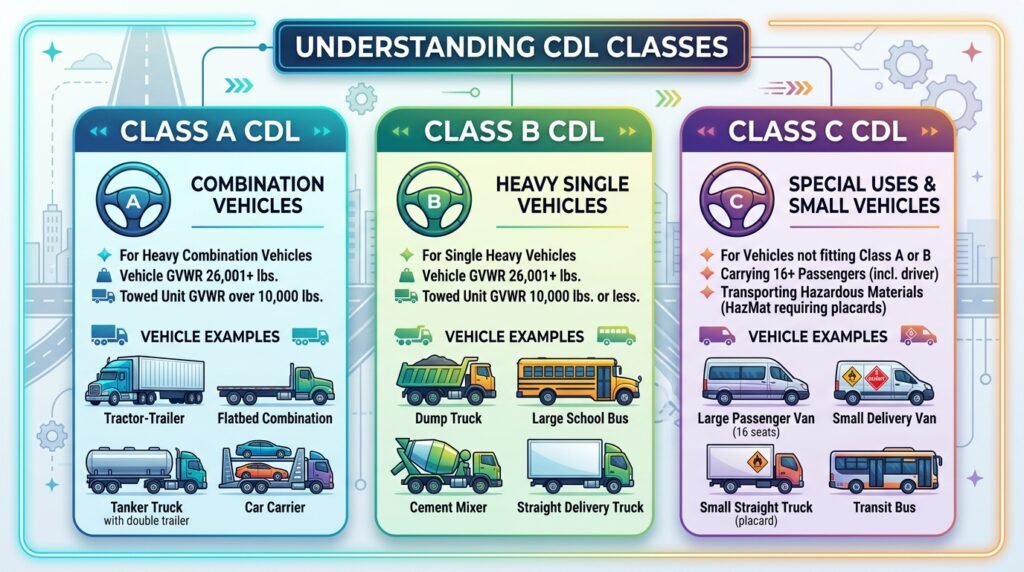
There are three main types of CDL licenses you should know about:
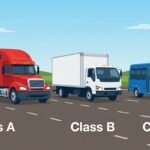
- Class A CDL — Covers combination vehicles with a combined GVWR over 26,001 pounds when the towed unit exceeds 10,000 pounds. This includes most semi-trucks and tractor-trailers.
- Class B CDL — Covers single vehicles over 26,001 pounds. This includes straight trucks, large buses, dump trucks, and box trucks above the weight limit.
- Class C CDL — Covers vehicles designed to carry 16 or more passengers or vehicles hauling hazardous materials that do not meet Class A or Class B weight thresholds.
Most aspiring truck drivers choose a Class A CDL because it unlocks the most career opportunities. With a Class A, you can operate nearly every type of commercial vehicle on the road.
Warning: Operating a commercial motor vehicle without a valid CDL is a serious offense. It can result in heavy fines, criminal charges, and permanent damage to your driving record.
CDL License Requirements You Must Meet
Before you begin the CDL process, you need to meet several baseline requirements. These come from both federal regulations and your individual state’s DMV rules.
Here is a quick overview of the core CDL requirements:
| Requirement | Details |
|---|---|
| Minimum Age | 18 (intrastate) or 21 (interstate) |
| Regular Driver License | Must hold a valid non-CDL license |
| DOT Physical | Must pass and obtain a medical card |
| Driving Record | Must be free of major disqualifications |
| Residency | Must prove state residency |
| English Proficiency | Must read and speak English well enough to communicate with officers and read signs |
Review the complete CDL license requirements by state on our site for details specific to where you live.
Age Requirements for a CDL
You must be at least 18 years old to obtain a CDL in most states. However, there is an important restriction that catches many people off guard.
At age 18, you can only drive commercially within your home state. This is called intrastate driving. If you want to haul freight or passengers across state lines (interstate), federal law requires you to be at least 21 years old.
A few states set their minimum CDL age at 21 for all applicants regardless of route. Check the CDL age requirements for your specific state before you start the application process.
Medical and Physical Requirements
Every person who holds a CDL must carry a valid DOT medical card. You earn this card by passing a DOT physical exam performed by a certified medical examiner listed on the FMCSA’s National Registry.
The DOT physical exam checks several areas of your health, including:
- Vision (must be at least 20/40 in each eye)
- Hearing (must perceive a forced whisper at 5 feet)
- Blood pressure (must be below 140/90 for a full two-year certification)
- Cardiovascular health
- Neurological function
- General physical fitness for safe driving
Common reasons drivers fail the DOT physical include uncontrolled high blood pressure, uncorrected vision problems, insulin-dependent diabetes without an exemption, untreated sleep apnea, and certain heart or lung conditions.
Your CDL medical card is typically valid for up to 24 months. Drivers with certain conditions may receive a shorter certification period. Learn how to maintain your card in our DOT medical card guide.
You must keep your medical card current for the entire time you hold your CDL. If it expires, your CDL becomes inactive until you pass a new physical.
Driving Record and Background Check
Your driving history matters when you apply for a commercial learners permit or CDL. The DMV and your state will review your record for disqualifying offenses.
Certain violations can prevent you from getting or keeping a CDL. These include:
- DUI or DWI convictions (in any vehicle)
- Leaving the scene of an accident
- Using a commercial vehicle to commit a felony
- Multiple serious traffic violations
- Operating a CMV with a suspended or revoked license
Review the full list of offenses in our CDL disqualifications guide to make sure your record is clear before you apply.
You also need a valid, non-CDL driver license in good standing before you can start the CDL application process.
How to Get a CDL License Step by Step
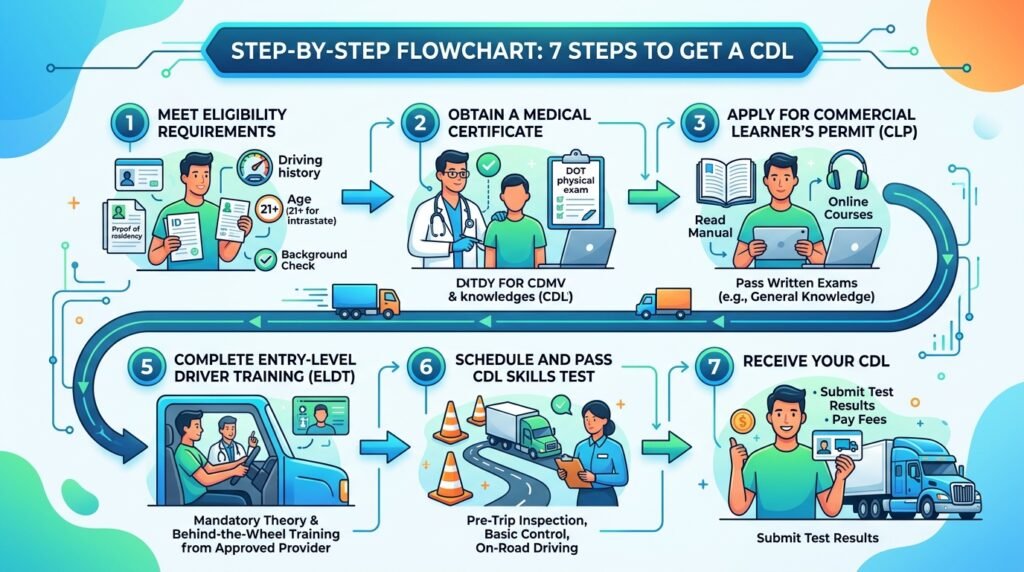
Here is the complete step by step breakdown of how to get a CDL. Follow these seven steps in order and you will have your license in hand.
Step 1 — Choose Your CDL Class
Your first decision is which CDL class matches your career goals.
A Class A CDL is the most versatile option. It qualifies you for the widest range of CDL jobs including long-haul trucking, flatbed hauling, and tanker driving. Most major trucking companies require Class A.
A Class B CDL fits drivers who want to operate straight trucks, city buses, school buses, or dump trucks. A Class C CDL covers smaller specialty vehicles.
If you are not sure which class to choose, read our guide on types of CDL licenses for a detailed comparison of what each class allows you to drive.
You may also want endorsements such as:
- H — Hazmat: Required to haul hazardous materials
- T — Doubles/Triples: Required to pull double or triple trailers
- P — Passenger: Required for passenger vehicles
- N — Tanker: Required for tanker vehicles
- S — School Bus: Required for school bus operation
Think about your ideal job first. Then pick the class and endorsements that match.
Step 2 — Pass the DOT Physical Exam
Your next step is to schedule and pass the DOT physical exam. Find a certified medical examiner using the FMCSA’s National Registry of Certified Medical Examiners (opens in new tab).
The exam typically costs between $75 and $150 based on available information. It takes about 30 to 60 minutes to complete.
Bring the following to your appointment:
- Photo ID
- List of all medications you take
- Glasses or contacts if you wear them
- Any relevant medical records (for conditions like diabetes or sleep apnea)
If you pass, the examiner gives you a CDL medical card. Hold onto this card because you will need it when you visit the DMV for your permit.
Step 3 — Get Your Commercial Learners Permit
The CDL permit test is a written knowledge exam you take at your local DMV. Passing it earns you a commercial learners permit (CLP).
The written test covers several subjects depending on your class:
- General knowledge — Required for all CDL classes
- Air brakes — Required if your vehicle has air brakes
- Combination vehicles — Required for Class A only
- Endorsement-specific tests — Required for any endorsements you add
The CLP requirements typically include:
- A valid driver license
- Your DOT medical card
- Proof of identity and state residency
- Social Security number
- Application fee (usually $10 to $50 depending on your state)
Study your state’s CDL manual thoroughly before test day. You can also sharpen your skills with a CDL practice test online to see real exam-style questions.
Once you pass, your commercial learners permit allows you to practice driving a commercial vehicle. You must always have a licensed CDL holder sitting in the passenger seat while you practice.
Read our full CDL permit guide for state-specific details and study strategies.
Step 4 — Complete Entry Level Driver Training
Since February 7, 2022, the federal government requires all new CDL applicants to complete entry level driver training (ELDT). The Federal Motor Carrier Safety Administration (FMCSA) enforces this rule nationwide.
ELDT applies to you if you are:
- Getting a Class A or Class B CDL for the first time
- Upgrading from a Class B to a Class A CDL
- Adding a hazmat (H), passenger (P), or school bus (S) endorsement
You must attend a training program listed on the FMCSA’s Training Provider Registry (opens in new tab). Training from unlisted providers does not count.
ELDT consists of two parts:
- Theory instruction — Classroom or online learning that covers vehicle systems, safety regulations, trip planning, and basic driving principles.
- Behind-the-wheel (BTW) training — Hands-on driving on a practice range and on public roads under instructor supervision.
The federal rule does not set a specific number of required training hours. Instead, your training provider determines when you have demonstrated proficiency in all required skills. Most full-time programs complete ELDT in 3 to 8 weeks.
After you finish, your training provider reports your completion to the Training Provider Registry. This unlocks your eligibility to take the CDL skills test. Find all the details in our ELDT requirements guide.
Step 5 — Practice Driving a Commercial Vehicle
Seat time behind the wheel is what separates confident drivers from nervous test-takers. Use every practice hour your program offers.
Focus your practice on these critical skills:
- Pre-trip vehicle inspection — Walking around the truck and identifying every component
- Straight-line backing — Keeping the trailer straight while reversing
- Offset backing — Backing into a space that is offset to your left or right
- Parallel parking (sight-side and blind-side)
- Coupling and uncoupling — Connecting and disconnecting a trailer (Class A)
- Shifting gears smoothly and at the right RPM
- Making safe turns — Especially right turns with wide trailer swing
- Lane changes and merging on highways
Most truck driving school programs include 40 to 160 hours of behind-the-wheel practice. The more time you spend in the driver seat, the more natural the skills become.
Step 6 — Pass the CDL Skills Test
The CDL skills test is your final exam. Some people call it the CDL road test. It has three separate parts, and you must pass all of them.
Part 1 — Pre-Trip Vehicle Inspection
You walk around your vehicle and explain each component to the examiner out loud. You need to demonstrate that you can identify problems before hitting the road.
Part 2 — Basic Controls Test
You perform backing maneuvers on a closed course or testing area. This includes straight-line backing, offset backing, and sometimes parallel parking. You lose points for hitting boundary markers, pull-ups, and encroachments.
Part 3 — On-Road Driving Test
You drive on public roads while the examiner evaluates your skills. They watch for proper turns, lane changes, mirror usage, speed control, and overall safe driving behavior.
If you fail one section, most states let you retake just that section without repeating the parts you passed. However, retake policies and fees vary by state.
Prepare thoroughly with our CDL road test guide for detailed scoring criteria and common mistakes.
Step 7 — Receive Your CDL
After you pass the CDL skills test, visit the DMV with your test results. Pay the license issuance fee and complete any remaining paperwork.
Your state will process your CDL and either hand you a temporary license or mail your permanent card. Congratulations — you are now a licensed commercial driver ready to hit the road.
Most CDL licenses are valid for 4 to 8 years depending on your state. You must renew before expiration and keep your DOT medical card current at all times.
How Much Does a CDL Cost
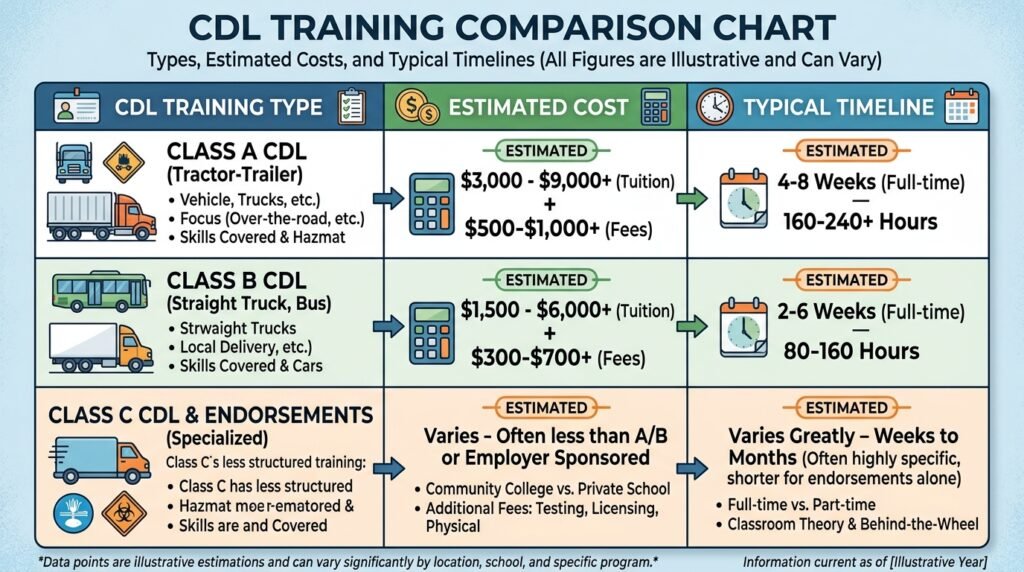
One of the first questions people ask is how much does a CDL cost. The answer depends on which training path you choose and which state you live in.
Here is a typical cost breakdown based on available information:
| Expense | Estimated Cost Range |
|---|---|
| DOT Physical Exam | $75 — $150 |
| CLP Application and Permit Fee | $10 — $50 |
| CDL Training Program (Private School) | $3,000 — $10,000 |
| CDL Skills Test Fee | $50 — $200 |
| CDL License Issuance Fee | $25 — $100 |
| Study Materials and Practice Tests | $0 — $50 |
| Total (with private school) | $3,160 — $10,550 |
Note: These are average estimates. Actual costs vary by state and provider. Check your local DMV and training schools for current 2026 pricing.
Several strategies can help you reduce or even eliminate training costs:
- Company-sponsored programs — Many trucking companies pay for your training in exchange for a work commitment of 1 to 2 years
- Community college CDL programs — Often priced between $1,500 and $5,000, significantly less than private schools
- Workforce development grants — State agencies sometimes fund CDL training for qualifying applicants
- GI Bill and veteran benefits — Military veterans can use education benefits at approved CDL programs
- Nonprofit organizations — Some groups offer subsidized or free training for disadvantaged populations
Get a complete price breakdown in our truck driving school cost guide. You can also explore our list of free CDL training programs if budget is your biggest concern.
How Long Does It Take to Get a CDL License
How long does it take to get a CDL? That depends on your schedule and training path.
| Training Path | Typical Timeline |
|---|---|
| Full-time private truck driving school | 3 — 8 weeks |
| Company-sponsored CDL program | 2 — 8 weeks |
| Community college CDL program | 8 — 16 weeks |
| Part-time CDL training | 2 — 6 months |
Most people who attend a full-time CDL training program complete the entire process in about 7 weeks. This includes time for the CDL permit test, classroom instruction, behind-the-wheel practice, and the CDL skills test.
The fastest route is an intensive, full-time truck driving school that runs five days per week. These programs move quickly through both theory and driving practice.
Part-time programs work better if you have a job, family, or other commitments that prevent you from attending full-time. They cover the same material but spread it across evenings and weekends over several months.
Keep in mind one key federal rule. You must hold your CLP for at least 14 days before you are eligible to take the CDL skills test. No exceptions.
Your timeline also depends on DMV scheduling in your area. Some states have longer wait times for skills test appointments. Book your test date as early as possible to avoid delays.
Can You Get a CDL Without Going to School
A common question is how to get a CDL license without going to school. The honest answer is that it has become much harder since 2022.
The ELDT rule that took effect on February 7, 2022, requires all first-time CDL applicants to complete training through a provider registered on the FMCSA Training Provider Registry (opens in new tab). You cannot simply study on your own and show up at the DMV for the skills test.
However, you still have flexible options:
- Company-sponsored training — Trucking companies like Werner, CRST, and Swift are registered ELDT providers. They train you on the job, and the training counts toward your requirement.
- Short accelerated programs — Some registered providers offer fast-track courses that last only 2 to 3 weeks.
- Individual instruction — A few registered training providers offer one-on-one training rather than large classroom settings.
The bottom line: you need some form of registered training. But you do not need a traditional 8-week school program. Explore all your options to find what fits your situation.
Exceptions to the ELDT Requirement
Certain groups are exempt from ELDT:
- Drivers who already held a valid CDL before February 7, 2022
- Military personnel with equivalent military vehicle training and experience
- Drivers who are only renewing or transferring an existing CDL without upgrading the class or adding certain endorsements
If you think you qualify for an exception, check our ELDT requirements guide for the complete list of exemptions.
Best CDL Training Programs to Consider
Your training program shapes your experience, your skills, and your test readiness. Choose carefully.
Private Truck Driving Schools
Private truck driving schools are the most popular option for new CDL applicants. They offer focused, intensive programs that typically last 3 to 8 weeks.
Pros:
- Fast completion time
- Dedicated instructors and modern equipment
- Most offer job placement assistance after graduation
Cons:
- Higher cost ($3,000 to $10,000)
- Quality varies significantly between schools
Research schools in your area using our best CDL schools guide. Look for schools with high pass rates, good student reviews, and proper ELDT registration.
Community College Programs
Many community colleges run CDL programs at lower price points, often between $1,500 and $5,000. These programs frequently qualify for federal financial aid and Pell Grants.
Community college programs usually take 8 to 16 weeks. They tend to offer thorough instruction and a structured learning environment. Check with your local college to see what CDL options they offer.
Company-Sponsored Training
Large trucking carriers offer free CDL training in exchange for a post-graduation work commitment. You agree to drive for the company for a set period, usually 1 to 2 years.
This is an excellent path if you want to get a CDL for free. You pay nothing upfront and go straight into a paying job after you earn your license.
One word of caution: read the contract thoroughly. Some companies charge back the cost of training if you leave before your commitment ends. Understand the terms before you sign.
Free CDL Training Options
Several sources offer free CDL training programs with no strings attached or with minimal obligations:
- Workforce Innovation and Opportunity Act (WIOA) programs — Funded by federal grants through your state’s workforce development agency
- State-specific job training programs — Many states run free or subsidized training programs for in-demand occupations including truck driving
- Veterans programs — VA benefits, Troops to Trucks, and similar initiatives help veterans earn a CDL at no cost
- Nonprofit organizations — Some groups fund CDL training for low-income applicants, returning citizens, or other underserved groups
Browse our complete list of free CDL training programs to find options near you.
State-Specific CDL Requirements
Every state follows the same federal CDL framework, but each state adds its own rules, fees, and procedures on top. Knowing your state’s specific CDL requirements saves you time and confusion.
For a full breakdown of rules across all 50 states, visit our CDL license requirements by state guide. Below are quick overviews for two of the most popular states for CDL applicants.
How to Get a CDL in Florida
Florida is a top state for commercial driving careers thanks to its busy ports, distribution centers, and year-round shipping routes.
To get a CDL in Florida, follow these general steps:
- Meet the minimum age of 18 (intrastate) or 21 (interstate)
- Hold a valid Florida driver license
- Pass the DOT physical exam and obtain your medical card
- Pass the Florida CDL knowledge test at a DMV office or authorized third-party testing site
- Complete ELDT from a registered training provider
- Pass the CDL skills test
- Pay the CDL license fee ($75) and receive your commercial driver license.
The Florida Department of Highway Safety and Motor Vehicles (FLHSMV) manages all CDL licensing. Florida has a large number of ELDT-registered truck driving school options across the state.
How to Get a CDL in Texas
Texas has one of the biggest trucking industries in the country. Getting a CDL in Texas opens doors to thousands of driving jobs.
To get a CDL in Texas, you generally need to:
- Meet the minimum age of 18 (intrastate) or 21 (interstate)
- Hold a valid Texas driver license
- Pass the DOT physical exam and receive your medical card
- Pass the CLP knowledge test at a Texas Department of Public Safety (DPS) office
- Complete ELDT through a registered training provider
- Pass the CDL skills test at a DPS-approved testing location
- Pay the CDL license fee ($97) and receive your commercial driver license.
Texas has hundreds of ELDT-registered CDL training programs spread across the state. The Texas DPS website lists approved testing locations and appointment scheduling.
Tip: Regardless of your state, always check your state’s official DMV or driver licensing agency website for the most current fees, documents, and procedures.
7 Tips to Pass Your CDL Tests on the First Try
Failing a CDL test costs you extra money, time, and stress. Use these tips to boost your chances of passing on your very first attempt.
1. Study the CDL manual cover to cover. Your state CDL manual is the single best study resource. Read it completely at least twice before your CDL permit test.
2. Take online practice tests repeatedly. Use a CDL practice test tool to quiz yourself. Keep practicing until you score 90% or higher consistently.
3. Master the pre-trip inspection by heart. Practice your inspection walk-around and verbal callouts until they become automatic. This is the section most people underestimate.
4. Log extra hours on backing maneuvers. The basic controls section of the CDL skills test trips up more test-takers than any other. Spend extra time on straight-line backing, offset backing, and parallel parking.
5. Drive the test area in advance. If possible, practice driving near the test route. Get familiar with the roads, intersections, speed limits, and tricky spots.
6. Exaggerate your mirror checks. Examiners watch your eyes. Turn your head visibly when checking mirrors so the examiner can clearly see that you are scanning properly.
7. Stay calm and drive smoothly. Speed is not the goal. Smooth, safe, and controlled driving impresses examiners. Talk yourself through each action if it helps you stay focused.
Common test-day mistakes to avoid:
- Skipping components during the pre-trip inspection
- Hitting cones or boundary lines during backing
- Rolling through stop signs
- Forgetting to signal before turns and lane changes
- Driving too fast in school zones or construction zones
- Failing to check mirrors before changing lanes
Our CDL road test guide breaks down exactly what examiners score and how to avoid the most common errors.
Frequently Asked Questions
Most people get a CDL in 3 to 8 weeks when they attend a full-time CDL training program. Part-time programs take 2 to 6 months. The overall timeline includes time for the CLP permit test, ELDT training, practice driving, and the CDL skills test. You must hold your CLP for at least 14 days before testing.
To get a CDL in Texas, visit a Texas DPS office to apply for your commercial learners permit. Pass the written knowledge test, complete ELDT at a registered training provider, and then pass the three-part CDL skills test. You must be at least 18 for intrastate or 21 for interstate driving. Check the Texas DPS website for current fees and appointment availability.
Earning a CDL takes dedication but it is achievable for most people. The written test requires focused studying, and the CDL road test requires real practice time behind the wheel. With proper training and preparation, most students pass. The backing maneuvers during the basic controls test tend to be the most challenging part for new drivers.
Since the ELDT rule took effect in 2022, you must complete training from a provider registered on the FMCSA Training Provider Registry. You cannot skip training entirely. However, company-sponsored programs, short accelerated courses, and one-on-one instruction offer alternatives to traditional truck driving school. These options satisfy the federal requirement while fitting different schedules and budgets.
The total CDL cost ranges from about $3,000 to $10,000 when you attend a private truck driving school. This figure includes the DOT physical, permit fees, training, testing, and license fees. Free CDL training programs, company sponsorships, and workforce grants can reduce or eliminate the cost. Community college programs typically cost less than private schools.
It depends on the vehicle’s weight rating. You need a CDL if the box truck’s GVWR exceeds 26,001 pounds. Many smaller box trucks fall under this limit and only require a standard driver license. Always check the truck’s weight rating sticker on the door frame to confirm whether a CDL is required.
Conclusion
Now you know exactly how to get a CDL from start to finish. The process comes down to seven clear steps: choose your class, pass the DOT physical exam, earn your CDL permit, complete ELDT training, practice driving, pass the CDL skills test, and collect your license.
The entire CDL process takes most people 4 to 16 weeks depending on the training path they choose. Costs range from free (through company sponsorships or grants) up to around $10,000 for private school programs.
A commercial driver license opens the door to a high-demand, well-paying career. Trucking companies across the country are hiring, and qualified drivers command strong pay and benefits. Your investment in time and training can pay for itself within the first few months on the job.
Ready to take the first step? Check the CDL license requirements for your state and start exploring CDL schools near you. Your career on the open road starts with a single decision to get moving.
Based on available information as of 2026. Requirements, fees, and procedures may change. Always verify current details with your state DMV and the FMCSA official website.
CDL Eligibility Checker Tool


![DOT Drug Test: What You Must Know in 2026 [Full Guide]](https://compliantdriversprogram.com/wp-content/uploads/2026/03/DOT-Drug-Test-150x150.jpeg)



Leave a Reply