

A single bad roadside inspection can spike your safety score overnight. That spike puts you on FMCSA’s watchlist, raises your insurance premiums, and scares away shippers. Most carriers never understand how the CSA scoring system actually works until the damage is already done.
This guide covers everything about your CSA score in trucking and your DOT safety rating. You will learn how the FMCSA calculates your score, which violations hurt the most, and how to look up your current rating. You will also get clear, proven steps to bring a bad score down.
Whether you are an owner-operator, a fleet manager, or a brand-new carrier, this guide is built for you.
Last updated: March 20, 2026
Key Takeaways
- Your CSA score comes from roadside inspections, crash reports, and investigation results over the past 24 months
- The FMCSA tracks 7 BASIC score categories, each ranked on a percentile from 0 to 100
- Lower percentile scores are better — higher scores trigger FMCSA intervention
- Your DOT safety rating (Satisfactory, Conditional, Unsatisfactory) is a separate system from your CSA score
- You can check your carrier safety score for free on the FMCSA SMS website
- Individual truck drivers can view their CSA history through a PSP report
What Is a CSA Score in Trucking?
CSA stands for Compliance, Safety, Accountability. The FMCSA created this program to measure how safely motor carriers operate on American roads.
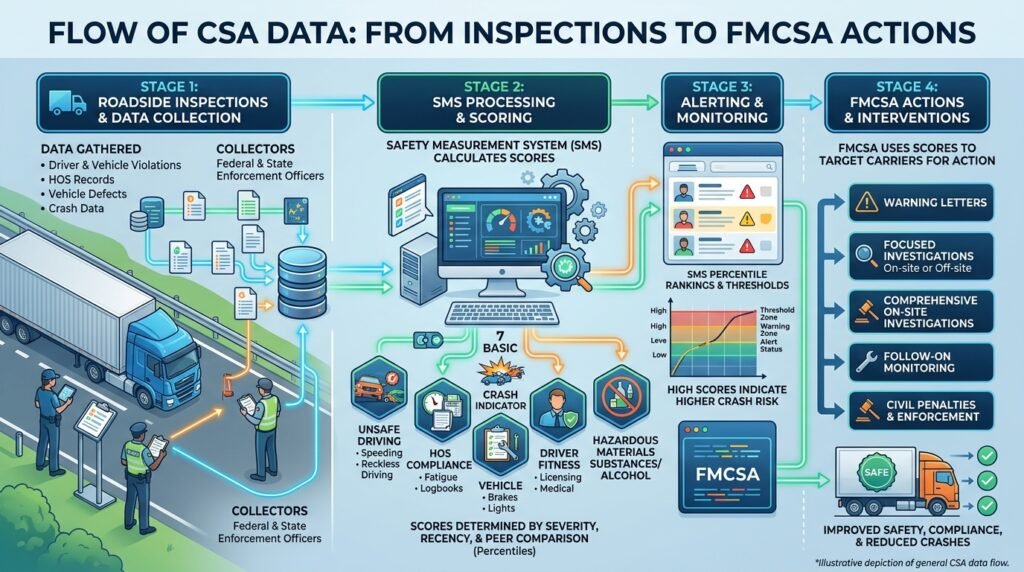
Your CSA score in trucking is built on real data. The FMCSA pulls information from DOT inspections at all levels, crash reports, and compliance reviews. It feeds that data into the Safety Measurement System (SMS). The SMS then calculates scores across seven safety categories called BASICs.
Every motor carrier with an active USDOT number receives CSA scores. Owner-operators get them too. The scores update once a month as new inspection and crash data enters the system.
Think of your CSA score as a safety report card. Strong scores keep regulators away. Weak scores invite warning letters, investigations, and even shutdown orders. Shippers and brokers also pull your scores before assigning you freight.
The CSA program applies to both CSA scores for trucking companies and CSA scores for truck drivers. Companies carry the scores on their USDOT profile. Individual drivers carry their history on a PSP report, which employers can access during the hiring process.
Breaking Down the FMCSA Safety Measurement System
The FMCSA SMS score is the engine behind the entire CSA program. It collects 24 months of safety data and ranks your carrier against similar peers. Understanding this system helps you manage your score instead of getting blindsided by it.
The 7 BASIC Score Categories
BASIC stands for Behavior Analysis and Safety Improvement Categories. The FMCSA tracks your performance across seven areas:
| BASIC Category | What It Measures |
|---|---|
| Unsafe Driving | Speeding, reckless driving, lane violations, seatbelt issues |
| Crash Indicator | Crash history, frequency, and severity patterns |
| Hours of Service (HOS) Compliance | Logbook violations, exceeding drive-time limits |
| Vehicle Maintenance | Brake defects, tire problems, lights, mechanical failures |
| Controlled Substances/Alcohol | Drug and alcohol test failures and related violations |
| Hazardous Materials Compliance | Improper handling, labeling, or transport of hazmat |
| Driver Fitness | Invalid CDL, expired medical certificates, unqualified drivers |
Each BASIC receives its own percentile ranking from 0 to 100. Your score shows where you stand compared to carriers of a similar size and inspection count.
How Percentile Rankings Are Calculated
The FMCSA does not simply count your violations. It weighs them by severity and age. Then it compares your weighted total against carriers with a similar number of inspections.
Here is the basic process:
- The FMCSA gathers your inspection results and crash records
- Each violation receives a severity weight based on its danger level
- Recent violations get a higher time-weight multiplier
- Your total weighted score is compared against peer carriers in your safety group
- You receive a percentile ranking from 0 to 100
Higher percentiles are worse. A score of 85 in Unsafe Driving means 85% of similar carriers performed better than you in that category.
The FMCSA sets intervention thresholds for each BASIC. Cross that threshold, and the agency may send warning letters, schedule investigations, or launch enforcement actions.
| BASIC Category | Intervention Threshold |
|---|---|
| Unsafe Driving | 65th percentile |
| Crash Indicator | 65th percentile |
| HOS Compliance | 65th percentile |
| Vehicle Maintenance | 80th percentile |
| Controlled Substances/Alcohol | 80th percentile |
| HM Compliance | 80th percentile |
| Driver Fitness | 80th percentile |
Confirm these intervention threshold percentiles match the current March 2026 FMCSA SMS methodology. As of early 2026, the standard intervention thresholds for general motor carriers under the FMCSA Safety Measurement System are:
- Unsafe Driving: 65th percentile
- HOS Compliance: 65th percentile
- Crash Indicator: 65th percentile
- Vehicle Maintenance: 80th percentile
- Controlled Substances/Alcohol: 80th percentile
- Driver Fitness: 80th percentile
- Hazardous Materials Compliance: 80th percentile
Carriers with scores at or above these percentiles in any BASIC are prioritized for FMCSA interventions such as warning letters, increased roadside inspections, and targeted or comprehensive safety investigations.
Notice that the three highest-risk categories – Unsafe Driving, Crash Indicator, and HOS – have lower thresholds. The FMCSA acts faster when it spots problems in those areas.
How CSA Points and Violation Weights Work
Not every violation damages your score equally. A missing fire extinguisher does not carry the same impact as texting behind the wheel. The FMCSA assigns CSA points to each violation based on how dangerous it is.
How Violation Severity Weights Work
Each violation discovered during a DOT inspection receives a violation weight from 1 to 10. Higher numbers mean greater safety risk.
Here are examples of common violations and their severity weights:
| Violation | Severity Weight | BASIC Category |
|---|---|---|
| Speeding 15+ mph over the limit | 10 | Unsafe Driving |
| Texting while driving | 10 | Unsafe Driving |
| Operating with a revoked CDL | 10 | Driver Fitness |
| Failing a drug or alcohol test | 10 | Controlled Substances |
| Driving beyond HOS limits | 7 | HOS Compliance |
| Inoperative brakes | 8 | Vehicle Maintenance |
| No valid medical certificate | 5 | Driver Fitness |
| Tire tread depth below minimum | 3 | Vehicle Maintenance |
| No fire extinguisher | 1 | Vehicle Maintenance |
Confirm these specific severity weight values against the current March 2026 FMCSA violation severity table.
As of early 2026, FMCSA continues to assign roadside inspection violations a severity weight from 1 to 10 within each BASIC, where 1 represents lower risk and 10 represents the highest risk relative to other violations in that same category. The most severe violations, such as texting while driving, operating with a revoked or suspended CDL, dangerous unsafe driving, and serious vehicle maintenance defects that result in out‑of‑service orders, typically carry the highest possible severity weights (10). Drug and alcohol test failures, critical Hours of Service violations, and improper hazardous materials handling also fall into the upper severity brackets.
For the exact weight of any specific violation code, always cross‑check the latest violation severity weight table on the FMCSA’s SMS or DataQs resources using your USDOT number.
Violations that trigger out-of-service orders receive an extra multiplier on top of their base weight. An OOS order means the problem was dangerous enough to pull the vehicle or driver off the road immediately. That multiplier makes the violation hit your carrier safety score even harder.
Certain CDL-related violations, such as operating without a valid license or driving with a suspended CDL, carry the maximum severity weight of 10. Drug and alcohol violations also sit at that top tier.
Time Weighting: Why Recent Violations Hurt More
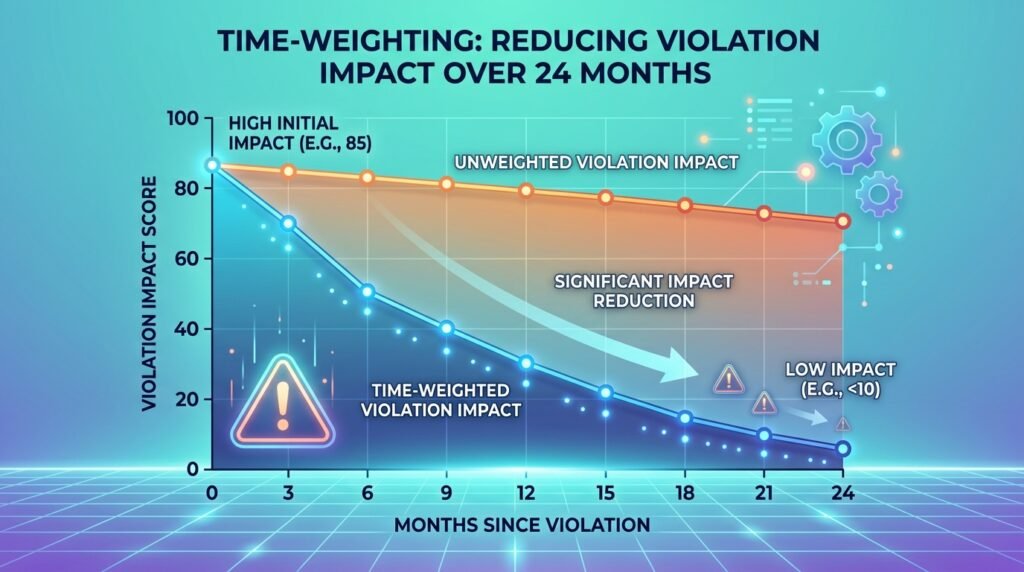
The FMCSA gives extra weight to newer violations. This design rewards carriers who clean up their safety performance over time.
Here is the time weighting breakdown:
- 0 to 6 months old: Violation counts at triple weight (multiplier of 3)
- 6 to 12 months old: Violation counts at double weight (multiplier of 2)
- 12 to 24 months old: Violation counts at base weight (multiplier of 1)
- Over 24 months old: Violation drops off your record completely
A speeding violation from last month damages your score three times more than the same violation from 18 months ago. Every clean month you add pushes older violations into lower-weight brackets.
The combination of severity weight and time weight creates your total violation score for each BASIC. The FMCSA adds up all your weighted violations, compares that total to your peer group, and assigns your percentile ranking.
DOT Safety Rating Explained
Your DOT safety rating is a separate evaluation from your CSA score. Many carriers confuse these two systems. They work differently and come from entirely different processes.
Three DOT Safety Rating Categories
The FMCSA assigns one of three ratings after it conducts a compliance review (CR) or safety audit:
- Satisfactory: Your company meets federal safety standards. You are clear to operate without restrictions.
- Conditional: Your company has safety management problems that need correction. You can still operate, but you are on notice.
- Unsatisfactory: Your company does not meet safety standards. You may receive a federal operations out-of-service order.
Many carriers also show a status of “Not Rated.” This simply means the FMCSA has not completed a full compliance review of your company yet. Most new carriers start with this status after finishing their initial audit.
How DOT Ratings Differ from CSA Scores
Your CSA score updates monthly based on inspection and crash data. Your DOT safety rating only changes after a formal FMCSA compliance review or audit.
You can hold strong CSA scores and still receive a Conditional DOT rating if your compliance review uncovers internal safety management failures. The reverse is also true. A carrier with a Satisfactory rating can still show high CSA percentile scores.
Both systems matter. Shippers and brokers often check your DOT safety rating and your CSA BASIC percentiles through the FMCSA SAFER web system and the Company Snapshot FMCSA tool.
Warning: A DOT safety rating of Unsatisfactory can result in a federal operations out-of-service order. This shuts down your authority until you fix the problems and pass a new compliance review.
You can view your current DOT safety rating by looking up your USDOT number on the FMCSA SAFER system (opens in new tab). This tool shows your DOT snapshot, including rating status, operating authority, and insurance details.
How to Check Your CSA Score
Checking your CSA score is free and takes just a few minutes. The process differs depending on whether you are looking up a company score or an individual truck driver CSA score.
CSA Score Lookup for Carriers
Follow these steps to check your company’s carrier safety score:
- Visit the FMCSA SMS website (opens in new tab)
- Enter your USDOT number or company name in the search bar
- Click on your company from the results list
- View your BASIC percentile scores across all seven categories
- Click into each BASIC to see the specific violations driving your score
The SMS website shows your current percentile rankings, the number of inspections on file, and which BASICs sit above the intervention threshold. You can also drill down into your full inspection and violation history.
You can also use the Company Snapshot FMCSA tool for a broader view of your safety profile. This includes your DOT safety rating, operating authority status, and insurance information. Access it through the FMCSA SAFER web portal mentioned above.
PSP Reports for Individual Truck Drivers
The SMS system shows carrier-level data. But what about individual drivers?
Drivers can check their personal safety history through a PSP report (Pre-Employment Screening Program). This report shows:
- Your roadside inspection history from the last 5 years
- Your crash history from the last 5 years
- The specific violations found during each inspection
Drivers can request their own PSP report through the FMCSA PSP website (opens in new tab). At the time of writing, the cost is typically around $10 per report.
Many carriers pull PSP reports during the hiring process. A clean report makes you a more attractive hire. A report loaded with violations may cause carriers to pass on your application.
Pro Tip: Check your own PSP report at least once a year. Look for errors. If you find incorrect violations, you can submit a DataQs challenge to the FMCSA to request a review and possible correction.
What Counts as a Good CSA Score?
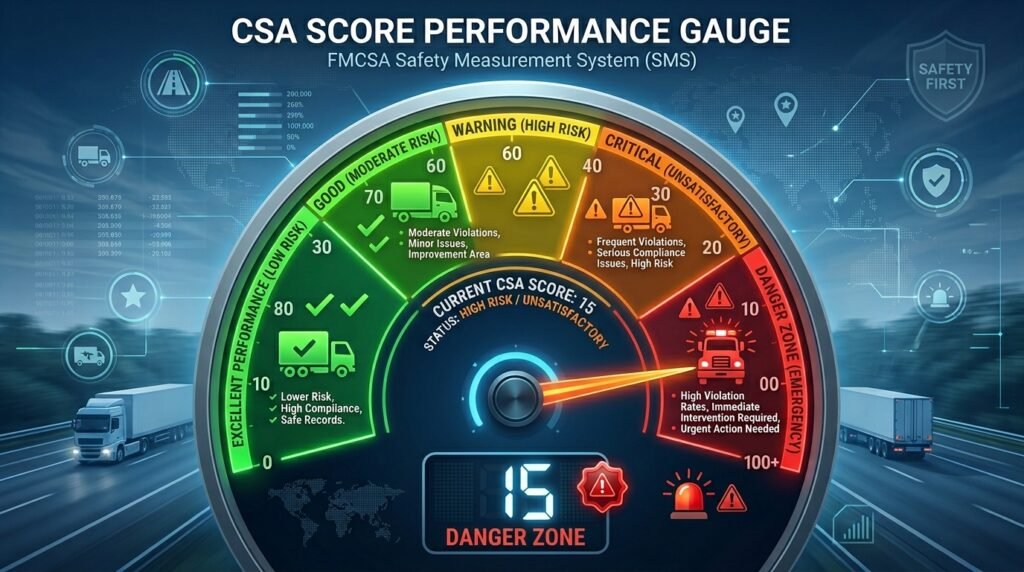
Since CSA scores use percentile rankings, lower numbers are better. A score of 0 means no violations on record. Any score below the intervention threshold is generally considered acceptable by the FMCSA.
Here is a general breakdown of score ranges:
| Score Range | What It Means |
|---|---|
| 0 to 25 percentile | Excellent — well below all intervention thresholds |
| 26 to 50 percentile | Good — performing better than the average carrier |
| 51 to 64 percentile | Watch zone — approaching thresholds for some BASICs |
| 65 to 79 percentile | Alert zone — above threshold for high-priority BASICs |
| 80 to 100 percentile | Danger zone — above threshold for all BASIC categories |
Keep in mind that different BASICs have different thresholds. A score of 70 in Vehicle Maintenance sits below that category’s 80th percentile threshold. But a score of 70 in Unsafe Driving sits above that category’s 65th percentile threshold.
The best carriers aim to keep all seven BASICs below the 50th percentile. This keeps them far from any intervention triggers. It also signals strong safety measurement performance to shippers, brokers, and insurance companies.
Your score also affects your ability to win freight contracts. Many large shippers refuse to work with carriers whose BASIC scores exceed internal limits. Some set their cutoff at the 50th or even 40th percentile.
7 Proven Ways to Improve Your CSA Score
A high CSA score is not permanent. The system uses a rolling 24-month window with time weighting. Your score can improve steadily with the right actions.
Here are seven strategies that work:
1. Fix Vehicle Maintenance Issues First
Vehicle Maintenance is the most common BASIC to score high in. Start a daily pre-trip and post-trip inspection program. Catch brake problems, tire issues, and lighting defects before a DOT inspector does. Document every repair.
2. Train Drivers on Roadside Inspection Procedures
Drivers who know what to expect during a DOT inspection perform better. Teach them to keep all documents organized and ready. Coach them to stay calm, be professional, and understand their rights during the process.
3. Build a Formal Fleet Safety Program
A structured fleet safety program creates accountability from top to bottom. It should include regular safety meetings, violation tracking by driver, coaching sessions, and corrective action plans. Companies with formal programs see their scores drop faster.
4. Challenge Incorrect Violations Through DataQs
Not every violation on your record is accurate. If you believe a violation was recorded in error, submit a challenge through the FMCSA DataQs system. A successful challenge removes the violation from your record and lowers your score.
Review every inspection report carefully. Look for wrong vehicle information, incorrect violation codes, or violations assigned to the wrong BASIC category.
5. Monitor Your Scores Monthly
Your FMCSA SMS score updates every month. Set a calendar reminder to check it. Look for rising trends in any BASIC. If one category is climbing, take corrective action before it crosses the intervention threshold.
6. Hire Drivers with Clean PSP Reports
Every driver you put on the road affects your company’s CSA score. Pull PSP reports during hiring. Avoid drivers with patterns of serious or repeated violations. One bad hire can spike your score across multiple BASICs.
7. Focus on High-Weight Violations
Not all improvements deliver equal results. Fixing a severity-10 violation has ten times the scoring impact of resolving a severity-1 issue. Target your highest-weight violations first for the fastest score drop.
The time weighting system works in your favor here. Every clean month you operate pushes older violations into lower-weight brackets. After 24 clean months, old violations disappear from your record completely.
How CSA Scores Impact Insurance and Business
Your CSA score directly hits your bottom line. Insurance companies, shippers, and brokers all use your safety data to make decisions about working with you.
Insurance Premium Effects
Insurance underwriters check your CSA BASIC scores when they calculate your commercial truck insurance cost. Higher scores signal higher risk. Higher risk means higher premiums.
Carriers with scores above intervention thresholds often pay significantly more for liability, cargo, and physical damage coverage. Some insurance companies refuse to write policies for carriers with extreme scores.
Improving your CSA score is one of the most effective ways to lower insurance costs over time. Even modest improvement across two or three BASICs can result in real premium reductions at your next renewal.
Freight and Contract Impacts
Many shippers and freight brokers set maximum CSA score thresholds in their carrier qualification standards. If your scores exceed their limits, you lose the load — no matter how competitive your rate is.
Large retailers, manufacturers, and third-party logistics companies (3PLs) routinely pull your DOT snapshot and BASIC scores before approving you. Keeping your scores clean opens doors to better-paying, more consistent freight.
FMCSA Enforcement Consequences
When your BASIC scores cross intervention thresholds, the FMCSA responds. The agency’s response escalates based on severity:
- Warning letter: The FMCSA notifies you that your score is above threshold
- Targeted investigation: An investigator may visit for a focused review of specific BASICs
- Comprehensive investigation: A full compliance review of your entire operation
- Cooperation agreement: You agree to specific corrective actions within a set deadline
- Operations out-of-service order: Your authority to operate is suspended
These consequences can devastate a business. An investigation alone takes significant time and resources to manage. An out-of-service order shuts down your trucks entirely until you resolve every issue.
Frequently Asked Questions
You can check your carrier CSA score for free on the FMCSA SMS website. Go to ai.fmcsa.dot.gov/SMS and enter your USDOT number to see all seven BASIC percentile rankings. Individual truck drivers can check their personal inspection and crash history by ordering a PSP report from psp.fmcsa.dot.gov. Based on available information, the PSP report costs a small fee per request.
A good CSA score is any percentile below the FMCSA intervention thresholds. For Unsafe Driving, Crash Indicator, and HOS Compliance, that means staying below the 65th percentile. For Vehicle Maintenance, Controlled Substances, HM Compliance, and Driver Fitness, stay below the 80th percentile. The strongest carriers keep all seven BASICs below the 50th percentile.
Focus on eliminating high-severity violations first. Build a strong vehicle maintenance program with daily inspections. Train drivers on proper inspection procedures. Challenge incorrect violations through the FMCSA DataQs system. Monitor your SMS score every month and address any rising BASIC immediately. Clean months push older violations into lower time-weight brackets automatically.
CSA BASIC percentile scores are assigned to the motor carrier, not the individual driver. However, each driver’s violations contribute to the company’s overall score. Individual drivers also have a personal safety record accessible through their PSP report. Many carriers review PSP reports when making hiring decisions.
Violations remain on your CSA record for 24 months from the date of the inspection. During that window, newer violations carry more weight than older ones because of the time weighting system. After 24 months, the violation drops off entirely and no longer affects your score.
Yes. If you believe a violation was recorded in error, submit a Request for Data Review through the FMCSA DataQs system. Include supporting documentation that explains why the violation is incorrect. If the reviewing state agency agrees, the violation may be removed or corrected on your record.
Conclusion
Your CSA score in trucking is one of the most important numbers in your business. It shapes your insurance costs, your access to quality freight, and your standing with the FMCSA. Understanding how the Safety Measurement System calculates your BASIC scores gives you the power to manage and improve them.
Start by checking your current carrier safety score on the FMCSA SMS website. Identify which BASICs rank highest. Focus your effort on violations with the greatest severity weights. Build a safety-first culture across your operation, and your numbers will follow.
A strong CSA score trucking profile protects your operating authority, your wallet, and your reputation. Take action today before a bad score takes those things away.
For more guidance on staying compliant and protecting your carrier authority, explore our full library of DOT compliance for trucking resources.
CSA Score Checker Tool







![DOT Drug Test: What You Must Know in 2026 [Full Guide]](https://compliantdriversprogram.com/wp-content/uploads/2026/03/DOT-Drug-Test-150x150.jpeg)



Leave a Reply