
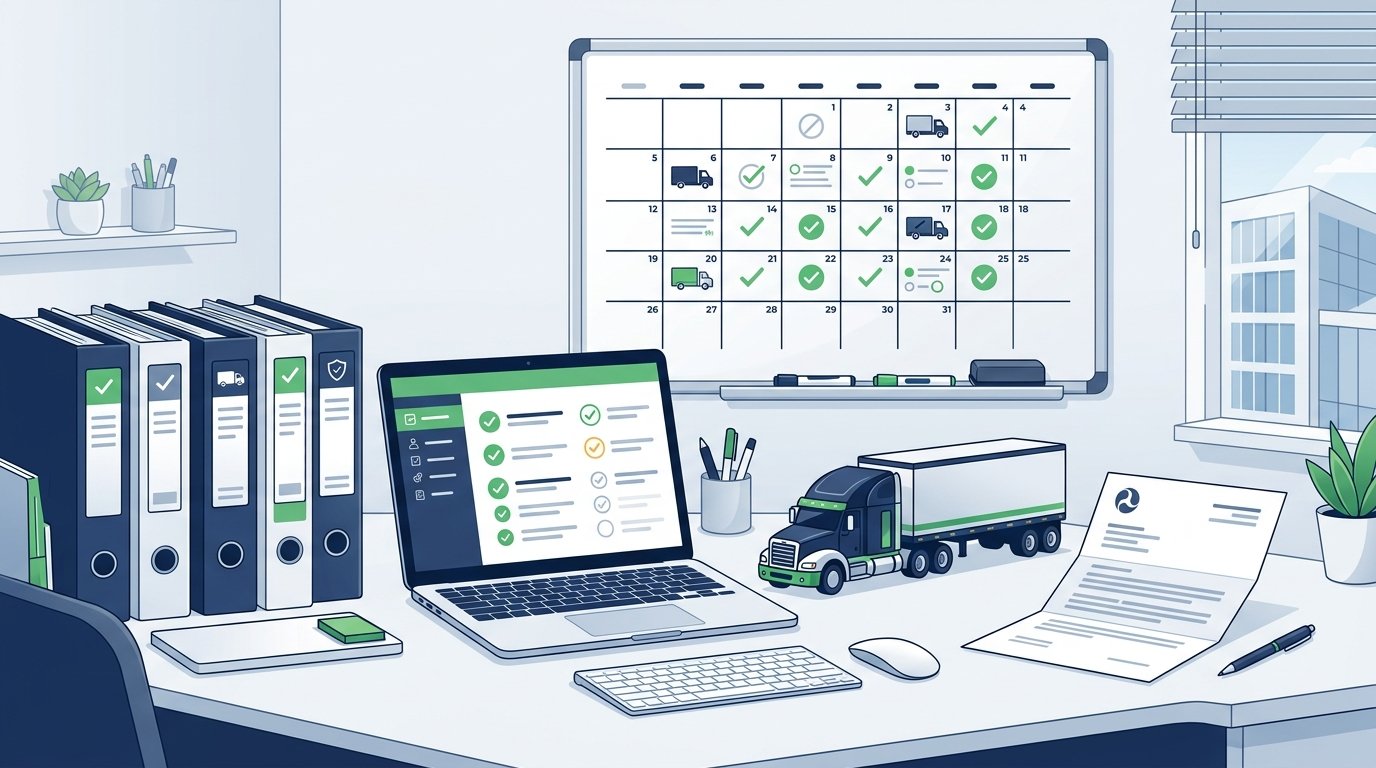
A single failed DOT audit can cost your trucking business tens of thousands of dollars. In the worst cases, it shuts your entire operation down overnight. Yet thousands of motor carriers still walk into their audit completely unprepared.
Whether you are a new carrier or a veteran fleet operator, a DOT audit is one of the biggest compliance events you will face. You need to know exactly what auditors review, which documents they request, and how to organize everything before they arrive. This guide gives you a clear, step-by-step plan for audit preparation in 2026. It covers checklists, fine amounts, common mistakes, and proven strategies to help you pass.
This article is written for owner-operators, fleet managers, safety directors, and anyone who holds an active DOT number.
Key Takeaways
- A DOT audit is a formal review of your compliance with federal motor carrier safety regulations.
- FMCSA can audit any carrier at any time — not just new entrants.
- Auditors check driver qualification files, HOS records, drug test results, and vehicle maintenance logs.
- Failing can lead to fines up to $16,000 per violation or a complete out-of-service order.
- Running a mock audit before the real one is the smartest way to prepare.
What Is a DOT Audit?
A DOT audit is a formal investigation of a motor carrier’s safety records and daily operations. The Federal Motor Carrier Safety Administration conducts these audits to confirm carriers follow federal safety rules.
During an audit, an FMCSA investigator visits your place of business. They review your documents, interview staff, and examine your safety management systems. The goal is to verify that you operate safely and meet all DOT regulations for truck drivers.
Think of it as a full report card for your trucking company. The auditor grades how well you manage your drivers, your vehicles, and your safety records.
Who Conducts These Reviews?
FMCSA investigators handle most federal DOT audits. State agencies may also perform audits on behalf of FMCSA. These auditors receive specific training to review every part of your operation.
You might receive advance notice before a DOT compliance review. Or the auditor could show up unannounced. Either way, you need records organized and current at all times. Waiting until you get a notice is already too late.
Types of DOT Compliance Reviews
As of March 2026, FMCSA continues to use the following primary audit types with no major name changes, though the Safety Measurement System (SMS) has undergone an overhaul: violations consolidated from 950+ to 116 groups, Vehicle Maintenance split into two categories (Driver Observed and Inspector-Detected), Controlled Substances/Alcohol merged into Unsafe Driving, scores based only on last 12 months, and refined thresholds (e.g., Driver Fitness at 90%).
- New Entrant Safety Audit: Required within first 12-18 months for new carriers.
- Compliance Review (CR): Thorough overall safety check.
- Focused Review: Targets specific areas like HOS or drug testing.
- Offsite Audit: Remote document submission.
FMCSA periodically refines programs via SMS updates, but core categories remain consistent for compliance reviews.
Each type of trucking audit follows a similar structure. The difference is the scope and depth of the review.

Why FMCSA Conducts Safety Reviews
FMCSA exists to reduce crashes, injuries, and deaths involving commercial motor vehicles. The FMCSA audit process is one of its strongest enforcement tools for keeping unsafe carriers off the road.
Here are the main reasons an audit gets triggered:
- New carrier monitoring — Every new entrant receives a safety audit within the first 18 months of operation.
- Poor safety record — High crash rates or excessive roadside inspection violations flag your company for review.
- Complaints — A complaint from the public, a shipper, or a driver can launch an investigation.
- Random selection — FMCSA may randomly select carriers for a compliance check.
- Follow-up — A previous audit finding may require a follow-up review to confirm corrections.
Your CSA score and DOT safety rating play a major role in whether you get selected. Carriers with high BASIC percentile scores face audits far more often than those with clean records.
New Entrant Audit Requirements
If you just received your operating authority, expect a new entrant safety audit. FMCSA uses this audit to decide whether your company can continue operating.
You must pass this audit to keep your authority active. Failing it means your DOT number could be revoked. Start your audit preparation on day one. Do not wait until the notice arrives in your mailbox.
Understanding FMCSA audit requirements early gives you the best chance of passing on the first try. Our full guide on new entrant safety audit requirements covers the entire process.
Key Areas Covered During a Compliance Check
A DOT compliance review examines six main safety categories. FMCSA calls these the Behavioral Analysis and Safety Improvement Categories (BASICs):
| BASIC Category | What Auditors Review |
|---|---|
| Unsafe Driving | Speeding, reckless driving, seatbelt violations |
| Hours of Service Compliance | ELD data, logbook records, rest period violations |
| Driver Fitness | Valid CDL, medical certificates, driver qualification files |
| Controlled Substances/Alcohol | Drug and alcohol testing program, results, Clearinghouse queries |
| Vehicle Maintenance | Inspection records, repair logs, annual inspection reports |
| Crash Indicator | Crash history, accident register entries |
Auditors typically review documents from the past 12 months at minimum. Some audits look back 24 to 36 months depending on the scope and severity of findings.
The DOT Compliance Review Process
Here is what to expect during a standard compliance review:
- You receive a notice letter or the auditor arrives unannounced at your terminal.
- The investigator explains the scope and purpose of the review.
- You provide all requested documents and records.
- The auditor reviews each record, checks for gaps, and may interview drivers or office staff.
- The investigator writes a detailed report with all findings.
- You receive a safety rating: Satisfactory, Conditional, or Unsatisfactory.
An Unsatisfactory rating is the worst outcome. It can lead directly to an out-of-service order. A Conditional rating means you have violations but can continue operating while you correct them within a given timeframe.
For a complete breakdown of DOT compliance for trucking requirements, check our dedicated guide.
Your Complete DOT Audit Checklist for 2026
Preparation is everything when it comes to passing your trucking audit. Use this DOT safety audit checklist to confirm you have every document organized before an auditor walks through your door.
Many carriers keep a printed or PDF copy of their checklist posted in the office. This keeps compliance top of mind for every team member.
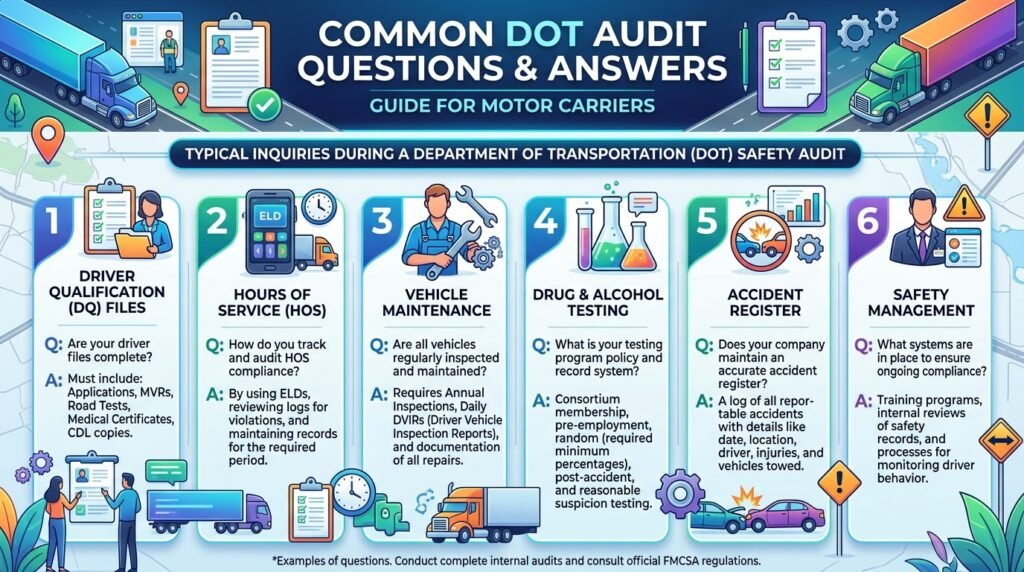
Driver Qualification Files
Every driver in your fleet needs a complete driver qualification file (DQF). Missing documents in these files are one of the top reasons carriers fail their DOT audit.
Each file must include:
- Completed employment application (going back 10 years of employment history)
- Motor vehicle record (MVR) pulled annually — see our MVR record check for CDL guide
- Road test certificate or equivalent documentation
- Copy of valid commercial driver’s license
- Current medical examiner’s certificate
- Annual review of driving record signed by a company official
- Previous employer safety performance history (past 3 years)
- List of traffic violations in the past 12 months signed by the driver
Our full driver qualification file guide breaks down each DQF requirement with examples.
Hours of Service and ELD Compliance
Hours of service (HOS) compliance is a major focus during any safety audit. Auditors pull your ELD data and compare it against supporting documents to look for violations.
Make sure you have:
- ELD records for all drivers (past 6 months minimum)
- Supporting documents for ELD data (fuel receipts, toll records, bills of lading, delivery receipts)
- Records of any HOS exemptions claimed
- Documentation of driver edits to ELD records with annotations
- Proof that all ELDs are registered on the FMCSA ELD registry
- Evidence your devices comply with current ELD mandate rules
Auditors compare ELD data against supporting documents to spot falsification. If the numbers do not match, you face serious penalties. Our ELD mandate guide explains all device and compliance requirements.

Drug and Alcohol Testing Program
Your drug and alcohol testing program must meet strict FMCSA standards. This is a zero-tolerance area during any safety audit DOT investigators conduct.
Required documents include:
- Written drug and alcohol testing policy distributed to all drivers
- Proof of random testing at required rates FMCSA random testing rates remain unchanged at 50% for drugs and 10% for alcohol, consistent for the sixth year since the 2020 increase.
- Pre-employment drug test results for every driver hired
- Records from the FMCSA Clearinghouse showing annual queries and pre-employment queries
- Documentation of reasonable suspicion training for supervisors (at least 60 minutes for drugs, 60 minutes for alcohol)
- Return-to-duty and follow-up testing records if applicable
- Consortium or third-party administrator (C/TPA) service agreement
Read our complete DOT drug test guide for full program requirements and testing procedures.
Vehicle Maintenance and Inspection Records
Your fleet maintenance records show auditors how seriously you take vehicle safety. Poor records raise immediate red flags during any compliance check.
Keep these documents organized and accessible:
- Annual vehicle inspection reports for every CMV in your fleet
- Driver vehicle inspection reports (DVIRs) from daily pre-trip and post-trip inspections
- Repair and maintenance records with dates, descriptions, and mechanic signatures
- Evidence that defects found during inspections were corrected before the vehicle returned to service
- Proof that all vehicles meet current DOT equipment standards
A thorough pre-trip inspection checklist helps your drivers catch and document issues daily.
Accident Register and Insurance Records
Federal regulations require you to maintain an accident register for the past 3 years. Each entry must include:
- Date of the accident
- City and state where it occurred
- Name of the driver involved
- Number of injuries and fatalities
- Whether hazardous materials were released
You also need current proof of financial responsibility (MCS-90 or BMC-91 filing) and your operating authority documentation. Our trucking authority guide covers insurance and authority requirements.
How to Prepare Step by Step
Knowing what auditors check is only half the battle. You also need a structured plan to get every document in order. Follow these audit preparation steps to get ready for your next trucking audit.
Run a Mock DOT Audit
A mock DOT audit is the single most effective preparation tool available. It simulates the real experience so you find and fix problems before the investigator does.
Here is how to run one:
- Assign a knowledgeable person to act as the auditor, or hire a compliance consultant.
- Pull every document listed in the checklist above.
- Review each file against current FMCSA audit requirements.
- Write down every gap, missing document, expired certificate, or error.
- Create an action plan to fix each issue with specific deadlines.
- Recheck everything after all corrections are made.
If you manage a larger fleet, consider building a fleet safety program that includes regular mock audits on a quarterly or semi-annual schedule.
Organize and Review Every Document
Paper files get lost in cabinets. Digital files scatter across hard drives and email inboxes. Pick one document management system and stick with it.
Follow these best practices for document review:
- Use clearly labeled folders for each driver and each vehicle.
- Maintain digital backups of all physical documents.
- Set calendar reminders for documents that expire (medical certificates, MVRs, annual vehicle inspections).
- Review all files quarterly. Do not wait until an audit notice arrives.
- Cross-reference your DOT compliance checklist against actual files every month.
Good DOT recordkeeping habits make audit day far less stressful and dramatically reduce your risk of failure.
Train Your Team on Compliance Basics
Your drivers and office staff should understand what a DOT audit involves. When everyone on your team knows the basics of compliance, fewer mistakes happen in daily operations.
Cover these topics in regular training sessions:
- How to complete DVIRs correctly and thoroughly
- HOS rules, common violations, and personal conveyance guidelines
- Your company drug and alcohol policy and testing procedures
- What to do and what to say if an auditor shows up at the terminal
Training does not need to be complicated. A 30-minute quarterly review keeps compliance fresh in everyone’s mind.
What Happens When You Fail?
Failing a DOT audit carries serious consequences. The severity depends on the type and number of violations the investigator finds.
Here is what can happen after a failed audit:
- Fines — Civil penalties assessed for each individual violation found.
- Conditional rating — You may continue operating but must correct violations within a set timeframe.
- Unsatisfactory rating — Severe or widespread violations that may result in a shutdown order.
- Out-of-service order — You must stop all operations immediately until every issue is resolved.
An out-of-service order is the worst-case scenario. It halts all operations on the spot. Your drivers cannot drive. Your trucks cannot move. Revenue stops completely until FMCSA lifts the order.
Common DOT Audit Fines and Penalties
FMCSA fines vary based on the violation type and severity. Here are common penalty ranges:
| Violation Type | Approximate Fine Range |
|---|---|
| Recordkeeping violations | $1,000 – $16,000 per violation |
| Hours of service violations | $1,200 – $16,000 per violation |
| Drug and alcohol program failures | $5,000 – $16,000 per violation |
| Operating after out-of-service order | Up to $32,208 per violation |
| Pattern of violations | Higher multiplied penalties |
FMCSA has adjusted civil penalties for inflation per 49 CFR Appendix B to Part 386. Key maximums relevant to DOT audits include: recordkeeping/HOS violations up to $19,246 per violation (carriers) or $4,812 (drivers); drug/alcohol program failures up to $19,246; operating after out-of-service up to $32,399; pattern violations subject to multipliers.
These numbers add up fast. A single audit with multiple violations across categories can produce total penalties exceeding $50,000. Our detailed guides on FMCSA fines and penalties and DOT fines explain current amounts and appeal options.
Warning: Penalties increase significantly for repeat violations. If FMCSA finds the same issues during a follow-up audit, fines can double or triple. Fix violations the first time.
5 Tips to Pass Your Safety Audit With Confidence
You do not need to fear a DOT audit if you build the right habits. These five strategies keep your operation audit-ready all year long.
1. Treat every day like audit day. Keep records current at all times. Carriers that scramble to organize files after getting a notice are the ones that fail.
2. Stay on top of driver qualification files. Missing or expired DQF documents are the single most common audit failure point. Check every file at least once a month.
3. Monitor your CSA scores regularly. Your BASIC scores on the FMCSA Safety Measurement System show you exactly which areas auditors will focus on. High percentiles in any category make you a target.
4. Fix roadside inspection violations immediately. Every DOT inspection result feeds directly into your safety record. Unresolved violations stack up and trigger audits.
5. Invest in compliance help. If you operate five or more trucks, consider hiring a compliance consultant or purchasing compliance management software. The cost of professional help is far less than the cost of failing an audit.
Connecticut DOT Overtime Audit: A Special Case
Some readers search for the Connecticut DOT overtime audit. This is a different type of review that focuses on state-level operations rather than federal FMCSA compliance rules.
The Connecticut DOT has faced audits related to internal overtime practices for state employees. These reviews examine how overtime hours are tracked, approved, and paid within the state DOT agency itself.
No specific Connecticut DOT overtime audit details or findings appear in recent publications for 2025-2026. Available reports focus on traffic safety performance targets, work zone speed control program progress, and overall traffic fatality declines (274 in 2025 vs. 312 in 2024), with no mention of overtime-related internal audits.
This type of audit does not apply to private motor carriers or trucking companies. If you are a carrier, your focus should remain on the federal DOT audit and FMCSA compliance review process described throughout this guide.
Frequently Asked Questions
Start by gathering every required document: driver qualification files, HOS and ELD records, drug and alcohol testing records, vehicle maintenance logs, and your accident register. Run a mock audit to find gaps. Fix every issue before the real investigator arrives. Build a system that keeps you organized year-round so you are always ready.
A DOT audit checklist is a complete list of all the documents and records that FMCSA investigators review during an audit. It covers driver files, ELD data, drug test results, maintenance records, insurance documentation, and accident records. Use the detailed checklist in this guide to make sure nothing is missing from your files.
A DOT audit checks your compliance with federal motor carrier safety regulations across six main areas: unsafe driving records, hours of service compliance, driver fitness, controlled substance and alcohol testing, vehicle maintenance, and crash history. Investigators want to confirm that you run a safe, compliant operation.
You may receive a Conditional or Unsatisfactory safety rating. Fines can range from $1,000 to more than $16,000 per individual violation. In severe cases, FMCSA issues an out-of-service order that forces you to stop all operations until you resolve every problem. Repeat offenders face even steeper penalties.
There is no fixed schedule. FMCSA can audit your company at any time. New entrant carriers get audited within 18 months of receiving authority. After that, audits happen based on your safety record, public complaints, or random selection. Carriers with poor CSA scores face more frequent reviews.
Yes. If you receive a Conditional or Unsatisfactory rating, you can request an upgrade review from FMCSA. You must first correct all cited violations and submit supporting documentation proving the improvements. FMCSA then decides whether to upgrade your rating. Based on available information, this process can take several months to complete.
Conclusion
A DOT audit does not have to be a crisis. When you know what to expect and prepare your documents well in advance, you put yourself in the strongest position to pass.
Start with the complete checklist in this guide. Run a mock audit. Fix every gap before an FMCSA investigator finds them. Keep your driver qualification files, ELD records, drug testing program, and vehicle maintenance logs organized and current throughout the year.
The carriers that pass their DOT audit every time are the ones that treat compliance as a daily habit rather than a last-minute scramble. Stay proactive and build strong recordkeeping systems. Your next audit will be a routine event instead of an emergency.
For more help strengthening your compliance program, explore our guide on DOT compliance for trucking and start building the systems that keep you audit-ready 365 days a year.
Audit Preparation Checklist







![DOT Drug Test: What You Must Know in 2026 [Full Guide]](https://compliantdriversprogram.com/wp-content/uploads/2026/03/DOT-Drug-Test-150x150.jpeg)



Leave a Reply