
A single ticket on your driving record can cost you a trucking job. Every year, thousands of CDL holders lose job offers because of what shows up on their MVR. Knowing what is on your motor vehicle record — and how to fix problems — gives you a real edge over other drivers.
An MVR record check is one of the most critical steps in CDL driver hiring and compliance. Employers use this report to review your complete driving history before they let you operate a commercial vehicle. The DOT also requires carriers to pull a fresh MVR for every driver at least once a year.
This guide explains everything CDL drivers need to know about MVR records in 2026. You will learn what an MVR shows, why employers check it, how the DOT annual review works, and how to get your own copy. Your MVR is a key document inside your driver qualification file, which every carrier must maintain under federal law.
Key Takeaways
- An MVR record shows your complete driving history pulled from the state DMV.
- DOT requires employers to run MVR checks on CDL drivers at least once every 12 months.
- Violations, accidents, suspensions, and license status all appear on your MVR.
- You can request your own MVR to catch errors before an employer pulls it.
- A clean MVR helps you land better trucking jobs and pay lower insurance rates.
What Is an MVR Record for CDL Drivers?
MVR stands for motor vehicle record. It is a document from your state DMV that shows your driving history. This includes every license you have held, tickets you have received, accidents on file, and any suspensions or revocations.
For CDL drivers, the MVR carries extra weight. The Federal Motor Carrier Safety Administration (FMCSA) requires carriers to check the MVR of every commercial driver they employ. This is not optional. It is a federal rule under 49 CFR Part 391.
Your MVR covers activity in the state where your license was issued. If you held licenses in multiple states, employers may need to pull records from each one.
Think of your MVR as your driving report card. It tells employers whether you are a safe, reliable driver or a potential risk on the road.
MVR vs. PSP Report — What Is the Difference?
Many drivers mix up the MVR with the Pre-Employment Screening Program (PSP) report. They are not the same thing.
Your MVR comes from the state DMV. It shows state-level records like tickets, points, and license status.
A PSP report comes from the FMCSA. It shows federal-level data, including DOT inspection results and crash records.
| Feature | MVR | PSP Report |
|---|---|---|
| Source | State DMV | FMCSA |
| Content | Tickets, points, license status | DOT inspections, crash data |
| Time period | Varies by state (3-10 years) | 5 years of crashes, 3 years of inspections |
| Cost | Typically $5-$25 per state | $10 per report |
| Required by DOT annually? | Yes | No, but commonly used at hiring |
Both reports matter for your CDL career. But the MVR is the one DOT specifically requires employers to check every year.

Why Employers Run Driving Record Checks
Carriers check your driving record for three main reasons: legal compliance, safety, and insurance.
DOT Legal Requirements
Federal law requires motor carriers to check the MVR of every CDL driver. This applies at two key points:
- Before hiring — Employers must review your driving record from every state where you held a license in the past three years (49 CFR 391.23).
- Every 12 months after hire — Employers must pull a new MVR for each driver at least once per year (49 CFR 391.25).
If a carrier fails to complete these checks, they face serious penalties during a DOT audit. Missing MVR records are one of the most common audit findings.
Safety and Risk Management
Your MVR tells an employer how you behave behind the wheel. A record full of speeding tickets, at-fault crashes, or DUI charges sends a clear warning. The employer takes on liability every time they let a driver operate a commercial vehicle.
Carriers with too many risky drivers see their CSA scores climb. High CSA scores bring more DOT inspections. They can also threaten a carrier’s operating authority.
Insurance Requirements
Insurance companies pull MVRs too. They use your driving history to set premium rates. A driver with multiple violations costs more to insure. Some insurance providers will refuse to cover drivers with major offenses on their record.
If you have a rough driving history, you may need insurance for a bad driving record, which almost always comes at a higher price.
What Shows Up on a Motor Vehicle Record?
Your MVR contains detailed information about your driving history. Here is what employers and insurers typically see when they pull the report.
- Traffic violations — Speeding tickets, running red lights, improper lane changes, and other moving violations all appear.
- Accidents — Any crash reported to the DMV shows up. This includes at-fault and sometimes not-at-fault incidents, depending on the state.
- License status — Your MVR shows whether your license is valid, suspended, revoked, or expired. For CDL holders, it also displays endorsements like HazMat, tanker, or doubles/triples.
- Points — Many states use a point system. Your MVR shows how many points you have and when they were added.
- DUI/DWI offenses — These are among the most damaging entries on any MVR. A DUI with a CDL can end a commercial driving career entirely.
- Suspensions and revocations — Any past suspensions or revocations appear along with the reason and dates.
- CDL disqualifications — Federal disqualifications for serious or major violations show on your record. Our guide on CDL disqualifications explains how these work.
How Far Back Does an MVR Go?
This depends on your state. Most states show the last three to five years of driving history on a standard MVR. Some states report seven or even ten years.
| Time Period | What Typically Appears |
|---|---|
| 3 years | Standard moving violations, minor accidents |
| 5 years | Major violations, DUI/DWI, suspensions |
| 7-10 years | Some states retain serious offenses this long |
| Lifetime | A few states keep DUI and felony driving records permanently |
3-10 years, varies by state: most show 3-5 years for standard MVR (e.g., CA: 3 years, TX: 7 years for serious violations, NY: 5 years). DUI often 7-10+ years or lifetime in some states. Check your state DMV website for exact policy.
Employers running a driving record check for DOT purposes usually pull the standard MVR. But they can request an extended history if the state offers one. Always check your state DMV website for exact details.
Annual Review of Driving Record — DOT Requirements
The annual review of driving record is a DOT requirement every motor carrier must follow. It falls under 49 CFR 391.25, which spells out the exact obligations.
What 49 CFR 391.25 Requires
Each year, the motor carrier must complete the following steps:
- Pull a current MVR for every CDL driver from each state where the driver held a license during the past year.
- Review the MVR for any new violations or changes in license status.
- Have a designated carrier official review and sign off on the record.
- Place the reviewed MVR in the driver’s qualification file.
- Take appropriate action on any problems found, such as retraining, counseling, or termination.
This process is not a suggestion. It is a legal requirement. Carriers who skip it face fines, poor audit results, and increased liability if a driver causes a crash. Understanding DOT compliance for trucking starts with getting the annual review right.
What Happens If an Employer Skips the Annual Review?
If a carrier does not complete the annual MVR check, several consequences can follow:
- DOT audit failure — Missing annual reviews are a red flag during any compliance audit. This can result in fines or a conditional safety rating.
- Increased liability — If a driver with a bad record causes a crash, the carrier faces massive legal exposure for not catching the problem earlier.
- Higher CSA scores — Compliance failures raise a carrier’s safety scores and bring extra scrutiny from FMCSA.
Proper DOT recordkeeping includes maintaining current MVR reviews for every active driver on the roster.
The Employer’s Review Process
The annual review is more than just pulling a report and dropping it in a file. The carrier must evaluate the MVR. The reviewing official must decide whether the driver still meets minimum safety qualifications.
If the MVR shows serious violations, the carrier must determine whether the driver can safely continue operating a commercial vehicle. This decision must be documented and kept on file for future reference. There is no standard form for this, but many carriers use the FMCSA’s suggested format.
How to Get Your MVR for CDL Purposes
You do not have to wait for an employer to pull your MVR. You can get your own copy at any time. In fact, checking your own record before applying for a trucking job is one of the smartest things you can do.
Step-by-Step Process to Request Your MVR
- Visit your state DMV website. Every state DMV offers MVR requests. Some states call it a “driving record” or “driver history report.”
- Choose the report type. Most states offer a standard (3-year) or complete (5-10 year) record. For CDL purposes, get the most complete version available.
- Submit your request. You can usually do this online, in person, or by mail. Online is the fastest method.
- Pay the fee. Fees vary by state. Most charge between $5 and $25.
- Review the report carefully. Check every entry. Look for errors, outdated information, or violations you do not recognize.
Where to Request Your MVR
Each state handles MVR requests differently. Here are the most common options:
- Online — Most states allow you to order your MVR through their official DMV website. Results often arrive within minutes.
- In person — Visit your local DMV office with your driver’s license and payment.
- By mail — Some states accept mailed requests with a completed form and a check or money order. This takes the longest, usually 5 to 15 business days.
Important: If you held a CDL in more than one state over the past three years, you may need to request an MVR from each state. Employers are required to do this under DOT rules, and you should do the same to stay ahead of any surprises.
MVR Check Costs and Processing Times
The cost of getting an MVR varies from state to state. Some charge as little as a few dollars. Others charge $25 or more for a complete history.
| State (Example) | Standard MVR Cost | Complete MVR Cost | Online Available? |
|---|---|---|---|
| Texas | $8.00 | $12.00 certified | Yes |
| California | $5.00 | $10.00 | Yes |
| Florida | $8.00 | $10.00 | Yes |
| Ohio | $5.00 | $8.00 | Yes |
| Pennsylvania | $13.00 | $16.00 | Yes |
| Illinois | $6.00 | $9.00 | Yes |
Fees shown are approximate and subject to change. Always check your state DMV website for current pricing.
Processing times depend on how you submit your request:
- Online requests — Instant to 24 hours in most states
- In-person requests — Same day at most DMV offices
- Mail requests — 5 to 15 business days
Employers who need to run MVR checks on multiple CDL drivers often use third-party screening services. These services pull motor vehicle records from all 50 states through a single platform. This saves time, especially for large fleets with drivers licensed in different states.
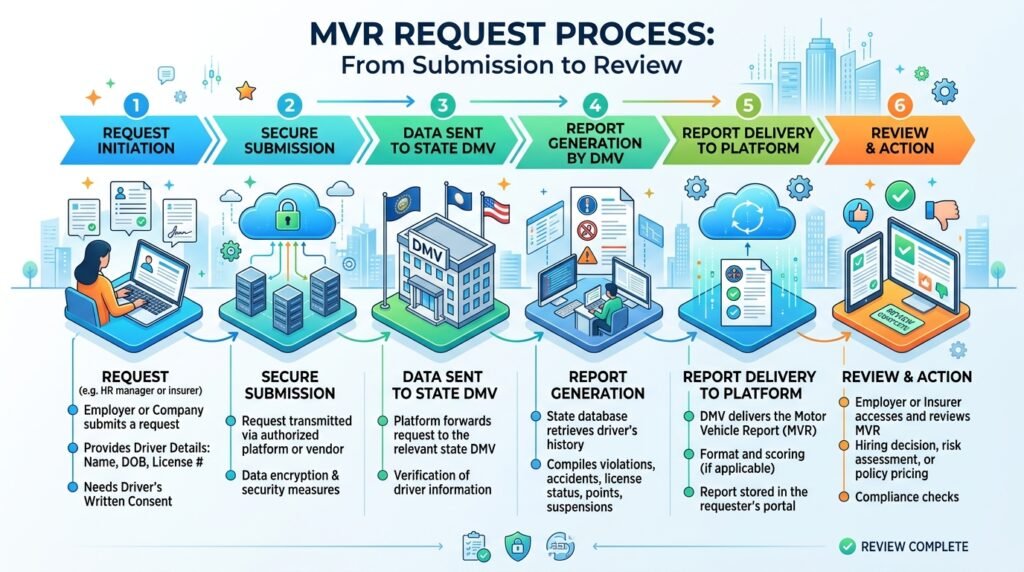
How MVR Violations Affect Your CDL Career
Not all violations carry the same weight. Some are minor issues that add points to your record. Others can permanently disqualify you from holding a CDL.
Minor Violations on Your MVR
Minor violations include offenses like:
- Speeding (under 15 mph over the limit in a CMV)
- Improper lane changes
- Following too closely (when not classified as serious)
- Minor equipment violations
These violations add points to your license and show up on your MVR. They may not disqualify you from driving. But they do add up. Too many minor violations within a short period make employers hesitate before hiring you.
Keep in mind that a speeding ticket with a CDL carries more consequences than the same ticket on a regular license. CDL holders are held to a higher standard.
Serious Traffic Violations for CDL Holders
The FMCSA defines specific offenses as “serious” for CDL drivers. According to FMCSA regulations, these include:
- Speeding 15 mph or more over the posted limit
- Reckless driving
- Improper or erratic lane changes
- Following too closely
- Driving a CMV without a valid CDL in possession
- Driving a CMV without the correct class or endorsement
Two serious violations within a three-year period result in a 60-day CDL disqualification. Three serious violations within three years trigger a 120-day disqualification.
Our detailed CDL violations guide breaks down each offense and its consequences.
Major Violations That Can End Your Career
Major violations lead to automatic CDL disqualification. The FMCSA lists these offenses as career-ending:
- DUI or DWI in any vehicle, commercial or personal
- Leaving the scene of an accident (hit and run)
- Using a CMV to commit a felony
- Driving a CMV while your CDL is revoked, suspended, or canceled
- Causing a fatality through negligent vehicle operation
- Operating a CMV with a BAC of 0.04% or higher
A first major violation results in a one-year disqualification. A second major violation means lifetime disqualification. These show up on your MVR and are visible to every employer who runs a check.
The NHTSA works alongside the FMCSA to track crash data and enforce safety standards that directly affect CDL drivers.
5 Ways to Keep Your Driving Record Clean
Your MVR follows you throughout your entire trucking career. Protecting it is one of the best investments you can make. Here are five proven strategies.
1. Obey traffic laws every single time.
This sounds basic. But carelessness is the top reason drivers pick up violations. Slow down. Use your signals. Maintain safe following distances. One moment of impatience can mark your record for years.
2. Contest tickets you believe are unfair.
Not every citation is deserved. If you believe a ticket was issued incorrectly, fight it in court. A dismissed ticket does not appear as a conviction on your MVR. This effort can save your record and your career.
3. Complete a defensive driving course.
Some states allow drivers to remove points from their record by finishing an approved defensive driving program. Check with your state DMV for available courses and eligibility requirements.
4. Pull your own MVR at least once a year.
Errors happen more often than you think. A violation from another driver with a similar name could end up on your record by mistake. Review your MVR regularly and dispute any inaccuracies right away.
5. Stay current on all CDL requirements.
An expired medical certificate, a lapsed endorsement, or a missed renewal deadline can trigger a license downgrade or suspension. This shows up on your MVR immediately. Follow our CDL renewal guide to keep everything up to date.
Pro Tip: Set a calendar reminder to check your MVR about three months before your employer’s annual DOT review. This gives you enough time to dispute errors or take corrective action before the carrier pulls your report.
MVR Records and Trucking Insurance
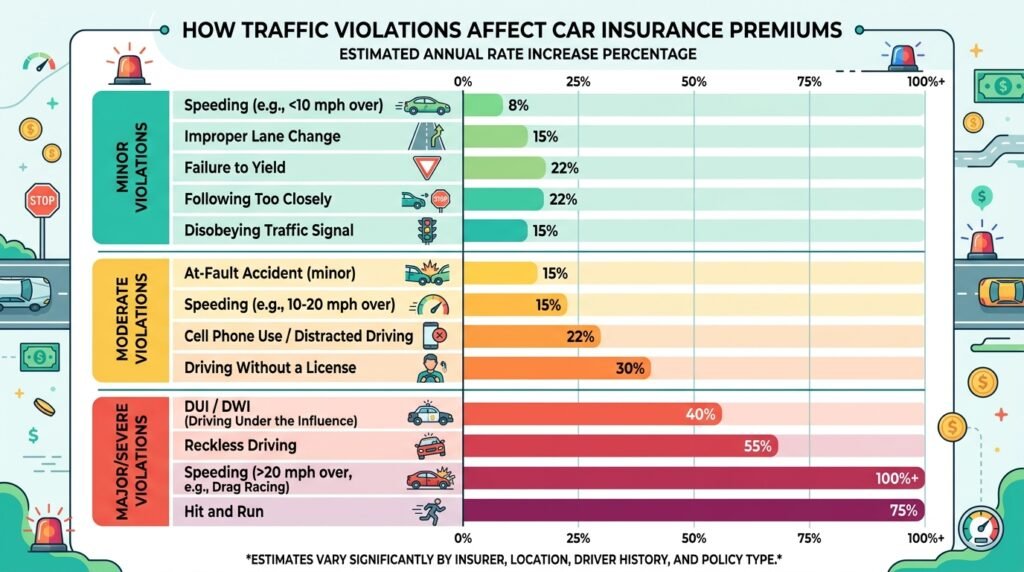
Your MVR directly influences your insurance costs. Insurance companies review your driving history when setting premium rates for both personal and commercial coverage.
Drivers with clean MVRs pay lower premiums. Drivers with violations, at-fault accidents, or DUI convictions pay significantly more. In some cases, carriers cannot add a driver to their commercial policy at all because of the entries on that driver’s MVR.
If your record has problems, you may be classified as a high-risk driver. This means you will likely need high-risk auto insurance, which comes with higher premiums and fewer provider options.
What Insurance Companies Focus on in Your MVR
Insurance underwriters pay close attention to these entries:
- At-fault accidents — These are the biggest red flags for any insurer.
- DUI/DWI convictions — These can make you uninsurable with standard carriers.
- Multiple speeding tickets — A pattern of speeding signals risky driving behavior.
- License suspensions — Any history of suspension raises serious concerns.
- Reckless driving charges — These tell insurers the driver makes dangerous decisions.
The good news is that most violations affect your insurance rates for only three to five years. After that window, they age off your active record in most states. Until then, keeping a clean record going forward is the best way to bring rates back down.
Frequently Asked Questions
An MVR record check for CDL drivers is a review of your state-issued driving history. Employers pull this report from the DMV to view your violations, accidents, license status, and suspensions. The DOT requires this check before hiring and at least once every 12 months after that.
Under 49 CFR 391.25, employers must check each CDL driver’s MVR at least once every 12 months. They must also pull it before hiring a new driver. The reviewed MVR must be placed in the driver’s qualification file with a signed review.
Yes. You can request your own motor vehicle record from your state DMV at any time. This is a smart step before submitting job applications. It lets you catch errors and address problems before an employer sees them.
Costs vary by state. Most states charge between $5 and $25 for a standard driving history report. A few states offer free annual MVR access to the driver themselves. Check your state DMV website for current fees and ordering options.
This depends on your state. Most states display three to five years of driving history on a standard MVR. Some states retain serious offenses like DUI for seven to ten years. A few states keep certain felony driving offenses on file permanently.
Contact your state DMV immediately to start a dispute. You will need to provide documentation that proves the error. Common mistakes include violations from another driver with a similar name or records from a state where you never held a license. Most states have a formal process to correct inaccurate entries.
Conclusion
Your MVR record is the backbone of your CDL career. It tells employers, insurers, and regulators exactly how you perform behind the wheel. A clean record opens doors to better jobs, lower insurance costs, and fewer compliance headaches. A bad record does the opposite.
Understanding what appears on your motor vehicle record and taking steps to protect it gives you a real advantage. Pull your own MVR at least once a year. Fight tickets that are not deserved. Stay current on your CDL requirements and medical certifications. These habits protect both your career and your income.
The annual driving record DOT review is not going away. Every carrier must complete it, and every CDL driver should prepare for it. Make sure your MVR record is accurate and clean before your employer pulls it.
If you need help understanding your full compliance picture, explore our DOT regulations for truck drivers resources. Your MVR record as a CDL holder is your professional reputation on paper. Treat it that way.
Based on available information as of 2026. Regulations and fees may change. Always verify current requirements on official government websites.
MVR Status Checker







![DOT Drug Test: What You Must Know in 2026 [Full Guide]](https://compliantdriversprogram.com/wp-content/uploads/2026/03/DOT-Drug-Test-150x150.jpeg)



Leave a Reply