

The FMCSA Clearinghouse is the single most important electronic database every commercial driver and motor carrier employer needs to understand in 2025 and beyond. Since its launch in January 2020, the Federal Motor Carrier Safety Administration’s Drug and Alcohol Clearinghouse has fundamentally changed how DOT drug test violations are recorded, reported, and accessed across the trucking industry.
Whether you hold a Commercial Driver’s License (CDL), manage a fleet of ten trucks, or oversee compliance for a large carrier, this guide breaks down everything you need to know — from registration and login to employer queries, violation reporting, and the return-to-duty process. We have updated every section to reflect the latest Clearinghouse II final rule changes taking effect through 2025 and 2026.
What Is the FMCSA Drug and Alcohol Clearinghouse?
The drug and alcohol clearinghouse is a secure, online database operated by the Federal Motor Carrier Safety Administration (FMCSA). It serves as a centralized violation database where drug and alcohol program violations committed by CDL holders are recorded and made accessible to current and prospective employers.
Before the Clearinghouse existed, a driver who tested positive for drugs with one employer could simply move to a different state, apply with a new carrier, and start driving again — often without anyone knowing about the previous violation. The system was fragmented, paper-based, and riddled with gaps that put the traveling public at risk.
The CDL Drug and Alcohol Clearinghouse closed those gaps permanently. Today, every employer regulated under DOT regulations for truck drivers must query the Clearinghouse before hiring a driver and at least once annually for every current driver on their roster.
Why Was the Clearinghouse Created?
Congress mandated the creation of the Clearinghouse through the Moving Ahead for Progress in the 21st Century Act (MAP-21) in 2012. The goals were straightforward:
- Prevent drivers with unresolved violations from job-hopping between carriers
- Create real-time reporting of drug and alcohol testing violations
- Give employers immediate access to a driver’s violation history through a single electronic database
- Improve highway safety by keeping impaired drivers off the road
The FMCSA drug testing database went live on January 6, 2020, and became the mandatory system of record for all FMCSA-regulated employers.
Who Must Use the CDL Clearinghouse?
The Clearinghouse applies to every individual and organization involved in DOT-regulated drug and alcohol testing for commercial motor vehicle (CMV) drivers. This includes:
| User Type | Clearinghouse Obligation |
|---|---|
| CDL Holders & Applicants | Must register and provide electronic consent for full queries |
| Employers (Motor Carriers) | Must conduct pre-employment and annual Clearinghouse queries |
| Consortia/Third-Party Administrators (C/TPAs) | Must report violations and may conduct queries on behalf of employers |
| Medical Review Officers (MROs) | Must report verified positive test results and refusals |
| Substance Abuse Professionals (SAPs) | Must report initial assessments and return-to-duty compliance |
If you hold a CDL license and operate a commercial motor vehicle in interstate or intrastate commerce under federal authority, the Clearinghouse applies to you — no exceptions for company size or vehicle type.
FMCSA Clearinghouse Registration: Step-by-Step Guide
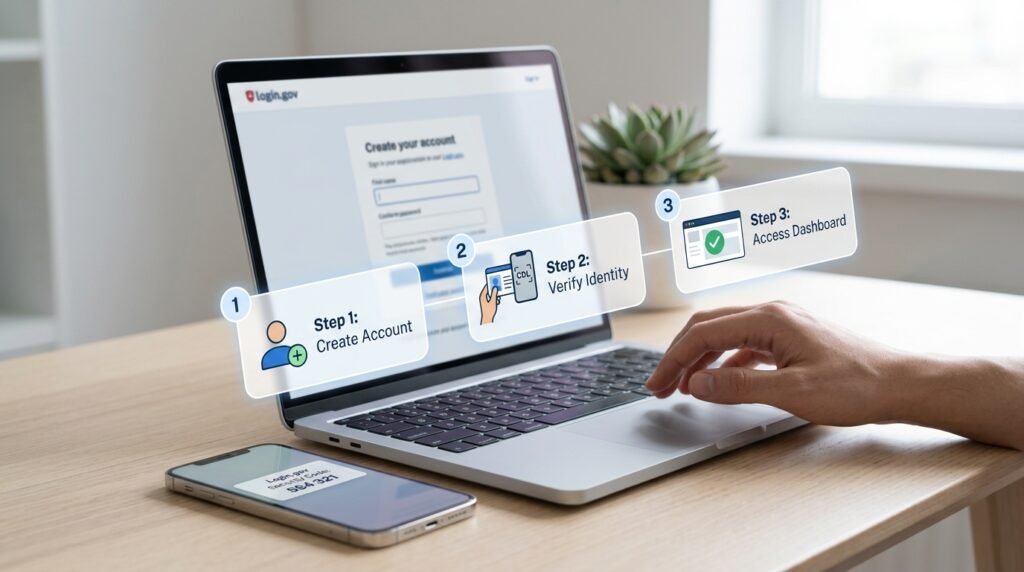
Every user must complete FMCSA Clearinghouse registration before they can interact with the system. The process differs depending on your role, but every registration starts at the same place: the official FMCSA Clearinghouse portal at https://clearinghouse.fmcsa.dot.gov.
How Drivers Register for the FMCSA Clearinghouse
Driver registration is free. Here is the process:
- Go to the Clearinghouse website and click “Register.”
- Create a login.gov account — This is the federal government’s secure authentication system. You will need a valid email address and must set up multi-factor authentication.
- Select “Driver” as your role when prompted.
- Verify your identity — You must provide your CDL number, state of issuance, and date of birth. The system cross-references this information with state licensing databases.
- Complete your profile — Add your contact information and review your dashboard.
Once registered, drivers can:
- View their own Clearinghouse record at any time (free of charge)
- Respond to employer consent requests for full queries
- Monitor whether any violations have been reported against them
Pro Tip: Many drivers ask how to check Clearinghouse status — simply log in to your Clearinghouse dashboard and navigate to “My Clearinghouse Record.” You will see any violations, queries, or return-to-duty information associated with your CDL.
How Employers Register for the FMCSA Clearinghouse
Employer registration requires a few additional steps:
- Create a login.gov account (same process as drivers).
- Select “Employer” as your role.
- Enter your USDOT Number — Your company must have an active USDOT registration. The system will verify your authority.
- Designate a Clearinghouse administrator — This person manages your organization’s account, assigns query permissions, and ensures DOT compliance for trucking operations.
- Purchase query plans — Full queries cost $1.25 each. Limited queries are free.
Employers must also decide whether they will conduct queries themselves or designate a C/TPA to handle Clearinghouse responsibilities on their behalf.
Registration for C/TPAs and Medical Review Officers
C/TPAs, MROs, and SAPs follow a similar registration process but select their specific roles during setup. These users have reporting obligations — they must enter violation data, test results, and return-to-duty determinations directly into the FMCSA database.
MROs, for example, are required to report every verified positive DOT drug test result to the Clearinghouse within specific timeframes. SAPs report when a driver begins and completes the DOT SAP program.
How the Drug and Alcohol Clearinghouse Works
Understanding the mechanics of the Clearinghouse is critical for both compliance and career protection. The system operates on three core functions: storing violation data, enabling employer queries, and tracking return-to-duty progress.
What Information Is Stored in the FMCSA Database?
The Clearinghouse contains records of the following drug and alcohol program violations:
- Positive drug test results verified by an MRO (including the DOT 5 panel drug test)
- Alcohol confirmation test results of 0.04 or greater during DOT alcohol testing
- Refusals to test — including substituted or adulterated specimens, failure to appear, and failure to remain at the collection site
- Actual knowledge violations — when an employer determines through direct observation or other means that a driver used drugs or alcohol in violation of regulations
- Return-to-duty test results and SAP reports
- Follow-up testing plans and results
Each positive test record and violation remains in the Clearinghouse for five years from the date of the violation determination, provided the driver has completed the full return-to-duty process. If the driver has not completed the return-to-duty process, the violation remains in the system indefinitely.
How Violations Are Reported
Violation reporting in the Clearinghouse involves multiple parties:
| Reporting Party | What They Report | Timeframe |
|---|---|---|
| MRO | Verified positive drug test results, refusals (substituted/adulterated) | By close of the next business day following verification |
| Employer | Actual knowledge violations, refusals to test (non-MRO), negative return-to-duty results | Varies by violation type |
| SAP | Initial assessment completion, follow-up testing plan | After each milestone |
| C/TPA | Reports on behalf of employer if designated | Per employer’s agreement |
This multi-layered reporting structure ensures that no single point of failure can allow a violation to go unrecorded. It creates the real-time reporting environment Congress envisioned when it mandated the system.
Real-Time Reporting and Record Updates
One of the most significant advantages of the Clearinghouse over the previous paper-based system is speed. When an MRO verifies a positive drug test, that information can appear in the driver’s Clearinghouse record within hours — not weeks or months.
This means that if a driver tests positive during a pre-employment drug test with Carrier A on Monday, Carrier B can see that violation during a pre-employment query on Tuesday. The days of hiding violations are over.
FMCSA Clearinghouse Employer Query: Full & Limited Queries
The FMCSA Clearinghouse employer query system is the primary tool carriers use to perform a driver record check. There are two types of queries, and understanding the difference is essential for compliance.
Pre-Employment Full Query
A full query reveals detailed information about any drug and alcohol violations in a driver’s Clearinghouse record. This includes:
- The type of violation (positive test, refusal, actual knowledge)
- The substance involved
- The date of the violation
- The driver’s return-to-duty status
Full queries require the driver’s electronic consent. The driver must log in to their Clearinghouse account and approve the request before the employer can view the detailed results.
Every employer must conduct a full pre-employment query before allowing a new driver to operate a CMV. This is a non-negotiable requirement under 49 CFR Part 382, and it applies alongside — not instead of — the traditional requirement to contact previous employers about a driver’s drug and alcohol testing history.
Full queries cost $1.25 per query as of 2025.
Annual Clearinghouse Query Requirements
Beyond pre-employment, employers must conduct at least one query per year for every driver currently performing safety-sensitive functions. For annual queries, employers have two options:
- Limited query (free): Tells the employer only whether the Clearinghouse contains any records for the driver — a simple “yes” or “no” response. If the answer is “yes,” the employer must immediately follow up with a full query.
- Full query ($1.25): Provides complete details. Some employers skip the limited query step and go straight to annual full queries to simplify their process.
Employers must keep records of all queries conducted, which becomes part of the driver qualification file for each CDL holder.
Important Note for 2025–2026: Under the Clearinghouse II final rule, employers are no longer required to request drug and alcohol testing history from a driver’s previous employers if a full Clearinghouse query returns no violations. This is a major procedural change. (More details in the Clearinghouse II section below.)
How to Check Clearinghouse Status as a Driver
Drivers should proactively monitor their Clearinghouse records. Here is how:
- Log in to your Clearinghouse account at clearinghouse.fmcsa.dot.gov.
- Navigate to “My Clearinghouse Record.”
- Review any entries — including violations, queries from employers, and return-to-duty progress.
Checking your own record is free and unlimited. If you find an error, you can dispute it through the Clearinghouse’s DataQs system. Given how critical this record is to your livelihood, we recommend checking it at least quarterly, and always before applying for a new driving position.
Clearinghouse Violations and Their Impact on Your CDL
A violation in the FMCSA Clearinghouse is one of the most serious events that can happen in a commercial driver’s career. It does not just affect your current job — it follows you across employers, across state lines, and across years.
Types of Violations Recorded
Violations fall into several categories:
- Positive drug test: Any confirmed positive result on a DOT-regulated drug test, including the substances covered under the DOT 5 panel drug test — marijuana (THC), cocaine, opiates, amphetamines/methamphetamines, and PCP.
- Alcohol violation: A confirmed breath or saliva alcohol test result of 0.04 BAC or higher. Learn more about DOT alcohol testing requirements.
- Refusal to test: Broadly defined to include failure to appear, leaving the collection site, failing to provide a sufficient specimen without a valid medical reason, tampering with a specimen, or refusing to submit to a required test.
- Actual knowledge determination: An employer’s determination, based on direct observation or credible evidence, that a driver used prohibited drugs or alcohol in violation of federal regulations.
How a Positive Test Record Affects Your Career
The moment a violation appears in the Clearinghouse:
- You are immediately prohibited from performing any safety-sensitive function — you cannot drive a CMV.
- Every employer who queries you will see the violation (with your consent for full queries).
- You cannot be hired by any FMCSA-regulated employer until you have completed the full return-to-duty process.
- The violation remains for five years after you complete return-to-duty — or indefinitely if you never complete it.
For drivers who also face state-level consequences, such as a DUI with CDL, the combined impact can include CDL suspension or revocation on top of the Clearinghouse record.
CDL Disqualifications Related to Clearinghouse Violations
Clearinghouse violations can contribute to CDL disqualifications under both federal and state law. While the Clearinghouse itself does not revoke your CDL, the underlying violation — particularly a positive drug test or refusal — can trigger:
- State licensing agency actions (suspension, revocation)
- Employer termination
- Insurance disqualification
- Loss of ability to pass the DOT physical exam medical certification process
Drivers with Clearinghouse violations should also be aware that these records can affect their MVR record indirectly, as states increasingly cross-reference Clearinghouse data with licensing databases.
The Return-to-Duty Process After a Clearinghouse Violation
A Clearinghouse violation is serious, but it is not necessarily career-ending. The federal regulations provide a structured path back to driving through the return-to-duty process. However, it requires strict compliance with every step, and there are no shortcuts.
Steps to Complete the Return-to-Duty Process
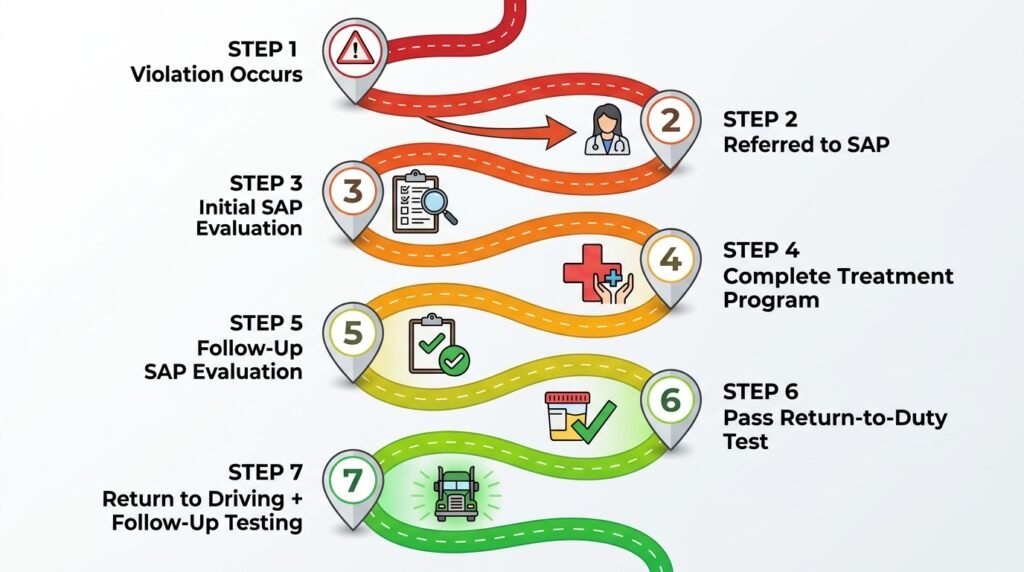
The return-to-duty process follows a specific sequence:
- Referral to a DOT-qualified Substance Abuse Professional (SAP) — Your employer (or former employer) must provide you with a list of SAPs. You can also find one through the DOT SAP program.
- Initial SAP evaluation — The SAP conducts a face-to-face clinical assessment to determine what education and/or treatment you need.
- Complete prescribed treatment — This could range from drug education courses to inpatient rehabilitation, depending on the SAP’s determination.
- Follow-up SAP evaluation — After completing treatment, you return to the SAP for a follow-up assessment. The SAP determines whether you have complied with their recommendations.
- Return-to-duty test — You must pass a directly observed DOT drug test (and/or alcohol test, depending on the original violation) with a negative/compliant result.
- SAP reports to the Clearinghouse — The SAP reports that you have completed the process, and the Clearinghouse record is updated.
- Follow-up testing plan — The SAP develops a follow-up testing plan requiring a minimum of six directly observed tests in the first 12 months after returning to duty, with the possibility of additional testing for up to 60 months.
Working with a DOT SAP (Substance Abuse Professional)
Choosing the right SAP is a critical decision. The SAP must be listed on SAMHSA’s directory and hold the required credentials (licensed physician, psychologist, social worker, or certified addiction counselor with DOT-specific training).
The SAP does not work for your employer — they serve as an independent evaluator. Their role is to assess your situation, prescribe appropriate treatment, and verify your compliance. Learn more about the complete SAP process in our DOT SAP program guide.
Follow-Up Testing Requirements
Follow-up testing is non-negotiable and extends well beyond the initial return-to-duty test:
- Minimum 6 tests in the first 12 months
- SAP may require up to 60 months of follow-up testing
- All follow-up drug tests are directly observed
- Results are reported to the Clearinghouse
Missing a follow-up test is treated as a refusal, which creates a new Clearinghouse violation — compounding the original problem significantly.
Who Is Exempt from the FMCSA Clearinghouse?
One of the most common questions we receive is: who is exempt from the FMCSA Clearinghouse?
The short answer: very few people. The Clearinghouse applies to all CDL holders who perform safety-sensitive functions for FMCSA-regulated employers. However, there are limited exemptions:
- Non-CDL drivers who are not required to hold a CDL for their position are not subject to Clearinghouse requirements (though they may still be subject to other DOT drug testing requirements under different agencies like PHMSA or FTA).
- Drivers operating solely under state authority in states that have not adopted FMCSA drug and alcohol testing regulations may not be covered, though this is increasingly rare.
- Agricultural exemptions — Certain farm vehicle operations are exempt from CDL requirements entirely, and by extension, the Clearinghouse.
- Military vehicles operated by active-duty military personnel for military purposes are exempt.
Common misconception: Owner-operators and small carriers sometimes believe they are exempt because of their size. They are not. If you hold a CDL and perform safety-sensitive functions in commerce, you are subject to Clearinghouse requirements regardless of whether you operate one truck or one thousand.
It is also worth noting that DOT physical disqualifications and Clearinghouse violations are separate systems — failing a DOT physical does not create a Clearinghouse record, and vice versa. However, both can independently prevent you from driving.
Clearinghouse II Final Rule: What Changes in 2025–2026
The FMCSA published the Clearinghouse II final rule (officially titled “Drug and Alcohol Clearinghouse II”) to address gaps identified in the original regulation. Key provisions began taking effect in November 2024, with full implementation rolling through 2025 and into 2026.
Key Changes Under Clearinghouse II
Here are the most significant changes drivers and employers need to understand:
1. Elimination of the Manual Previous Employer Check (for most situations)
Under the original rule, employers were required to both query the Clearinghouse and contact a driver’s previous employers from the past three years to obtain drug and alcohol testing records. Clearinghouse II eliminates the requirement to contact previous employers when a full Clearinghouse query returns no violations.
This is a major administrative burden reduction, but it also means that Clearinghouse reporting accuracy is more critical than ever. If a violation fails to make it into the system, there is now one fewer safety net to catch it.
2. State Licensing Agency Access
Clearinghouse II grants state driver’s licensing agencies (SDLAs) direct access to query the Clearinghouse. This means that when you renew or transfer your CDL, your state can check whether you have unresolved Clearinghouse violations.
Beginning in 2025–2026, states will be required to:
- Query the Clearinghouse before issuing, renewing, or upgrading a CDL or CLP
- Remove the CLP or CDL privilege (downgrade the license) from any driver with an unresolved violation who has not completed the return-to-duty process
This is a game-changer. Previously, a driver with an unresolved Clearinghouse violation could still hold a valid CDL — they just could not legally drive for an FMCSA-regulated employer. Under Clearinghouse II, the CDL itself is at risk. Drivers cannot simply wait out the clock; they must resolve violations or lose their license.
3. Enhanced Reporting Requirements
The final rule tightens reporting timelines and clarifies responsibilities for MROs, employers, and SAPs. It also addresses situations where drivers leave one employer before a test result is verified, ensuring the violation still gets reported to the Clearinghouse.
External Resource: For the complete regulatory text of the Clearinghouse II final rule, see the Federal Register: Drug and Alcohol Clearinghouse II.
How the FMCSA Clearinghouse Connects to DOT Drug Testing
The Clearinghouse does not replace DOT drug and alcohol testing — it complements it. Think of the Clearinghouse as the reporting and record-keeping layer that sits on top of the existing testing framework.
DOT 5 Panel Drug Test and the Clearinghouse
Every DOT-regulated drug test uses the DOT 5 panel drug test, which screens for:
- Marijuana (THC)
- Cocaine
- Opiates (codeine, morphine, heroin/6-AM, hydrocodone, hydromorphone, oxycodone, oxymorphone)
- Amphetamines / Methamphetamines (including MDMA/ecstasy)
- Phencyclidine (PCP)
When a specimen tests positive at the laboratory, the MRO reviews the result, interviews the donor, and makes a verification decision. If the MRO verifies the result as positive, that information is reported to the Clearinghouse — creating a permanent (five-year) record tied to the driver’s CDL number.
DOT Alcohol Testing and Clearinghouse Reporting
DOT alcohol testing follows a two-step process using evidential breath testing (EBT) or approved saliva devices. A confirmed result of 0.04 BAC or higher constitutes a violation that must be reported to the Clearinghouse.
Results between 0.02 and 0.039 BAC trigger a temporary removal from safety-sensitive functions (minimum 24 hours) but do not create a Clearinghouse violation record.
The distinction matters enormously — a 0.04 result triggers the full Clearinghouse reporting chain and requires the complete return-to-duty process, while a 0.039 result, while still serious, stays between the driver and their employer.
Types of DOT Tests That Can Generate Clearinghouse Violations
Not all DOT tests are created equal, but any of the following DOT drug testing types can produce a result reportable to the Clearinghouse:
- Pre-employment tests
- Random tests
- Post-accident tests
- Reasonable suspicion tests
- Return-to-duty tests
- Follow-up tests
Employer Compliance: Avoiding Costly Clearinghouse Mistakes
For motor carriers, Clearinghouse compliance is not optional, and the penalties for getting it wrong are severe. Here is what employers need to know to stay on the right side of the law.
Common Compliance Errors
Based on FMCSA audit findings and industry reports, the most common employer mistakes include:
- Failing to conduct annual queries — Every driver on your roster must be queried at least once per calendar year. Many small carriers forget or do not have a system to track query deadlines.
- Using a limited query without follow-up — If a limited query returns “yes” (records exist), you must immediately conduct a full query. Operating a driver during this gap is a violation.
- Allowing a driver with an unresolved violation to drive — If a query reveals a violation and the driver has not completed return-to-duty, they must be immediately removed from safety-sensitive duties.
- Not reporting violations they are required to report — Employers are responsible for reporting actual knowledge violations, certain refusals, and negative return-to-duty test results. Failure to report is itself a violation.
- Incomplete driver qualification files — Clearinghouse query records must be maintained alongside other documents like the DOT medical card, MVR, and employment history in the driver qualification file.
Penalties for Non-Compliance
FMCSA can assess civil penalties of up to $16,864 per violation for employers who fail to comply with Clearinghouse requirements (penalty amounts adjusted annually for inflation). In egregious cases, penalties can reach $59,017 per violation.
Beyond fines, non-compliance can result in:
- Unsatisfactory safety ratings
- Out-of-service orders
- Loss of operating authority
- Increased liability exposure in accident litigation
Maintaining proper Clearinghouse compliance is a cornerstone of broader DOT compliance for trucking operations. It is not a standalone task — it must be integrated into your overall safety management system.
External Resource: For the latest enforcement guidance and penalty schedules, visit the FMCSA Drug and Alcohol Clearinghouse official page.
Clearinghouse Statistics: Understanding the Scale
The FMCSA publishes Clearinghouse statistics that reveal just how widely the system is being used and what kinds of violations are most common. As of 2025:
- Over 1.1 million violations have been reported to the Clearinghouse since its inception.
- Marijuana (THC) remains the most commonly detected substance, accounting for roughly 50% of all positive drug tests.
- Approximately 250,000+ drivers currently have unresolved violations and are prohibited from driving.
- A significant percentage of drivers with violations never complete the return-to-duty process, effectively ending their commercial driving careers.
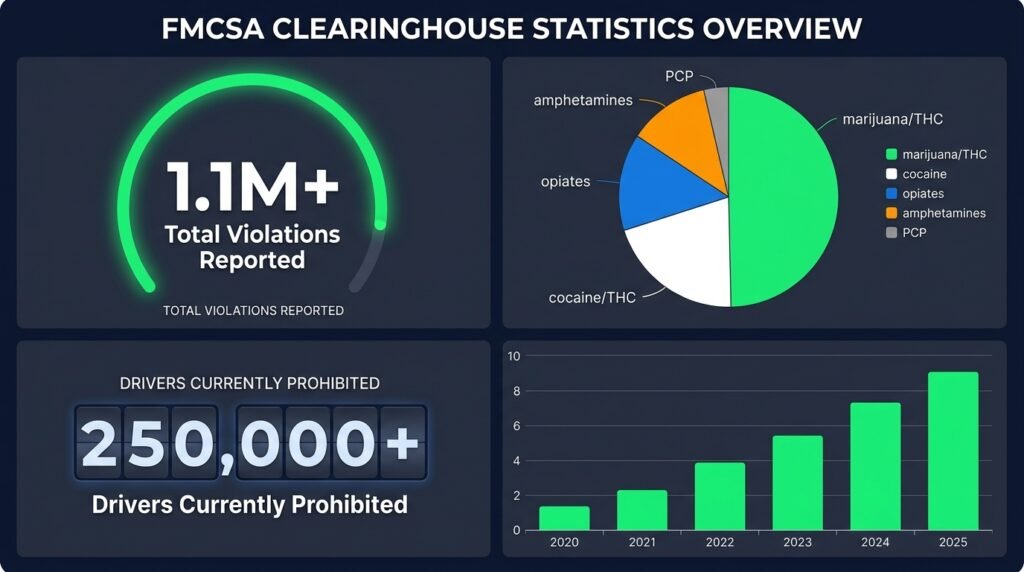
These numbers underscore the system’s impact. The Clearinghouse is not a paper tiger — it has removed hundreds of thousands of non-compliant drivers from the road.
External Resource: Review the latest data at the FMCSA Clearinghouse Dashboard & Statistics.
Frequently Asked Questions
The FMCSA Clearinghouse is a secure electronic database maintained by the Federal Motor Carrier Safety Administration. It records drug and alcohol program violations by CDL holders across the United States, including positive drug tests, alcohol test failures, refusals to test, and actual knowledge violations. Employers are required to query the Clearinghouse before hiring CDL drivers and at least annually for current drivers. The system prevents drivers with unresolved violations from operating commercial motor vehicles and tracks their progress through the return-to-duty process.
Very few CDL-related roles are exempt. Non-CDL drivers, active military operating military vehicles, and certain agricultural vehicle operators may be exempt. However, any driver who holds a CDL and performs safety-sensitive functions for an FMCSA-regulated employer is subject to Clearinghouse requirements — regardless of company size, fleet size, or whether the driver is an owner-operator. If you need a CDL to do your job, the Clearinghouse applies to you.
Driver registration and record viewing are free. Employer registration is free. Limited queries (annual screening) are free. Full queries cost $1.25 each. There is no subscription fee — employers pay per full query.
Violations remain in the Clearinghouse for five years from the date of the final violation determination, but only if the driver completes the full return-to-duty process. If the driver never completes return-to-duty, the record stays in the system indefinitely — and under Clearinghouse II, this will eventually result in a CDL downgrade by the state licensing agency.
Yes. If you believe a violation was reported in error, you can submit a dispute through the FMCSA DataQs system. The reporting party (MRO, employer, or SAP) will be notified and required to review the record. However, simply disagreeing with a legitimate test result is not grounds for a successful dispute — there must be a factual or procedural error.
Yes. While registration is not technically required until an employer needs to run a full query on you (you must provide electronic consent), we strongly recommend that every CDL holder register proactively. It allows you to monitor your record, respond to employer queries quickly, and avoid delays in the hiring process.
If an employer fails to conduct required queries, they are in violation of federal regulations and subject to civil penalties up to $16,864 per occurrence. If an unqueried driver causes an accident and is later found to have a Clearinghouse violation, the employer’s liability exposure increases dramatically.
No. You are prohibited from performing any safety-sensitive function — including driving a CMV — from the moment a violation is reported until you have completed every step of the return-to-duty process, including passing a return-to-duty test and being released by your SAP. There are no exceptions to this prohibition.
Conclusion
The FMCSA Clearinghouse has transformed how the trucking industry manages drug and alcohol compliance. What was once a fragmented, easily exploited system is now a centralized, real-time violation database that holds drivers and employers equally accountable.
For drivers, the message is clear: register for the Clearinghouse, know your record, and understand that a single violation has career-wide consequences. If you do face a violation, take the return-to-duty process seriously and complete it fully — an unresolved record will now cost you your CDL under Clearinghouse II.
For employers, the Clearinghouse is both a safety tool and a compliance obligation. Conduct your pre-employment and annual queries without fail. Report violations on time. Maintain records in your driver qualification files. And stay current with the regulatory changes rolling out through 2025 and 2026.
The FMCSA drug and alcohol clearinghouse is not going away — it is getting stronger. The Clearinghouse II rule, with its state licensing integration and streamlined employer obligations, makes the system more powerful and more consequential than ever before.
If you need help navigating the Clearinghouse, understanding your obligations under DOT drug testing regulations, or returning to duty after a violation, the Compliant Drivers Program is here to help you every step of the way.
Last updated: 2025. This article reflects the latest FMCSA Clearinghouse regulations, including the Clearinghouse II final rule provisions effective through 2026.
Clearinghouse Status Checker






![DOT Drug Test: What You Must Know in 2026 [Full Guide]](https://compliantdriversprogram.com/wp-content/uploads/2026/03/DOT-Drug-Test-150x150.jpeg)



Leave a Reply