
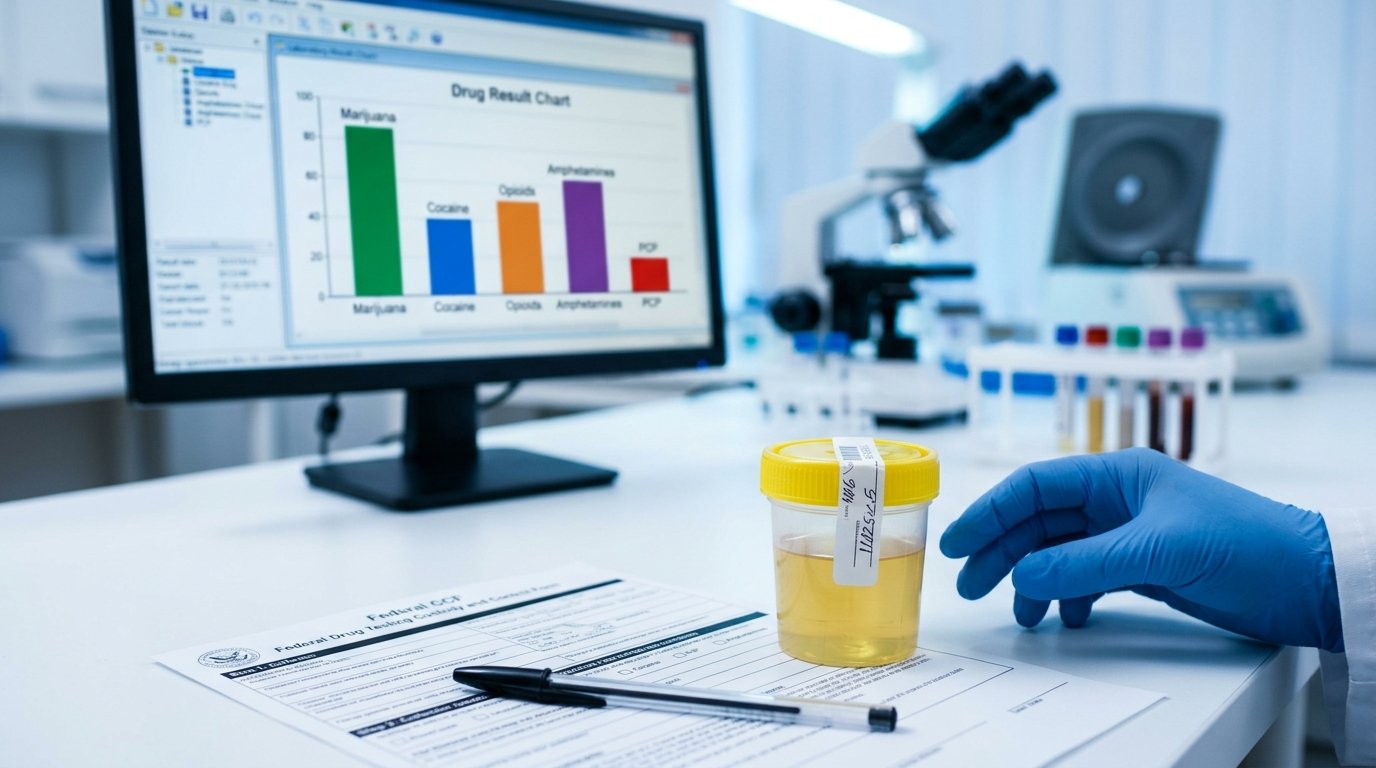
You’re about to take a DOT 5 panel drug test – and you have no idea what they’re actually looking for. What substances? What amounts? How far back can they detect?
Most drivers don’t know the answers until it’s too late. A single surprise on test day can end a career.
The Department of Transportation uses one specific test for every safety-sensitive employee in the country. It screens for exactly five categories of drugs. No more, no less. The same panel applies whether you drive a semi, fly a plane, or operate a transit bus.
This guide covers everything about the DOT 5 panel drug test — every substance tested, exact cutoff levels, detection windows, how the process works, and what separates it from a non-DOT test. If you work in any DOT-regulated role, this is information you cannot afford to skip.
📋 Key Takeaways
- The DOT 5 panel drug test screens for marijuana, cocaine, opioids, amphetamines, and PCP — no other substances.
- Federal rules under 49 CFR Part 40 set exact cutoff levels for each drug category.
- Opioid testing expanded in 2010 and again in recent years to include additional synthetic opioids like oxycodone and hydrocodone.
- A DOT test follows stricter collection, chain-of-custody, and lab procedures than most non-DOT tests.
- Failing this test triggers mandatory removal from safety-sensitive duties and entry into the SAP evaluation process.
What Is a DOT 5 Panel Drug Test?
A DOT 5 panel drug test is a federally mandated urine test. It checks for five specific categories of controlled substances. The Department of Transportation requires this exact panel for all safety-sensitive employees across every DOT agency.
The rules come from 49 CFR Part 40 — the federal regulation that governs all DOT workplace drug and alcohol testing. The Substance Abuse and Mental Health Services Administration (SAMHSA) sets the laboratory standards and cutoff levels used in this test.
Here’s what makes it different from a random drug screen you might take for a non-regulated job:
- Standardized panel — Every DOT test screens the same five drug categories. No employer can add or remove substances.
- Strict collection rules — A trained collector follows an exact protocol with chain-of-custody documentation.
- Lab certification required — Only SAMHSA-certified laboratories can process DOT specimens.
- MRO review — A Medical Review Officer (MRO) reviews every result before it becomes official.
- Split specimen — Every sample gets divided into two bottles (A and B) so you can request a retest.
This isn’t a quick-result dipstick test. It’s a controlled, documented, legally defensible process. Every step protects both the employee and the employer.
The test applies to anyone in a safety-sensitive position regulated by FMCSA, FAA, FTA, FRA, PHMSA, or USCG. If you hold a CDL, understanding this DOT drug test process is essential to keeping your career on track.
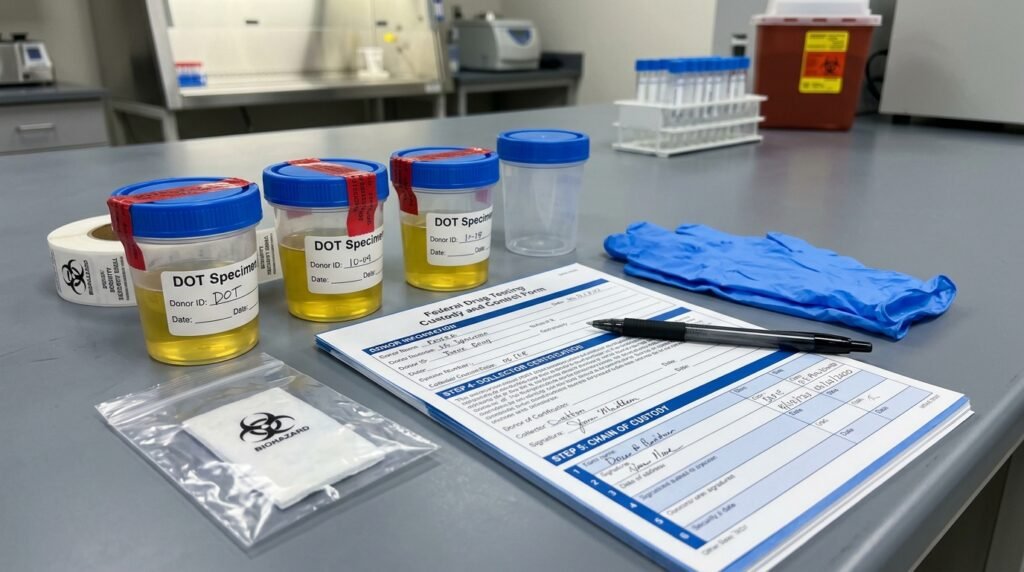
The 5 Substances Tested in a DOT Drug Panel
The DOT drug panel screens for exactly five drug categories. Each category includes the parent drug and its metabolites. Here’s a detailed breakdown of every substance tested.
1. Marijuana (THC)
The test detects THC (delta-9-tetrahydrocannabinol), the active compound in marijuana. It specifically looks for the metabolite THC-COOH in your urine.
Key facts:
- THC stays detectable longer than most other drugs
- Legal marijuana in your state does NOT matter — federal DOT rules override state laws
- CBD products that contain even trace amounts of THC can trigger a positive result
- Edibles, vapes, and smokable marijuana all produce the same metabolite
⚠️ Warning: Many CDL drivers assume legal state marijuana use protects them. It does not. DOT follows federal law. Marijuana remains a Schedule I controlled substance federally, and any positive result counts as a violation regardless of your state’s laws.
2. Cocaine
The test screens for benzoylecgonine, the primary metabolite of cocaine. This includes all forms:
- Powder cocaine
- Crack cocaine
- Any product containing coca leaf derivatives
Cocaine metabolites clear the body relatively fast compared to THC. But even occasional use produces detectable levels within the testing window.
3. Opioids
This is the broadest category on the 5 panel drug screen. The DOT opioid panel has expanded over the years to keep up with the opioid crisis.
Substances tested include:
- Codeine
- Morphine
- Heroin (detected as 6-acetylmorphine / 6-AM)
- Hydrocodone (Vicodin, Norco)
- Hydromorphone (Dilaudid)
- Oxycodone (OxyContin, Percocet)
- Oxymorphone (Opana)
[VERIFY: The expanded opioid testing panel was mandated by DOT/SAMHSA rule changes. Confirm the current specific opioids included under 49 CFR Part 40 for 2025–2026.]
The opioid category catches the most drivers off guard. Prescription painkillers trigger positive results. If you have a valid prescription, you’ll need to discuss it with the MRO during the verification process.
4. Amphetamines
The DOT substance testing panel checks for amphetamine-class drugs:
- Amphetamine (Adderall, Dexedrine)
- Methamphetamine (crystal meth, illicit meth)
- MDMA (ecstasy, molly)
- MDA (a related compound)
Prescription ADHD medications like Adderall will trigger a positive initial screen. The MRO will contact you to verify a legitimate prescription before reporting a final result.
5. Phencyclidine (PCP)
PCP — also known as angel dust — is the fifth and final substance on the DOT panel. While PCP use has declined significantly compared to other drugs, DOT still requires testing for it.
PCP can be:
- Smoked (often laced on cigarettes or marijuana)
- Taken orally
- Injected
Detection of PCP in a DOT test almost always results from intentional use. Cross-reactivity with common medications is extremely rare for this substance.
DOT Drug Test Cutoff Levels Explained
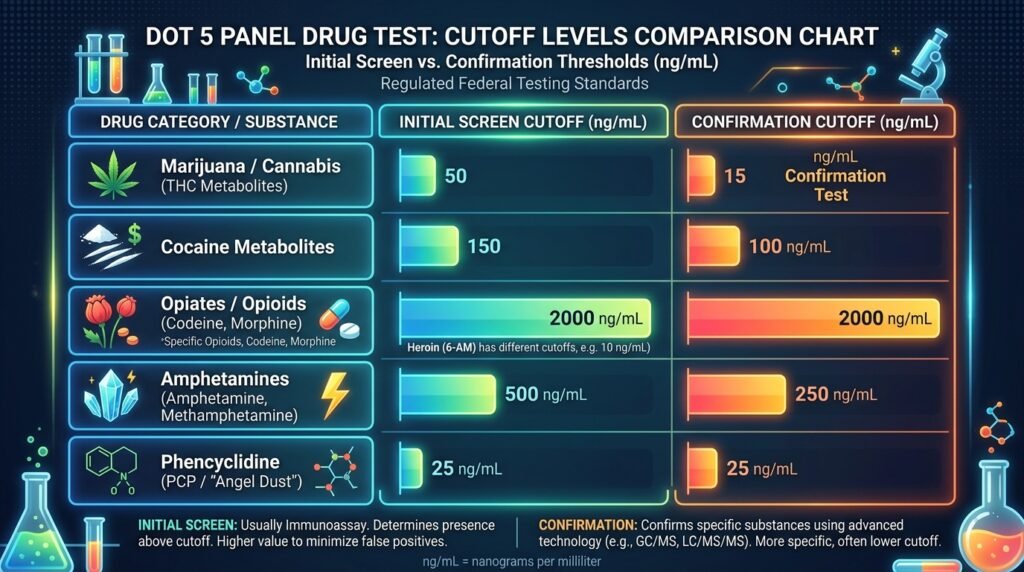
Every drug test uses cutoff levels — minimum concentration thresholds that separate a negative result from a positive one. The DOT uses two-tier testing with different cutoffs at each stage.
Initial Immunoassay Screen Cutoff Levels
The first lab test is a quick immunoassay screen. If your sample falls below these levels, the test is reported as negative. No further testing happens.
| Substance | Initial Screen Cutoff (ng/mL) |
|---|---|
| Marijuana (THC-COOH) | 50 ng/mL |
| Cocaine (Benzoylecgonine) | 150 ng/mL |
| Opioids — Codeine/Morphine | 2,000 ng/mL |
| Opioids — 6-AM (Heroin) | 10 ng/mL |
| Opioids — Hydrocodone/Hydromorphone | 300 ng/mL |
| Opioids — Oxycodone/Oxymorphone | 100 ng/mL |
| Amphetamines (AMP/MAMP) | 500 ng/mL |
| Amphetamines (MDMA/MDA) | 500 ng/mL |
| PCP | 25 ng/mL |
[VERIFY: Confirm these specific cutoff values against current 49 CFR Part 40 and SAMHSA Mandatory Guidelines for Federal Workplace Drug Testing Programs for 2025–2026.]
Confirmatory GC-MS/LC-MS Cutoff Levels
If your sample tests above the initial cutoff, the lab runs a confirmation test using gas chromatography-mass spectrometry (GC-MS) or liquid chromatography-tandem mass spectrometry (LC-MS/MS). These are far more precise.
| Substance | Confirmation Cutoff (ng/mL) |
|---|---|
| Marijuana (THC-COOH) | 15 ng/mL |
| Cocaine (Benzoylecgonine) | 100 ng/mL |
| Codeine | 2,000 ng/mL |
| Morphine | 2,000 ng/mL |
| 6-AM (Heroin marker) | 10 ng/mL |
| Hydrocodone | 150 ng/mL |
| Hydromorphone | 150 ng/mL |
| Oxycodone | 100 ng/mL |
| Oxymorphone | 100 ng/mL |
| Amphetamine | 250 ng/mL |
| Methamphetamine | 250 ng/mL |
| MDMA | 250 ng/mL |
| MDA | 250 ng/mL |
| PCP | 25 ng/mL |
[VERIFY: Cross-reference confirmation cutoffs with current SAMHSA guidelines and 49 CFR Part 40.]
Key Point: Notice that the confirmation cutoff for THC drops from 50 ng/mL to 15 ng/mL. This means your initial screen might be borderline negative, but the confirmation test catches a lower level. The two-tier system minimizes false positives while catching actual drug use.
Detection Windows for Each Substance
How far back can a DOT drug screening detect use? It depends on the substance, your metabolism, frequency of use, body composition, and hydration level.
Here are general detection windows for urine testing:
| Substance | Occasional Use | Regular/Heavy Use |
|---|---|---|
| Marijuana (THC) | 3–7 days | 15–30+ days |
| Cocaine | 2–4 days | 5–7 days |
| Opioids (short-acting) | 2–3 days | 3–4 days |
| Opioids (long-acting) | 3–4 days | 4–7 days |
| Amphetamines | 2–4 days | 5–7 days |
| Methamphetamine | 3–5 days | 5–7 days |
| MDMA | 2–4 days | 4–5 days |
| PCP | 3–7 days | 14–30 days |
[VERIFY: Detection windows are approximations based on general pharmacological data. Individual results vary significantly.]
Why THC Has the Longest Detection Window
THC is fat-soluble. Your body stores it in fat cells and releases it slowly over time. Heavy, daily marijuana users can test positive for 30 days or longer after their last use.
This makes marijuana the substance that catches the most commercial drivers. Even if you stopped using weeks ago, your body may still be releasing enough THC-COOH to exceed the 50 ng/mL initial screen cutoff.
Every other substance on the panel is water-soluble. Your body flushes them out much faster.
How the DOT Drug Screening Process Works
The DOT drug testing process follows strict federal procedures. Every step is documented and standardized. Here’s exactly what happens from start to finish.
Step 1 — Notification and Arrival
Your employer or a designated employer representative (DER) notifies you of the test. For random testing, you must report to the collection site immediately — usually within a few hours.
You’ll need:
- A valid photo ID
- Any paperwork your employer provides
Step 2 — Collection Site Procedures
A trained collector guides you through these steps:
- You empty your pockets and secure personal belongings
- The collector adds a bluing agent to the toilet water (prevents tampering)
- You provide a urine specimen in a collection cup — minimum 45 mL
- The collector checks the temperature of the specimen (must be 90–100°F within 4 minutes)
- The specimen gets split into two bottles — Bottle A (primary) and Bottle B (split)
- You initial the tamper-evident seals on both bottles
- The collector completes the Federal Drug Testing Custody and Control Form (CCF)
Step 3 — Laboratory Analysis
Both bottles ship to a SAMHSA-certified laboratory. The lab runs the initial immunoassay screen on Bottle A. If the initial screen is negative, the result is reported as negative.
If positive on the initial screen, the lab runs the GC-MS or LC-MS/MS confirmation test. Only a confirmed positive gets reported.
Bottle B stays sealed and stored. You can request testing of Bottle B if you dispute a confirmed positive result.
Step 4 — Medical Review Officer (MRO) Review
Every result — positive, negative, or otherwise — goes to an MRO before becoming final. The MRO is a licensed physician trained in DOT drug testing procedures.
For positive results, the MRO contacts you directly. This is called the verification process. You can:
- Present a valid prescription for the detected substance
- Provide a legitimate medical explanation
- Dispute the result and request a Bottle B test
If the MRO accepts your explanation, the result gets changed to negative. If not, the positive result becomes official and gets reported to your employer.
Step 5 — Reporting
Final results go to your employer’s DER. For CDL holders, positive results and refusals also get reported to the FMCSA Clearinghouse. This federal database tracks every drug and alcohol violation for commercial driver’s license holders.
DOT vs Non-DOT 5 Panel Drug Test
Many employers use a 5 panel non-DOT drug test for their own workplace policies. While the panel looks similar, the two tests differ in critical ways.
| Feature | DOT 5 Panel Test | Non-DOT 5 Panel Test |
|---|---|---|
| Drug categories tested | 5 (standardized by federal law) | 5 (employer can customize) |
| Additional substances | Not allowed — panel is fixed | Employer can add substances (e.g., barbiturates, benzodiazepines) |
| Collection procedure | Strict federal protocol (49 CFR Part 40) | Varies by employer/lab |
| Lab certification | SAMHSA-certified lab required | Any certified lab |
| MRO review required | Yes — mandatory | Optional (varies by employer) |
| Split specimen | Required | Optional |
| Chain of custody | Federal CCF form required | Varies |
| Legal consequences | Federal violation — reported to Clearinghouse | Employer-level consequences only |
| Cutoff levels | Set by SAMHSA/DOT — cannot be changed | Employer/lab can set custom levels |
| Specimen type | Urine only (for standard DOT test) | Urine, hair, saliva, blood (employer’s choice) |
The biggest difference? A DOT test cannot be modified. Your employer cannot add drugs, change cutoffs, or use a different specimen type. Everything follows federal DOT regulations.
A non-DOT test near you at a local clinic may use the same five panels but with different cutoff levels, different collection standards, and no MRO review. Results from a non-DOT test don’t count as DOT-compliant.
Bottom Line: If you’re in a DOT-regulated role, only a properly conducted DOT test counts. A non-DOT test — even if it’s a 5 panel — has no legal standing for DOT compliance purposes.
When Do You Face DOT Drug Testing?
DOT regulated drug testing isn’t a one-time event. You’ll face the 5 panel drug test at multiple points in your career. Here are all the situations that trigger testing.
Six Types of DOT Drug Testing
- Pre-employment testing — Before you perform any safety-sensitive function for a new employer. Read our full guide on pre-employment drug testing for CDL holders for details.
- Random testing — Unannounced, computer-generated selection throughout the year. FMCSA requires a random testing rate of [VERIFY: 50% of safety-sensitive employees for drugs and 10% for alcohol — confirm current annual FMCSA random testing rate for 2025–2026].
- Reasonable suspicion testing — When a trained supervisor observes behavior suggesting drug or alcohol use.
- Post-accident testing — After qualifying accidents that meet DOT thresholds (fatality, bodily injury with medical transport, or disabling vehicle damage with a citation issued).
- Return to duty testing — Before returning to safety-sensitive work after a violation. This test is directly observed.
- Follow-up testing — A minimum of 6 unannounced tests in the 12 months after returning to duty. Can extend up to 60 months.
Every single one of these tests uses the same DOT 5 panel drug test. The panel never changes. The procedures never change. The cutoff levels never change.
For a broader understanding of DOT alcohol testing, check out our separate guide — alcohol testing uses a breath or saliva test, not the urine panel.
What Happens If You Fail a DOT Drug Test
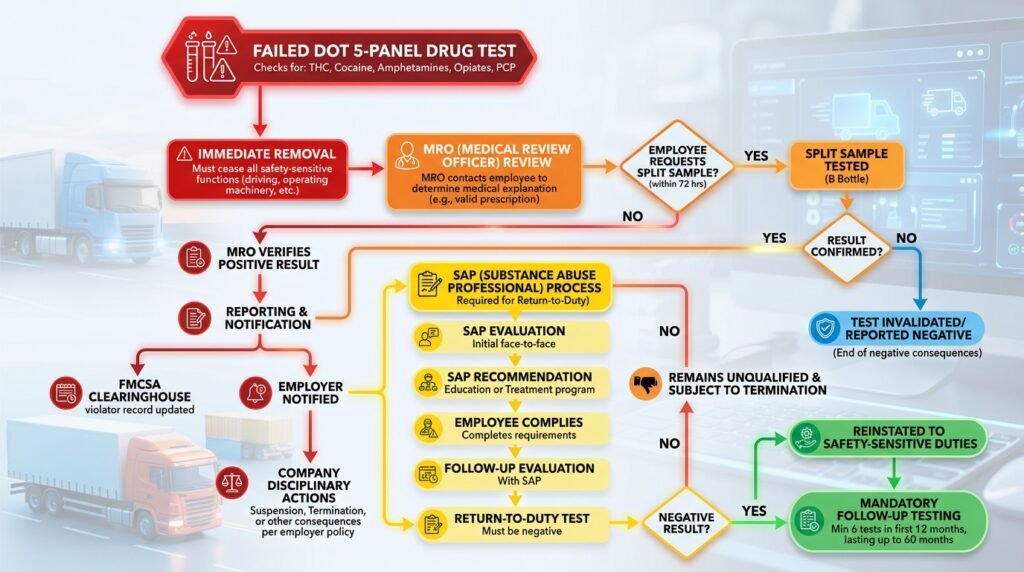
Failing a DOT drug test sets off a chain of serious consequences. Here’s the sequence:
Immediate consequences:
- Your employer removes you from all safety-sensitive duties immediately
- Your employer reports the violation to the FMCSA Clearinghouse (for CDL holders)
- Your Clearinghouse status changes to “not eligible”
- Every employer running a query can see your violation
Required next steps:
- Your employer provides a list of qualified Substance Abuse Professionals (SAPs)
- You must complete a SAP evaluation before you can start returning to duty
- The SAP recommends education or treatment based on your assessment
- After completing the SAP’s requirements, you return for a follow-up evaluation
- You must pass a directly observed return to duty test
- Follow-up testing continues for 12 to 60 months after your return
Read our detailed DOT SAP program guide for a complete step-by-step breakdown of the return to duty process.
Career impact:
- A first violation does not permanently disqualify your CDL
- However, failing to complete the SAP process means you can never return to a safety-sensitive position
- Some employers terminate immediately upon a positive result
- The violation stays visible in the Clearinghouse for [VERIFY: 5 years from the violation date under current FMCSA rules]
- Future employers will see it during mandatory Clearinghouse queries
- Repeated violations can lead to CDL disqualifications
💡 Important: A test refusal carries the same consequences as a positive result. Refusing includes failing to appear, leaving the collection site, not providing enough specimen without a medical explanation, or tampering with your sample.
Prescription Medications and the DOT Drug Panel
This is where many drivers get confused. Legitimate prescriptions for opioids or amphetamines will trigger a positive on the initial screen. But a positive screen doesn’t automatically mean a violation.
How the MRO Handles Prescriptions
When the MRO contacts you about a positive result, you can present:
- A valid prescription in your name
- Prescribed by a licensed medical provider
- For a medication taken as directed
The MRO verifies your prescription and determines whether the detected substance matches your medication. If everything checks out, the MRO reports the result as negative.
Medications That Can Cause Positive Results
- Opioid painkillers: Hydrocodone (Vicodin), oxycodone (OxyContin, Percocet), codeine-containing cough medications
- ADHD medications: Amphetamine salts (Adderall), dextroamphetamine (Dexedrine), lisdexamfetamine (Vyvanse — metabolizes to amphetamine)
- Certain cough suppressants: Dextromethorphan in high doses has caused rare false positives for PCP on immunoassay screens
The Catch With Prescriptions and Safety-Sensitive Work
Having a valid prescription clears your drug test. But it doesn’t automatically mean you can drive a commercial vehicle. Certain medications can impair your ability to safely perform your duties.
Your prescribing physician — and the doctor conducting your DOT physical exam — must determine whether your medication is safe for driving. Some opioids and sedating medications may result in DOT physical disqualifications even with a valid prescription.
Best Practice: Tell your prescribing doctor that you work in a safety-sensitive DOT-regulated role. Ask specifically whether your medication is compatible with commercial driving. Get it documented in writing.
Frequently Asked Questions
A DOT 5 panel drug test is a federally required urine test that screens for five categories of controlled substances: marijuana (THC), cocaine, opioids (including heroin, codeine, morphine, hydrocodone, oxycodone, and their metabolites), amphetamines (including methamphetamine and MDMA), and phencyclidine (PCP). Every DOT-regulated employer must use this exact panel. The test follows strict procedures outlined in 49 CFR Part 40.
A 5 panel non-DOT drug test screens for the same five general drug categories but doesn’t follow federal DOT collection, laboratory, or MRO procedures. Non-DOT employers can customize cutoff levels, add extra substances, or use alternative specimen types like hair or saliva. Results from a non-DOT test do not satisfy DOT requirements. If your job is DOT-regulated, only a proper DOT test counts.
The DOT tests for marijuana, cocaine, opioids, amphetamines, and PCP. The opioid category is the most comprehensive — it covers codeine, morphine, heroin (6-AM), hydrocodone, hydromorphone, oxycodone, and oxymorphone. The amphetamine category covers amphetamine, methamphetamine, MDMA, and MDA. No employer can change this panel.
Possibly. Many CBD products contain trace amounts of THC — sometimes more than their labels claim. The FDA does not tightly regulate CBD products, so THC content can vary wildly. If enough THC accumulates in your system and exceeds the 50 ng/mL initial screen cutoff (or 15 ng/mL confirmation cutoff), you will test positive. The DOT’s official position is clear: using CBD is not a valid medical explanation for a positive marijuana result.
Negative results typically come back within 24 to 72 hours. If the initial screen is positive and requires confirmation testing plus MRO review, results can take 3 to 5 business days or longer. The MRO verification process — where the MRO contacts you about a positive result — can add additional time depending on how quickly you respond.
No. The DOT 5 panel drug test is a urine test that covers drugs only. DOT alcohol testing uses a completely separate process — either a breath alcohol test (BAT) using an evidential breath testing device (EBT) or a saliva test. Both tests happen independently. Learn more in our DOT alcohol testing guide.
Conclusion
The DOT 5 panel drug test screens for exactly five drug categories — marijuana, cocaine, opioids, amphetamines, and PCP. Every safety-sensitive employee in the DOT system faces this same test with the same cutoff levels and the same strict collection procedures.
There are no shortcuts around it. State marijuana laws don’t protect you. CBD products carry real risk. And prescription medications require proper MRO verification.
Know what you’re being tested for. Understand the cutoff levels. Be aware of detection windows. If you take prescription medications, talk to your doctor about compatibility with your safety-sensitive position before test day surprises you.
If you’re preparing for a CDL career or returning to one, understanding the DOT 5 panel drug test is step one of staying compliant. For a complete picture of what’s required, explore our guide to DOT compliance for trucking.
Drug Test Detection Calculator






![DOT Drug Test: What You Must Know in 2026 [Full Guide]](https://compliantdriversprogram.com/wp-content/uploads/2026/03/DOT-Drug-Test-150x150.jpeg)



Leave a Reply