
A failed DOT physical can stop your trucking career before it even starts. Every year, thousands of commercial drivers lose their medical clearance because they did not know what to expect. Understanding CDL medical requirements ahead of time saves you time, money, and stress.
This guide covers everything you need to know about CDL medical requirements in 2026. Whether you are applying for your first commercial license or renewing your DOT medical card, you will find clear answers here. We break down the DOT physical exam, vision and hearing standards, blood pressure limits, and conditions like diabetes and sleep apnea that could affect your certification.
This guide is for current and future CDL holders, owner-operators, and fleet managers who need to stay compliant with federal regulations.
Key Takeaways
- All CDL drivers must pass a DOT physical exam and carry a valid DOT medical card at all times.
- The exam tests your vision, hearing, blood pressure, and overall fitness to drive safely.
- Certain conditions like uncontrolled diabetes, sleep apnea, and epilepsy can disqualify you.
- Your medical certificate CDL must be renewed every 1 to 2 years depending on your health status.
- Some non-CDL commercial drivers must also meet DOT medical card requirements.
What Are CDL Medical Requirements?
CDL medical requirements are the health standards set by the Federal Motor Carrier Safety Administration (FMCSA). Every driver who operates a commercial motor vehicle (CMV) must meet these standards. The goal is simple. You must be physically able to drive a large vehicle safely.
These rules apply to all CDL classes, including Class A, Class B, and Class C. They also apply to some non-CDL commercial drivers. The regulations are found in 49 CFR Part 391, Subpart E, which outlines the physical qualifications for drivers. You can review the full regulation on the FMCSA driver medical requirements page{target=”_blank”}.
To prove you meet these standards, you must pass a DOT physical exam. A certified medical examiner performs this exam. Once you pass, you receive a DOT medical card that you must keep current. If you are just starting the process, check out our how to get a CDL guide for a full overview of every step involved.
Your medical certification is not optional. Without it, you cannot legally operate a CMV on public roads.
The DOT Physical Exam Explained
The DOT physical exam is the gateway to your CDL career. It is a standardized medical evaluation designed to confirm you can handle the physical demands of commercial driving. This CDL medical exam is different from a regular checkup at your doctor’s office.
What Happens During a CDL Physical Exam?
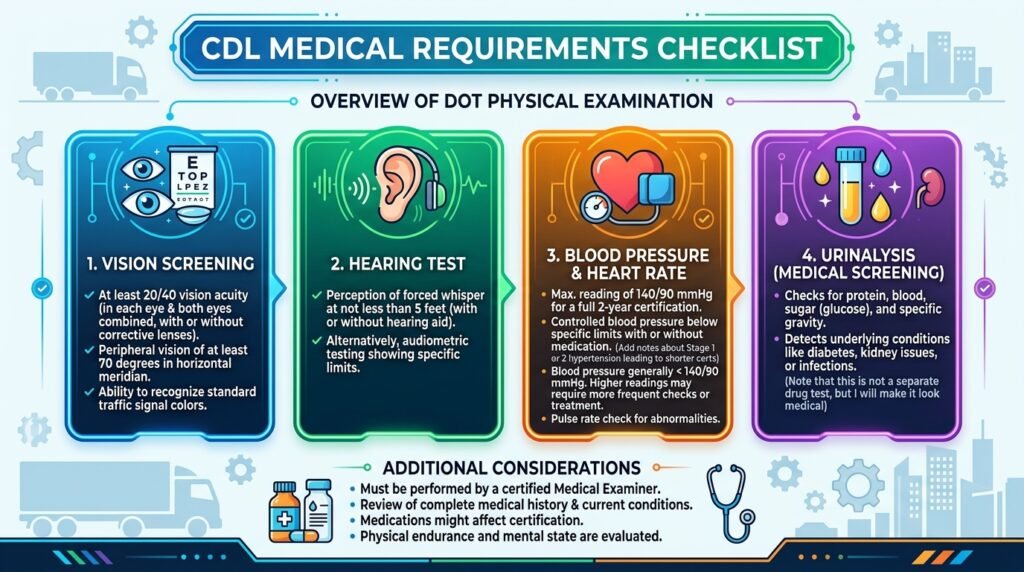
During the CDL physical exam, the medical examiner checks several areas of your health. Here is what you can expect:
- Vision test — You must have at least 20/40 acuity in each eye and both eyes together. Corrective lenses are allowed.
- Hearing test — You must hear a forced whisper from at least 5 feet away or pass an audiometric test.
- Blood pressure check — Your reading must fall within safe limits set by the FMCSA.
- Urinalysis — This screens for underlying conditions like diabetes. It is not a drug test.
- Physical examination — The examiner checks your heart, lungs, spine, limbs, and nervous system.
- Medical history review — You must disclose all current medications, past surgeries, and diagnosed conditions.
The entire exam usually takes 30 to 60 minutes. Be prepared to answer detailed questions about your health history. You can learn more about the process in our DOT physical exam guide.
Who Can Perform a DOT Physical?
Not just any doctor can perform a DOT physical. The examiner must be listed on the FMCSA National Registry of Certified Medical Examiners{target=”_blank”}. Qualified providers include:
- Medical doctors (MD)
- Doctors of osteopathy (DO)
- Physician assistants (PA)
- Advanced practice nurses (APN)
- Chiropractors (in some states, with limitations)
You can search for a certified examiner near you using the national registry website. You can also check our guide on finding a DOT physical near you and what it costs.
CDL Physical Requirements List
Here is a detailed breakdown of every CDL physical requirement you must meet. The FMCSA sets specific thresholds for each area of your health.
Vision Test Standards
Good vision is critical for safe driving. The DOT physical requirements for vision are strict but straightforward.
| Requirement | Standard |
|---|---|
| Distance vision | 20/40 in each eye and both eyes together |
| Peripheral vision | At least 70 degrees in each eye |
| Color vision | Must recognize traffic signal colors (red, green, amber) |
| Corrective lenses | Allowed (glasses or contacts) |
| Monocular vision | Requires a Federal Vision Exemption |
If you wear glasses or contacts, bring them to your exam. You will be tested with your correction in place.
Drivers with vision in only one eye can apply for a Federal Vision Exemption through the FMCSA. This process takes extra time, so plan ahead.
Hearing Test Standards
You must prove you can hear well enough to detect warning sounds on the road. The hearing test standards are:
- Hear a forced whisper at 5 feet or more in at least one ear, with or without a hearing aid
- OR score within acceptable limits on an audiometric test
Hearing aids are allowed during the exam and while driving commercially.
Blood Pressure and Heart Health
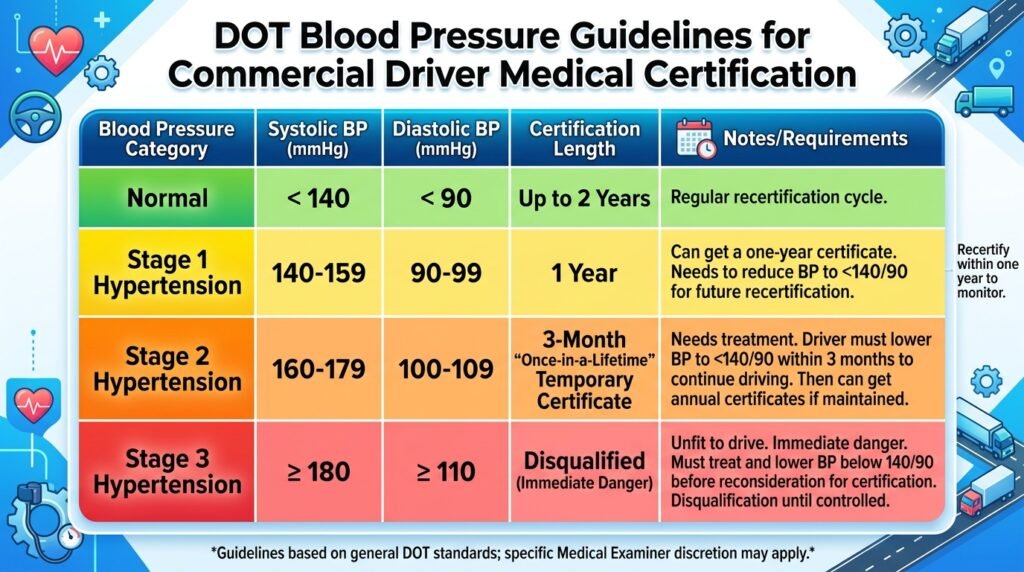
Blood pressure is one of the most common reasons drivers fail their DOT physical. The FMCSA uses specific categories to determine your certification length.
| Blood Pressure Reading | Certification Duration |
|---|---|
| Below 140/90 | 2-year certification |
| 140-159 / 90-99 (Stage 1) | 1-year certification |
| 160-179 / 100-109 (Stage 2) | One-time 1-year certificate; must lower to Stage 1 or below to recertify |
| 180/110 or higher (Stage 3) | Disqualified — cannot be certified |
If your reading falls in the Stage 2 range, you get a one-time certificate for one year. You must bring your numbers down before your next exam. Stage 3 readings lead to immediate disqualification.
Heart conditions like a history of heart attack, bypass surgery, or pacemaker use require additional evaluation. You may need clearance from a cardiologist before the examiner can certify you.
Diabetes and Insulin Use
Diabetes does not automatically disqualify you from holding a CDL. However, the rules depend on how you manage your condition.
- Diet-controlled or oral medication: You can receive a medical certificate CDL if your condition is stable and well-managed.
- Insulin-dependent: You must apply for a Federal Diabetes Exemption through the FMCSA. This requires regular monitoring and annual documentation from your treating physician.
The examiner will check your urine for sugar levels. You should also bring your most recent A1C test results and a letter from your doctor confirming your treatment plan.
Sleep Apnea Screening
Sleep apnea has become a major focus in the CDL medical exam process. This condition causes you to stop breathing during sleep. It leads to daytime fatigue, which is extremely dangerous for commercial drivers.
The examiner may screen you for sleep apnea based on:
- Body mass index (BMI) of 35 or higher
- Neck circumference of 17 inches or more
- Reported symptoms like loud snoring or excessive daytime sleepiness
If the examiner suspects sleep apnea, you may need a sleep study before receiving your medical card. Drivers diagnosed with this condition must use a CPAP machine and show compliance data. Read our full guide on sleep apnea and CDL requirements for detailed information.
What Medical Conditions Disqualify You From Getting a CDL?
Certain health problems will prevent you from passing the DOT physical exam. These are called disqualifying conditions. Some are absolute disqualifications. Others may allow you to drive with a waiver or exemption.
Absolute disqualifying conditions include:
- Epilepsy or any seizure disorder
- Vision loss that cannot be corrected to 20/40
- Hearing loss that does not meet minimum standards even with aids
- Uncontrolled blood pressure at Stage 3 (180/110 or higher)
- Active substance abuse or alcoholism
- Loss of a limb without a Skill Performance Evaluation (SPE) certificate
- Any condition that causes sudden loss of consciousness
Conditions that may disqualify without proper management:
- Diabetes requiring insulin (needs Federal Diabetes Exemption)
- Heart disease or history of cardiac events
- Sleep apnea (must demonstrate CPAP compliance)
- Certain psychiatric conditions
- Use of disqualifying medications such as methadone or Schedule I drugs
For a complete list of every condition, check out our guides on CDL disqualifications and DOT physical disqualifications.
Important: Having a medical condition does not always mean the end of your driving career. Many conditions can be managed with proper treatment and documentation. Talk to your doctor and the medical examiner about your options before assuming the worst.
DOT Medical Card Requirements
Your DOT medical card is proof that you passed the DOT physical exam. It is officially called the Medical Examiner’s Certificate (MEC), Form MCSA-5876. You must carry it and keep it current at all times while operating a commercial motor vehicle.
How Long Is a DOT Medical Card Valid?
The length of your DOT medical card depends on your health status at the time of the exam.
| Health Status | Card Validity |
|---|---|
| No health concerns | 2 years |
| Stage 1 high blood pressure | 1 year |
| Stage 2 high blood pressure | One-time 1-year certificate |
| Insulin-treated diabetes (with exemption) | Insulin-treated diabetes (with exemption): 1 year |
| Other monitored conditions | Varies based on examiner determination |
After your card expires, you must pass another DOT physical to get a new one. Driving with an expired card is a serious violation. It can lead to fines and being placed out of service by law enforcement.
Your medical certification must also be linked to your CDL through your state DMV. Since 2015, the FMCSA requires states to track your medical status electronically. If your card expires and you do not renew it, your CDL can be downgraded. For more details, read our complete DOT medical card guide.
DOT Medical Card Requirements for Non-CDL Drivers
You do not always need a CDL to be subject to DOT medical card requirements. If you drive a commercial vehicle in interstate commerce, you may still need a medical card. Non-CDL medical card requirements apply to drivers who operate:
- Vehicles weighing between 10,001 and 26,000 pounds
- Vehicles designed to transport 9 to 15 passengers (including the driver) for compensation
- Vehicles carrying hazardous materials in quantities that require placards
These DOT medical card requirements for non-CDL drivers follow the same DOT physical requirements as CDL drivers. The same exam applies. The same health requirements must be met.
If you are unsure whether you need a medical card, check with your employer or your state DMV for clarification.
CDL Medical Requirements 2026: What Has Changed
The FMCSA updates its regulations periodically. Staying current with CDL medical requirements 2026 changes is critical for maintaining your compliance and your career.
Here are the key updates and reminders for 2026:
Medical Examiner’s Certification Integration: All states now integrate your medical certificate CDL with your CDL record electronically. You must submit your medical card to your state DMV after every exam. Failure to do so can result in a CDL downgrade.
National Registry Enforcement: Only examiners listed on the FMCSA National Registry can perform DOT physicals. Always verify your examiner before booking your appointment. Use the DOT medical examiner database to confirm your provider is certified.
Sleep Apnea Screening Continues: While there is no formal FMCSA mandate requiring sleep apnea testing for all drivers, examiners continue to screen for it based on risk factors. Expect questions about your sleep habits and possible referral for a sleep study.
Insulin-Treated Diabetes Exemptions: The Federal Diabetes Exemption program continues to allow insulin-dependent drivers to qualify. Annual documentation from your treating physician is required.
Drug and Alcohol Clearinghouse: While not part of the medical exam itself, the FMCSA Drug and Alcohol Clearinghouse{target=”_blank”} works alongside the medical certification process. Employers must query the clearinghouse before hiring and at least annually.
For all regulatory updates, the official FMCSA driver medical requirements page{target=”_blank”} is your best and most reliable source.
How to Pass Your DOT Physical Exam
Passing the DOT physical does not have to be stressful. A little preparation goes a long way. Follow these practical tips to pass on your first try.
Before the exam:
- Gather your medical records. Bring documentation for every condition you are being treated for.
- Bring a list of all current medications with exact dosages.
- Bring your glasses, contacts, or hearing aids if you use them.
- Get a recent A1C test if you have diabetes.
- If you use a CPAP for sleep apnea, bring your compliance report showing at least 90 days of usage data.
- Avoid caffeine and high-sodium foods the day before. Both can temporarily raise your blood pressure.
- Get a good night of sleep before your appointment.
During the exam:
- Be completely honest about your medical history. Lying on the exam form is a federal offense.
- Stay calm and relaxed. Anxiety can temporarily raise your blood pressure reading.
- Ask questions if you do not understand something the examiner tells you.
After the exam:
- Submit your new medical certificate to your state DMV promptly. Do not delay this step.
- Set a calendar reminder 60 days before your card expires so you have time to schedule your next exam.
- Keep a copy of your medical card in your vehicle and in your driver qualification file.
Exemptions and Waivers for Disqualifying Conditions
If you have a condition that would normally disqualify you, do not give up. The FMCSA offers several exemption programs that could allow you to keep driving.
Federal Vision Exemption: This is for drivers who do not meet the vision standard in one eye but have adequate vision in the other. You must have at least 3 years of commercial driving experience and a clean safety record to qualify.
Federal Hearing Exemption: This is for drivers who do not meet the hearing test standard. Similar driving experience and safety record requirements apply.
Skill Performance Evaluation (SPE) Certificate: This is for drivers with limb loss or physical impairment. You must demonstrate you can safely operate a CMV during a supervised driving evaluation.
Federal Diabetes Exemption: This is for insulin-dependent drivers. You must submit medical documentation annually and maintain stable blood sugar levels under your doctor’s care.
Each exemption program has its own application process and timeline. Processing times vary, so apply well before your current certification expires.
Tip: Work closely with your medical examiner and your treating physician to prepare your exemption application. Complete and accurate documentation speeds up the approval process significantly.
For more on conditions that could affect your commercial driving privileges, visit our CDL disqualifications page.
Frequently Asked Questions
Yes. All CDL drivers must carry a valid DOT medical card while operating a commercial motor vehicle. Since 2015, your medical certification must also be on file with your state DMV. If your card expires and you do not renew it, your CDL can be downgraded until you pass a new DOT physical exam and submit updated documentation.
Conditions like epilepsy, uncontrolled high blood pressure at Stage 3, active substance abuse, and uncorrectable vision or hearing loss will disqualify you. Other conditions like diabetes, sleep apnea, and heart disease may require exemptions or additional documentation before you can be certified. See our full guide on DOT physical disqualifications for the complete list.
The cost varies by location and provider. In 2026, most DOT physical exams cost between $75 and $150, consistent with recent clinic pricing across the U.S. (ranging from $50-$60 at low-cost providers to $150+ at specialized ones). Check with your company or visit our DOT physical near me and cost guide for help finding affordable providers in your area.
Most healthy drivers renew every 2 years. Drivers with certain conditions like Stage 1 high blood pressure or managed diabetes may need to renew every year or even more frequently. Your medical examiner will tell you your exact certification period at the end of your exam.
It depends on the medication. Many common prescription drugs are allowed. However, certain medications are disqualifying. These include methadone, Schedule I controlled substances, and any medication that causes drowsiness or impairs your ability to drive safely. Always bring your complete medication list to the exam and discuss each one with the examiner.
Some do. Non-CDL medical card requirements apply to drivers operating commercial vehicles in interstate commerce that weigh between 10,001 and 26,000 pounds, transport 9 to 15 passengers for compensation, or carry placarded hazardous materials. These drivers must meet the same CDL physical requirements and pass the same DOT physical exam.
Conclusion
Meeting CDL medical requirements is not just a box to check. It is a vital part of keeping yourself and everyone else on the road safe. From passing the DOT physical exam to maintaining a valid DOT medical card, every step in this process matters for your career and your compliance.
Here is what to remember:
- Schedule your exam with a certified medical examiner from the FMCSA National Registry.
- Prepare your medical records, medications list, and specialist documentation in advance.
- Know the standards for the vision test, hearing test, blood pressure, and other CDL health requirements.
- If you have a condition like diabetes or sleep apnea, explore exemption options early.
- Submit your medical card to your state DMV promptly after every exam to avoid a CDL downgrade.
Staying on top of your CDL medical requirements protects your career and your livelihood. Do not wait until your card expires to start planning your next exam.
Ready to take the next step? Explore our CDL license requirements page for a full breakdown of everything you need to earn or maintain your commercial driver’s license.
Medical Eligibility Checker






![DOT Drug Test: What You Must Know in 2026 [Full Guide]](https://compliantdriversprogram.com/wp-content/uploads/2026/03/DOT-Drug-Test-150x150.jpeg)



Leave a Reply