

Ever wonder why so many truck drivers fail the CDL air brakes test on their first try? You gear up for your CDL written test, study hard, but those air brake questions trip you up. It happens because air brakes work different from car brakes, and you need to know the details.
Don’t worry, friend. This guide breaks down the CDL air brakes test just for you. You’ll get real air brake test questions with answers, tips on how to pass air brakes test CDL, and a full air brake CDL practice test free right here. By the end, you’ll feel ready to grab that air brake endorsement and hit the road.
What is the CDL Air Brakes Test?
Here’s the thing: the CDL air brakes test checks if you understand air brake systems on big trucks. You take this as part of your CDL written test if you want to drive vehicles with air brakes. Most states make it 25 questions, and you need 20 right to pass.
You’ll answer about brake components, inspection steps, and safety rules. It’s not just memorizing—you learn how to keep your truck safe. Check out our CDL Test Practice for more help.
The test matters because air brakes stop heavy loads fast. One wrong answer, and you wait weeks to retake it. In 2026, states added more questions on electronic stability control with air brakes.
Why You Need Air Brake Endorsement
Quick tip: without the air brake endorsement, you can’t drive most semis or buses. States require it for any truck over 10,001 pounds with air brakes. You add it to your CDL after passing the test.
It keeps roads safe too. Air brakes prevent accidents from brake fade or leaks. Most people don’t know this: trucks with bad air brakes cause 30% of big rig crashes (FMCSA, 2024).
Think about your dream job hauling freight. You need this endorsement to start. Skip it, and you limit your options to smaller rigs. New 2026 rules from FMCSA push for this on all Class A CDLs.
Air Brake System Basics
You use air brakes on big trucks because they handle heavy weight better than hydraulic ones. Air from the compressor fills tanks and pushes brakes when you press the pedal. Key parts include the compressor, governor, and slack adjusters.
The governor stops the compressor at cut-out pressure, around 120-140 PSI. It kicks back in at cut-in pressure, about 100 PSI lower. Air flows to service brakes for normal stops and spring brakes for parking.
Pro Tip: Always know your truck’s PSI range. Low air means spring brakes pop on at 20-45 PSI.
Brake lag happens when air takes time to reach brakes— up to half a second. That adds feet to your stopping distance. Practice feels it on downgrades. Modern trucks in 2026 have anti-lag valves to cut this time.
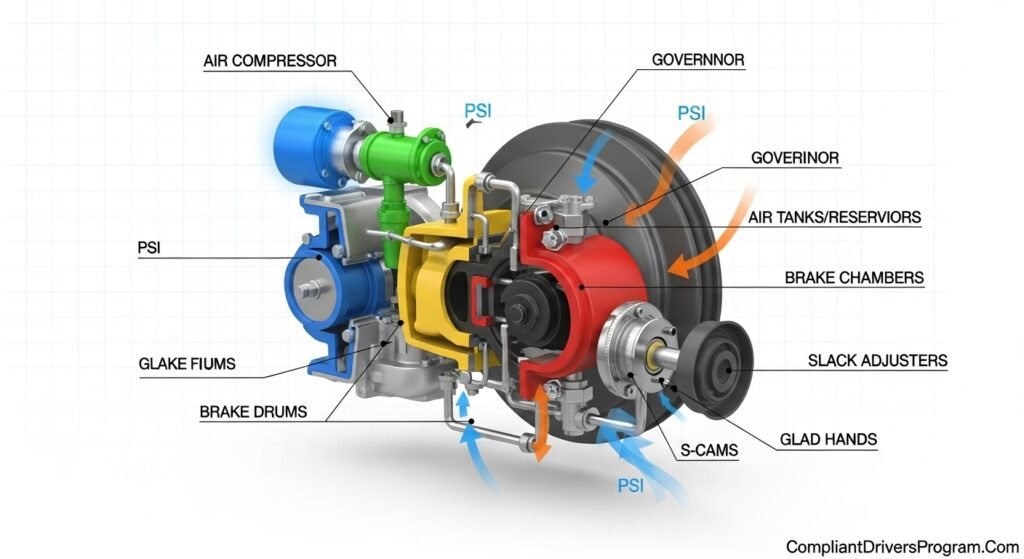
The supply system includes primary and secondary tanks. Wet tank catches water first. Air dryers, now standard on 2026 models, remove moisture better.
How Air Brakes Differ from Hydraulic
Most people don’t know this: hydraulic brakes use fluid, but air brakes use compressed air. Hydraulic works great for cars, but fails under heavy truck loads. Air brakes split into two systems for safety—if one fails, the other works.
Air systems need daily checks because air can leak fast. Hydraulic seals last longer but can’t handle 80,000-pound semis. You’ll see this on tests a lot.
Think about stopping a loaded trailer. Air pushes diaphragms in chambers to apply force. Hydraulic would overheat quick. Check Class A vs Class B CDL for vehicle types.
Step-by-Step Air Brake Inspection
You inspect air brakes daily before driving. Park on level ground and build air to governor cut-out. Then check for leaks.
Listen for leaks at glad hands, valves, and chambers. No more than 3 PSI loss per minute with brakes off, 4 PSI with them on. Pump the pedal to feel for softness.
Quick tip: drain water from tanks daily. Wet air freezes brakes in winter. Link this to your full CDL Pre Trip Inspection Test routine.
Do the seven-step check every time. Step one: build to 120 PSI. Step two: governor cut-out. Step three: low-pressure warning at 55-60 PSI.
Step four: tractor protection valve at 20-45 PSI. Step five: park brakes hold. Step six: service brakes stop truck. Step seven: roll test.
In 2026, add checks for ABS lights and electronic controls. They blink if faulty.
Full Seven-Step Air Brake Check
Here’s the thing: master the seven steps for your pre-trip. First, build air pressure to 120-140 PSI. Watch the governor cut out the compressor.
Second, pump brakes gently. Listen for the low-air warning buzzer at 60 PSI. It must work loud and clear.
Third, drain air to 20-45 PSI. Tractor protection valve pops, and spring brakes engage. Your truck shouldn’t move.
Fourth, build back to 90 PSI. Release parking brakes. Check service brakes—no leaks over 4 PSI per minute.
Fifth, roll forward slow at 5 MPH. Apply service brakes hard. Truck stops straight in 5 feet.
Sixth, test parking brakes on a 20% grade. Hold for 3 minutes—no roll back.
Seventh, check slack adjusters and drums. No cracks, proper adjustment.
Pro Tip: Time each step. Full check takes 10 minutes max.
Practice this hands-on. Schools use it for CDL Road Test & Skills Test.
Step-by-Step: Passing the CDL Air Brakes Test
Ready to pass? First, grab your state’s 2026 CDL handbook—free online from the DMV. Read the air brakes chapter twice. Focus on diagrams of the air brake system.
Next, take practice tests daily. Aim for 90% right before test day. Use apps or sites for CDL practice test air brakes questions.
Study 1-2 hours a day for two weeks. Test at the DMV early to avoid crowds. Bring ID and fee—about $10-30 per try in 2026.
Here’s the thing: relax during the test. Read each question slow. Eliminate wrong answers first. New tests include 2026 updates on electric air compressors.
Sample CDL Air Brakes Practice Test
Let’s dive into a bigger air brake CDL practice test. I’ve got 30 common questions with answers. Use this as your cdl air brakes practice test.
30 Air Brakes Quick Q&A
Tap to reveal answers✓ The governor cuts the compressor in and out.
✓ 100 PSI—it restarts the compressor.
✓ Between 20-45 PSI.
✓ 4 PSI per minute for trucks.
✓ Time for air to flow to brakes.
✓ It buzzes at 60 PSI.
✓ 1/2 the width of friction area.
✓ Build-up, governor, leaks—all of it.
✓ Compressor pulls it from the engine.
✓ No—get it to 100 PSI first.
✓ Drain air to 20 PSI and check pull-up.
✓ Brake fade—they stop working well.
✓ 120-140 PSI typical.
✓ Water and oil from tanks.
✓ No more than 1 inch by hand.
✓ Pump brakes till it buzzes at 60 PSI.
✓ Roll forward slow, apply brakes firm.
✓ Remove water to prevent freezing.
✓ Longer due to lag—add reaction time.
✓ Stop soon—possible leak or adjustment need.
✓ Cuts air to trailer if line breaks.
✓ Fault—truck still stops but less stable.
✓ Cuts front air first in emergencies.
✓ 7 seconds extra for air brake lag.
✓ Below 100 PSI—don’t drive.
✓ Manual needs daily checks; auto adjusts.
✓ Must match truck specs—no shortcuts.
✓ Alcohol evaporator or dryers mandatory.
✓ Mandatory dash cams for training now.
✓ Check both service and parking together.
How’d you do? Score 27+ and you’re golden. Review misses daily.
Advanced Brake Components Explained
You need to know more parts for 2026 tests. Quick-release valves dump air fast after stops. Relay valves speed air to back brakes.
Slack adjusters connect chambers to cams. Check angle—90 degrees perfect. S-cams turn to spread brake shoes.
Brake linings wear even. Measure thickness—1/4 inch minimum. Hoses crack? Replace over 2 years old.
Air reservoirs hold 100+ gallons on big rigs. Primary tank for rear, secondary for front. Crossfeed keeps balance.
Pro Tip: Trace air lines during pre-trip. Know primary from secondary.
Common Mistakes to Avoid
You might rush inspections and miss leaks. Always do the full seven-step check. Don’t ignore low PSI warnings—they save lives.
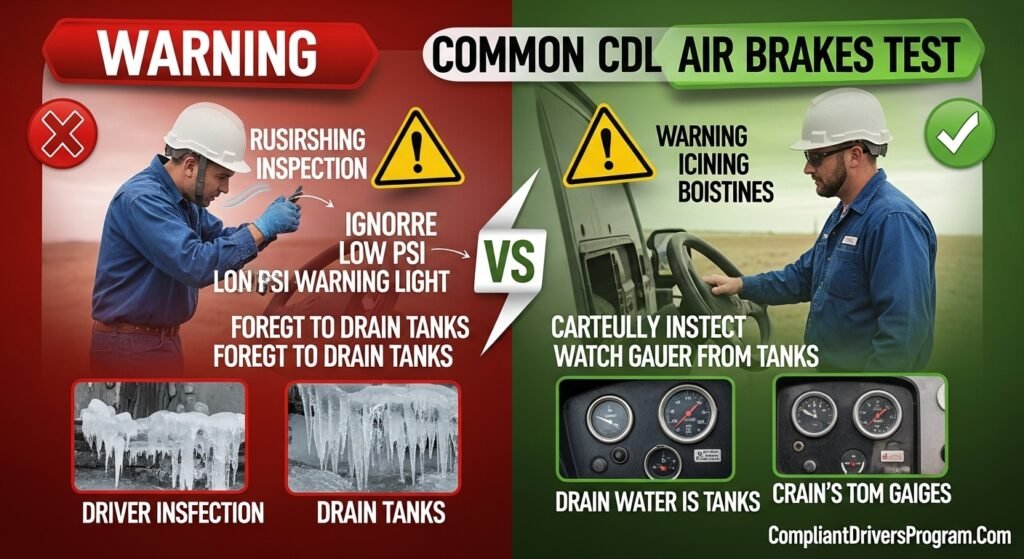
Skip practice tests? Big error. They show weak spots like governor pressures. For more, try our CDL General Knowledge Test.
Another trap: forgetting brake lag on tests. It adds 10-20 feet at 55 MPH. Adjust your following distance to 7 seconds.
Overlook ABS in 2026. Lights must work—tests check it now. Don’t pump brakes with ABS; let it do work.
Study Tips for Success
Here’s the thing: flashcards work great for PSI numbers. Write cut-in on one side, 100 PSI on back. Quiz yourself driving to work.
Join online forums for truckers. They share latest test changes. Apps like CDL Prep give timed CDL air brake practice test.
Pro Tip: Study with a buddy. Quiz each other on inspection steps.
Set a schedule: mornings for reading, evenings for tests. Track scores daily. Hit 95%? Book your test.
Teach others the seven steps. Explaining locks it in your brain. Use CDL Combination Test for trailer practice.
Video your pre-trip. Watch playback for misses. 2026 apps grade it automatic.
Costs and Time to Get Endorsement
Expect $10-50 for the test fee per state. Retakes cost the same. Study time runs 15-25 hours if you’re new.
Training schools charge $150-400 for air brake classes. They include hands-on inspection. Total time: 1-3 weeks prep.
FMCSA says proper training cuts fail rates by 40% (FMCSA, 2025). Worth the small cost. Entry-level training now mandatory for newbies.
Compare options in this table:
| Option | Cost | Time Needed | Effectiveness | Best For |
|---|---|---|---|---|
| Self-Study | $0-30 (handbook/apps) | 3 weeks | Medium | Quick learners |
| Online Courses | $40-120 | 10 days | High | Busy schedules |
| Truck School | $250-600 | 5-7 days | Very High | Hands-on practice Best CDL Schools |
| ELDT Provider | $300-800 | 1 week | Highest | 2026 compliance |
Self-study saves money but takes discipline. ELDT required for first CDL.
Real-World Scenarios and Examples
Picture this: you’re on I-80 downhill. Brakes fade from heat. You downshift, use retarder—safe stop.
Another: glad hand leak on trailer. Air drops fast. Hook up quick, test before roll.
Winter storm hits. Tanks freeze. You missed drain—stuck roadside. Daily checks prevent it.
2026 example: electric truck air brakes. Compressor runs quieter, greener. Tests cover hybrid systems now.
Pro hauler tip: log inspections daily. DOT audits love it.
External Resources for Practice
Boost your prep with trusted sites. The FMCSA Handbook has official rules. California DMV offers free PDFs too.
Wikipedia explains parts simply Air Brake System. DOT Air Brake Manual for deep dives.
FAQ
A: 25 questions on components, inspections, PSI levels, and safety. Pass with 80% right.
A: Study handbook, take 10 practice tests, master seven-step check. Practice two weeks.
A: Right here plus DMV sites. Do 100 questions minimum before testing.
A: Lets you drive air brake trucks legally. Required for Class A/B CDL often. See Types of CDL Licenses.
A: Not if you prep. Focus on leaks, governor, lag. 90% pass after practice.
A: Air uses compressed air, safer for heavy loads. Hydraulic for cars.
A: Wait 1-7 days by state. Study weak areas first.
A: More on ABS, ELDT, electric systems. Check FMCSA updates.
- Master PSI: cut-in 100, cut-out 120-140, springs 20-45.
- Do daily seven-step inspections for leaks and build-up.
- Practice 30+ questions daily to nail the CDL air brakes test.
- Adjust for brake lag—keep 7-second following distance.
- Use ELDT for 2026 compliance.
Your next step? Take our full CDL Test Practice now. Print these questions, quiz daily, and book your test. You’ll pass easy and hit the road earning. Drive safe!
Air Brakes Practice Test
CDL Air Brakes Practice Test
30 Questions • 30 Minutes • 80% to Pass
Real DMV Questions
Timed Exam Mode
Instant Explanations
Track Progress
Loading question…
💡 Explanation
Flashcard Study Mode
👆 Tap any card to reveal the answer
Critical PSI Pressure Zones
20-45
60
100-140
Key PSI Numbers to Memorize
| Component | PSI Range | Action |
|---|---|---|
| Governor Cut-Out | 120-140 PSI | Compressor stops |
| Governor Cut-In | 100 PSI | Compressor restarts |
| Low Air Warning | 60 PSI | Buzzer/light activates |
| Spring Brakes Engage | 20-45 PSI | Truck stops automatically |
| Tractor Protection Valve | 20-45 PSI | Closes to protect tractor |
| Safe Operating Range | 100-140 PSI | Normal driving |
| Max Leak (brakes off) | 3 PSI/min | Pass inspection |
| Max Leak (brakes on) | 4 PSI/min | Pass inspection |
7-Step Air Brake Inspection
- 1Build air pressure to 120-140 PSI. Watch governor cut out compressor.
- 2Pump brakes to test low-air warning. Buzzer must sound at 60 PSI.
- 3Drain air to 20-45 PSI. Tractor protection valve closes, spring brakes engage.
- 4Build back to 90 PSI. Check for leaks – max 4 PSI/min with brakes applied.
- 5Roll test at 5 MPH. Apply brakes firmly – truck must stop straight.
- 6Test parking brakes on grade. Hold 3 minutes with no rollback.
- 7Check slack adjusters manually. No more than 1 inch movement.
Air Brake Components
| Component | Function |
|---|---|
| Air Compressor | Pumps air into storage tanks |
| Governor | Controls when compressor turns on/off |
| Air Tanks/Reservoirs | Store compressed air |
| Air Dryer | Removes moisture from air system |
| Brake Chambers | Convert air pressure to mechanical force |
| Slack Adjusters | Connect chambers to brake cams |
| S-Cams | Turn to spread brake shoes against drums |
| Spring Brakes | Emergency/parking brakes |
| Glad Hands | Connect tractor and trailer air lines |
| Relay Valves | Speed up air delivery to brakes |







![DOT Drug Test: What You Must Know in 2026 [Full Guide]](https://compliantdriversprogram.com/wp-content/uploads/2026/03/DOT-Drug-Test-150x150.jpeg)



Leave a Reply