
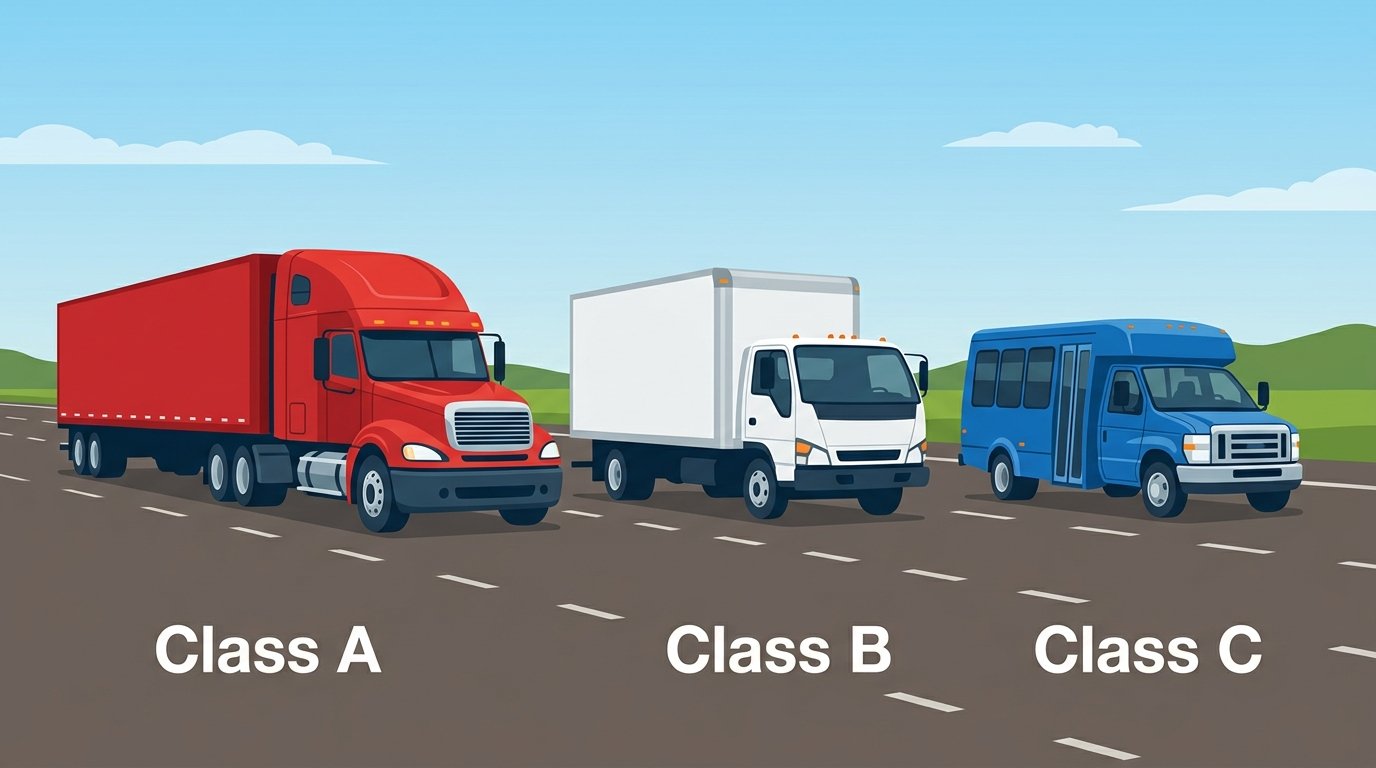
You want to drive commercial vehicles for a living. But there are 3 types of CDL license, and picking the wrong one wastes your time and money. Each class unlocks different vehicles, different jobs, and different pay scales.
This guide breaks down every CDL license class in plain English. You will learn exactly what Class A CDL, Class B CDL, and Class C CDL each cover. We explain the weight limits, vehicle types, job options, and requirements for each class. Whether you want to haul freight cross-country or drive a school bus in your hometown, this article helps you find the right fit.
Key Takeaways
- The 3 types of CDL license are Class A, Class B, and Class C
- Class A covers the heaviest combination vehicles with a GCWR over 26,001 lbs
- Class B covers heavy single vehicles with a GVWR over 26,001 lbs
- Class C covers vehicles carrying 16+ passengers or hazardous materials
- A higher CDL class lets you also drive vehicles in the lower classes
- Your career goals and target vehicle determine which class you need
What Are the 3 Types of CDL License?
The federal government splits commercial driver’s licenses into three distinct classes. These are Class A, Class B, and Class C. The Federal Motor Carrier Safety Administration (FMCSA) sets the national rules for all three.
Each class is based on the vehicle’s weight and what it carries. Heavier and more complex vehicles require a higher license class. A Class A CDL sits at the top of the scale. A Class C CDL covers lighter commercial vehicles with special cargo or passenger loads.
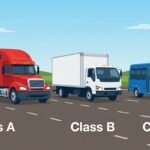
Here is a quick look at the different types of CDL:
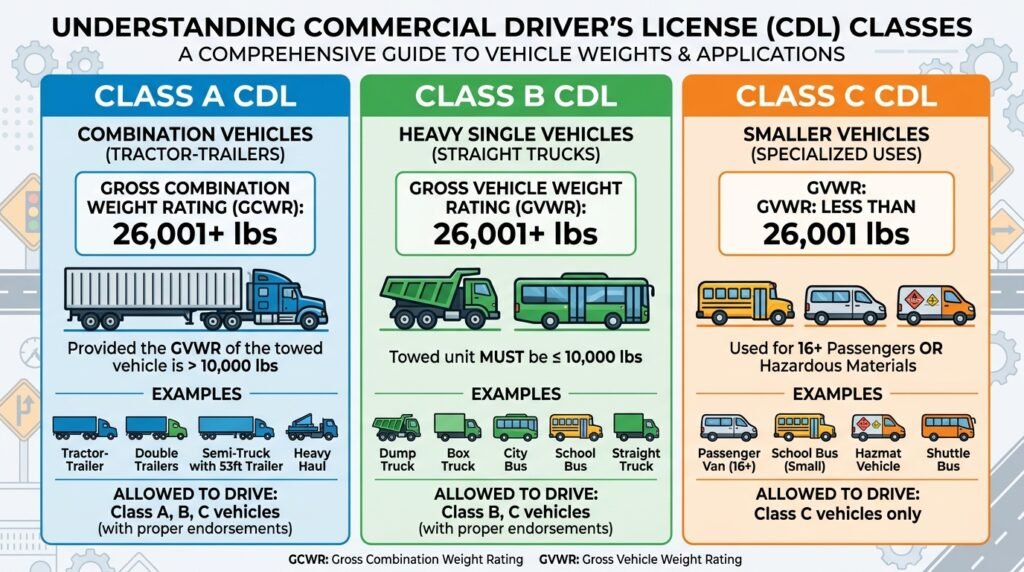
- Class A — Combination vehicles with a GCWR of 26,001 lbs or more, where the towed unit exceeds 10,000 lbs
- Class B — Single vehicles with a GVWR of 26,001 lbs or more
- Class C — Vehicles designed to carry 16+ passengers or transport hazardous materials
Every state follows these federal standards. However, each state may add its own rules on top of the baseline. Check our guide on CDL license requirements by state to see what your state expects.
So, how many types of CDL exist? Exactly three. Let us look at how each one is defined.
How CDL License Classes Are Defined
The Role of Vehicle Weight Ratings
Two weight numbers decide your CDL class. The first is Gross Vehicle Weight Rating (GVWR). This is the maximum safe weight of a single vehicle, including its cargo and passengers. The second is Gross Combination Weight Rating (GCWR). This is the combined maximum weight of the power unit plus any trailer it tows.
The FMCSA uses these weight limits to draw clear lines between the three classes. If a truck and its trailer together exceed 26,001 lbs GCWR, and the trailer alone exceeds 10,000 lbs GVWR, you need a Class A CDL. If only the single vehicle exceeds 26,001 lbs GVWR without a heavy trailer, a Class B CDL is enough.
For vehicles below both weight thresholds, a Class C CDL only applies if the vehicle carries 16 or more passengers or hauls placarded hazardous materials.
Why the CDL Class System Exists
Bigger vehicles are harder to stop, turn, and control. A loaded 18-wheeler handles nothing like a delivery van. The CDL class system makes sure drivers get trained on the exact vehicle types they will operate.
A driver skilled with a straight truck may not be ready for a tractor-trailer with 80,000 lbs of freight. That is why the FMCSA created three separate license classes with distinct knowledge tests and skills tests for each. This system protects drivers, passengers, and everyone else sharing the road.
The towing capacity of a vehicle also matters. Towing a heavy trailer adds complexity. You deal with wider turns, longer stopping distances, and the risk of jackknifing. This is exactly why combination vehicles require the highest CDL class.
Class A CDL: The Most Versatile Commercial License
A Class A CDL is the gold standard of commercial driving. It lets you operate the largest and heaviest vehicles on American roads. If you want maximum career flexibility, this is the class to pursue.
What Is a Class A License?
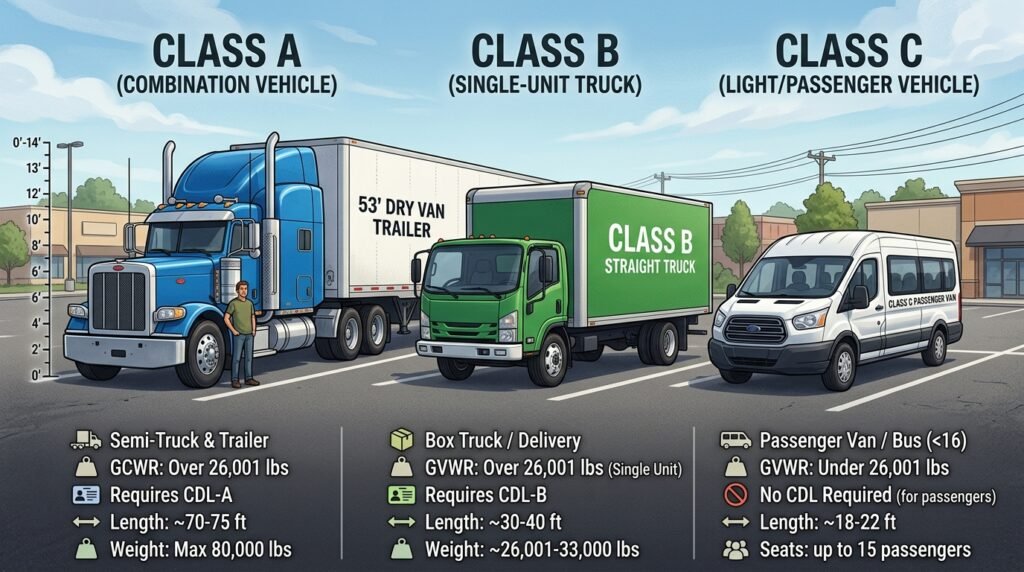
A Class A license allows you to drive combination vehicles. These are trucks connected to trailers that together have a GCWR of 26,001 lbs or more. The key detail is that the towed unit must have a GVWR exceeding 10,000 lbs.
Think of tractor-trailers, 18-wheelers, and big rigs. These are all Class A vehicles. Flatbed rigs, tanker combinations, and livestock haulers also belong in this category when paired with a heavy tractor unit.
Vehicles You Can Drive with a Class A CDL
With a Class A CDL, you can operate:
- Tractor-trailers and semi-trucks (18-wheelers)
- Flatbed trailer combinations
- Tanker truck combinations
- Livestock carriers
- Double and triple trailers (with proper endorsement)
- Most Class B and Class C vehicles (with applicable endorsements)
That last point is a big deal. A Class A holder can typically step down and drive Class B and Class C vehicles too. This gives you the widest range of options. Explore the full list in our guide on what you can drive with a Class A CDL.
Class A Weight Requirements
| Requirement | Threshold |
|---|---|
| Gross Combination Weight Rating (GCWR) | 26,001 lbs or more |
| Towed Vehicle GVWR | Must exceed 10,000 lbs |
If your towed vehicle weighs 10,000 lbs or less, you may only need a Class B CDL, even if the total GCWR is high. The weight of the towed unit is the deciding factor between Class A and Class B.
Class B CDL: Heavy Single Vehicle Operations
A Class B CDL covers heavy single vehicles. You do not need to drive combination rigs to put this license to good use. Many drivers choose Class B for stable local and regional work with predictable schedules.
What Can You Drive with a Class B CDL?
What can you drive with a Class B CDL? More than you might think. This class covers any single vehicle with a GVWR of 26,001 lbs or more. You can also tow a trailer, but only if that trailer has a GVWR of 10,000 lbs or less.
Common Class B vehicles include:
- Straight trucks (box trucks, delivery trucks)
- Large city transit buses
- Dump trucks (without heavy trailers attached)
- Cement mixers
- Garbage and recycling trucks
- Segmented buses
- Large tow trucks (with light trailers)
Common Class B Jobs and Career Paths
Class B CDL drivers fill essential roles in every community. Here are some popular career paths:
- City and transit bus driver
- Package and freight delivery driver
- Dump truck operator for construction sites
- Garbage and recycling truck driver
- School bus driver (with a Passenger and School Bus endorsement)
- Furniture and appliance delivery driver
Many of these positions offer steady hours and let you sleep in your own bed every night. If long-haul trucking does not appeal to you, a Class B might be the perfect fit. Browse more opportunities on our CDL jobs page.
Class B Weight Requirements
| Requirement | Threshold |
|---|---|
| Single Vehicle GVWR | 26,001 lbs or more |
| Towed Vehicle GVWR (if any) | 10,000 lbs or less |
The moment you tow a trailer exceeding 10,000 lbs GVWR, you cross into Class A CDL territory. Keep this in mind if your employer ever asks you to pull heavier loads.
Class C CDL: Specialized Vehicles and Passengers
A Class C CDL works differently from the other two classes. It is not about heavy weight at all. Instead, it focuses entirely on what the vehicle carries.
What Vehicles Need a Class C CDL?
You need a Class C CDL when your vehicle does not meet Class A or Class B weight thresholds but fits one of these descriptions:
- Designed to transport 16 or more passengers (including the driver)
- Used to carry hazardous materials that require placards under federal rules
- A combination of both passenger and HazMat requirements
Common Class C license vehicles include:
- Small passenger vans and minibuses with 16+ seats
- Small HazMat delivery trucks
- Church and organization shuttle buses
- Airport shuttle vans
- Some hotel and resort transport vehicles
When Do You Need a Class C License?
Many drivers overlook this class. They assume a regular driver’s license covers all smaller vehicles. But if your vehicle seats 16 or more passengers or hauls hazardous materials requiring placards, a standard license is not enough. You must carry a Class C CDL with the appropriate endorsements.
Here is a real-world example. A 15-passenger church van does not require a CDL. But add one more seat to make it 16 passengers, and now you need a Class C CDL with a Passenger (P) endorsement. That cutoff is strict and enforced.
Similarly, a small delivery truck carrying non-hazardous goods needs no CDL. Load that same truck with placarded hazardous materials, and you now need a Class C CDL with a Hazmat endorsement.
Important: A Class C CDL does NOT allow you to drive Class A or Class B vehicles. It only covers lighter vehicles with special cargo or passenger requirements. The hierarchy only works downward, never upward.
Side-by-Side Comparison: Class A vs Class B vs Class C
Seeing the difference between Class A B C CDL in one place makes the choice much clearer. Use this comparison table:
| Feature | Class A CDL | Class B CDL | Class C CDL |
|---|---|---|---|
| Weight Standard | 26,001+ lbs GCWR | 26,001+ lbs GVWR (single vehicle) | Below Class A and B thresholds |
| Towed Vehicle | Over 10,000 lbs GVWR | 10,000 lbs or under | Not weight-based |
| Typical Vehicles | Semi-trucks, tractor-trailers, flatbeds | Straight trucks, city buses, dump trucks | Passenger vans (16+), small HazMat trucks |
| Can Drive Lower Classes? | Yes (B and C with endorsements) | Yes (C only with endorsements) | No |
| Typical Training Length | 3 to 10 weeks | 2 to 6 weeks | 1 to 4 weeks |
| Average Annual Salary | $60,000 to $85,000+ | $45,000 to $65,000 | $38,000 to $55,000 |
| Job Demand (2026) | Very high (driver shortage) | High | Moderate |
| Skills Test Complexity | Most complex (includes coupling/uncoupling) | Moderate | Least complex |
For a deeper head-to-head breakdown of the top two classes, read our full Class A vs Class B CDL comparison.
Which CDL Class Do I Need?
Choosing the right CDL class depends on two things: the vehicle you plan to drive and your long-term career goals. Let us break both down.
Choose Based on Your Career Goals
Ask yourself what kind of driving career you want:
- Long-haul or over-the-road (OTR) trucking? You need a Class A CDL. Nearly every major trucking company requires it for their highway drivers.
- Local delivery and distribution routes? A Class B CDL covers most straight trucks and box trucks used for deliveries.
- School bus or public transit? Start with a Class B for large buses or a Class C for smaller shuttles. Both require a Passenger endorsement.
- HazMat transport in a smaller vehicle? A Class C CDL with the HazMat endorsement handles this.
- Owner-operator with your own rig? Definitely Class A. You also need commercial vehicle insurance before you hit the road.
Curious about pay differences between classes? Check out our guide on truck driver salary by CDL class and experience level.
Choose Based on Vehicle Type
If you already know what vehicle you will drive, match it directly to the right class:
| Vehicle You Want to Drive | CDL Class Needed |
|---|---|
| 18-wheeler or semi-truck | Class A |
| Flatbed with heavy trailer | Class A |
| Double or triple trailer | Class A + Doubles/Triples endorsement |
| Tanker combination rig | Class A + Tanker endorsement |
| Straight truck over 26,001 lbs | Class B |
| City transit bus | Class B + Passenger endorsement |
| Dump truck (no heavy trailer) | Class B |
| Cement mixer truck | Class B |
| School bus | Class B + Passenger + School Bus endorsements |
| 16+ passenger van or shuttle | Class C + Passenger endorsement |
| Small HazMat delivery vehicle | Class C + HazMat endorsement |
Pro Tip: When in doubt, get the Class A CDL. It covers Class B and Class C vehicles too. You keep all your career options open and qualify for the highest paying trucking jobs right away.
Expand Your CDL with Endorsements
A CDL class alone may not be enough for the job you want. Many employers require special endorsements on top of your base license. These endorsements prove you can safely handle specific types of cargo or vehicles.
Here are the most common CDL endorsements:
| Endorsement | Code | What It Covers |
|---|---|---|
| Hazardous Materials | H | Vehicles carrying placarded hazardous materials |
| Tanker | N | Vehicles carrying liquid in bulk tanks |
| Doubles/Triples | T | Pulling double or triple trailers |
| Passenger | P | Vehicles designed for 16+ passengers |
| School Bus | S | School bus operations specifically |
| HazMat + Tanker (combo) | X | Combined H and N for HazMat tankers |
Each endorsement requires passing an additional written knowledge test at your state DMV. Some endorsements, like HazMat, also require a TSA background check and fingerprinting. Get the full rundown in our CDL endorsements list.
Adding endorsements increases your value to employers significantly. Drivers who hold a tanker endorsement or HazMat qualification often earn noticeably higher pay. Specialized skills command premium wages in the trucking industry.
There are also restriction codes that limit what you can drive. Certain violations can lead to CDL disqualifications that strip endorsements or suspend your license entirely. Knowing the rules keeps your career on track.
Steps to Get Your CDL in 2026
Getting your commercial driver’s license follows a clear, step-by-step process. The FMCSA’s Entry Level Driver Training (ELDT) requirements remain in full effect for 2026. Here is what to expect.
- Meet basic eligibility requirements. You must be at least 18 years old for intrastate (within your state) commercial driving. Interstate (crossing state lines) driving requires you to be at least 21.
- Apply for your CDL learner’s permit. Study for and pass the written knowledge tests for your chosen class. Our CDL permit guide walks you through every step.
- Complete ELDT-approved training. Attend a training program registered on the FMCSA Training Provider Registry. This is mandatory before you can take your skills test.
- Pass the DOT medical exam. Get your DOT physical and receive your medical examiner’s certificate. Learn what the exam covers in our CDL medical requirements guide.
- Pass the three-part skills test. Complete the pre-trip vehicle inspection test, the basic vehicle controls test, and the on-road driving test.
- Receive your CDL. Visit your state DMV with your passing test results to get your official commercial driver’s license.
The overall process is similar for all three CDL classes. However, the knowledge tests and skills tests differ based on which class you pursue. Class A tests are the most involved because they include combination vehicle maneuvers like coupling, uncoupling, and trailer backing.
For a detailed walkthrough from start to finish, read our complete guide on how to get a CDL.
CDL Career Paths and Earning Potential
Your CDL class directly shapes your earning potential and job options. Here is what the job market looks like heading into 2026.
Class A Career Opportunities
Class A CDL holders have the broadest range of options. They qualify for:
- Over-the-road (OTR) and long-haul trucking
- Regional and dedicated route driving
- Owner-operator business opportunities
- Specialized hauling (oversized loads, refrigerated freight, auto transport)
- Tanker and HazMat combination transport
According to the Bureau of Labor Statistics, demand for heavy and tractor-trailer truck drivers remains strong through the decade. An ongoing driver shortage continues to push wages higher and create steady job openings across the country.
Class B Career Opportunities
Class B CDL holders typically work closer to home. Common career paths include:
- Municipal and city transit bus driver
- Waste management and recycling truck driver
- Construction dump truck operator
- Package delivery and distribution driver
- Concrete mixer truck operator
These jobs usually come with regular daytime schedules. Many public sector positions also include government benefits, retirement plans, and union protections.
Class C Career Opportunities
Class C CDL holders fill important niche roles:
- Airport and hotel shuttle driver
- Church and organization transport driver
- Small HazMat delivery vehicle operator
- Medical transport and paratransit driver
- Tour and charter shuttle driver
While starting salaries tend to be lower than Class A or Class B positions, many Class C jobs offer part-time flexibility and lighter physical demands. They can also serve as a stepping stone toward upgrading to a higher class later.
Frequently Asked Questions
The three types of CDL license are Class A, Class B, and Class C. Class A covers combination vehicles with a GCWR exceeding 26,001 lbs where the towed unit is over 10,000 lbs. Class B covers single vehicles over 26,001 lbs GVWR. Class C covers vehicles carrying 16 or more passengers or placarded hazardous materials that fall below Class A and B weight thresholds.
The main difference comes down to vehicle weight and configuration. Class A handles the heaviest combination rigs. Class B handles heavy single vehicles. Class C handles lighter vehicles with special cargo or passenger requirements. A higher class lets you also operate vehicles in the classes below it.
Class A is the most challenging. It requires the longest training period and includes the most complex skills test. You must demonstrate mastery of coupling and uncoupling trailers, combination vehicle air brakes, and advanced backing maneuvers. However, it also gives you access to the most job opportunities and highest pay.
Yes. Many drivers start with a Class B CDL and upgrade to Class A after gaining experience. You will need to complete additional ELDT training for combination vehicles, pass the Class A knowledge tests, and pass the Class A skills test. Some of your existing training and experience may help accelerate the process.
Usually not. Most personal pickup trucks with trailers fall well below the 26,001 lb GCWR threshold. However, if your combination exceeds that weight and the towed unit is over 10,000 lbs GVWR, you will need a Class A CDL. Always verify your vehicle’s specific weight ratings on the manufacturer’s door sticker.
Training time varies by class. Class A programs typically run 3 to 10 weeks. Class B programs take 2 to 6 weeks. Class C programs can be completed in 1 to 4 weeks. Your total timeline also depends on permit processing, medical exam scheduling, DMV wait times, and test availability in your state.
Conclusion
Now you know exactly what the 3 types of CDL license are and how each one works. Class A covers the biggest combination vehicles and unlocks the most career doors. Class B handles heavy single vehicles for dependable local and regional work. Class C serves drivers who transport passengers or hazardous materials in lighter vehicles.
Your best choice depends on your career goals, the vehicles you want to drive, and how much time you can invest in training. If you want maximum flexibility, go for the Class A CDL. It qualifies you for nearly every commercial driving job on the road.
Ready to take the next step? Visit our complete guide on how to get a CDL and start your journey toward a commercial driving career today. Make sure you also review the specific CDL license requirements for your state before you begin.
Based on FMCSA regulations current as of 2026. Always verify details with your state DMV and official federal sources for the latest updates.
CDL Class Selector Tool




![DOT Drug Test: What You Must Know in 2026 [Full Guide]](https://compliantdriversprogram.com/wp-content/uploads/2026/03/DOT-Drug-Test-150x150.jpeg)



Leave a Reply