

Getting hazmat placards wrong isn’t a paperwork issue you can shrug off. It’s one of the fastest ways to get a truck placed out of service during a roadside inspection, and it’s also one of the most preventable violations out there, once you understand exactly how the rules work.
I’ll walk you through what triggers a placarding requirement, which placard goes with which hazard class, what has to be on your shipping papers, and where drivers and carriers most often get tripped up.
What Hazmat Placards Actually Do
A placard is that diamond-shaped sign you see on the side of a tanker or trailer. It’s not decoration. It tells inspectors and, more importantly, emergency responders exactly what kind of hazard is on that vehicle before they open a single door. If a crash happens and a placard is missing, wrong, or unreadable, first responders are working blind at the worst possible moment.
Placarding and shipping papers work as a pair. The placard is the outside signal. The shipping paper is the detailed record that confirms what’s actually in the load, in what quantity, and who to call if something goes wrong. Get either one wrong, and the whole communication system breaks down.
The Legal Framework
Placarding and shipping paper requirements come from 49 CFR Part 172, the section of the Hazardous Materials Regulations that governs hazmat communication. Shipping paper rules sit in Subpart C, marking rules in Subpart D, and placarding rules in Subpart F. These regulations are written and enforced by the Pipeline and Hazardous Materials Safety Administration, with FMCSA handling the motor carrier enforcement side. Every driver hauling regulated quantities of hazardous materials is expected to know how these two subparts interact, not just one or the other.
When Placarding Is Required
Not every hazmat shipment needs a placard. Whether one is required comes down to two tables in 49 CFR 172.504, and knowing which table your material falls under changes everything about how you prepare the load.
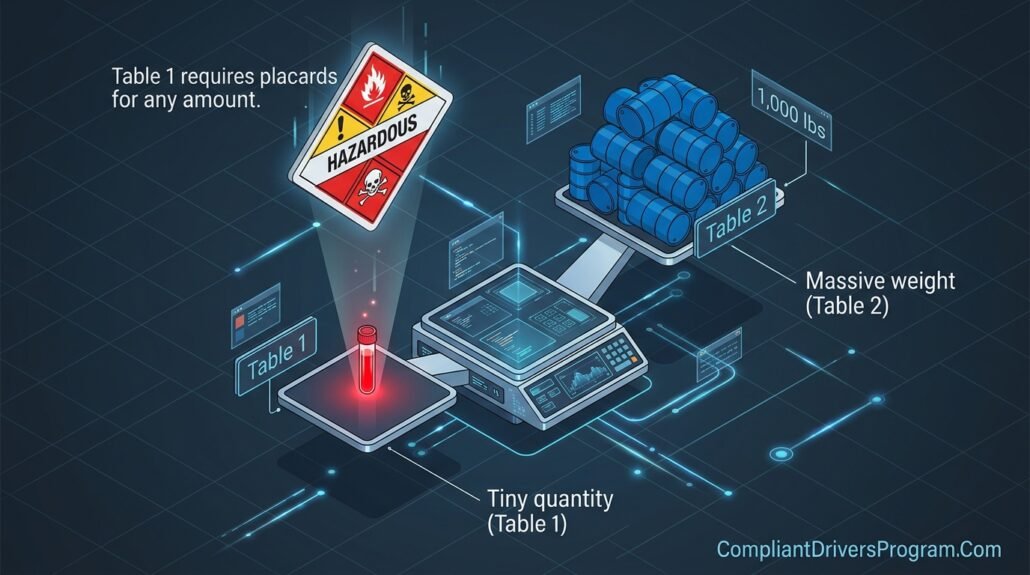
Table 1 Materials: Any Quantity Requires a Placard
Table 1 covers the most dangerous categories, and there’s no weight threshold here. If even one package of a Table 1 material is on the vehicle, it needs the placard. This includes:
- Division 1.1, 1.2, and 1.3 explosives
- Division 2.3 poison gas
- Division 4.3 materials that are dangerous when wet
- Division 5.2 organic peroxides (Type B, liquid or solid, temperature controlled)
- Division 6.1 poisonous materials in certain hazard zones
- Class 7 radioactive materials in specific categories
Table 2 Materials: The 1,001-Pound Threshold
Table 2 covers the more commonly hauled classes, like flammable liquids, corrosives, and most gases. These materials only trigger a placarding requirement once the aggregate gross weight on the vehicle reaches 454 kilograms, or 1,001 pounds. Below that weight, in non-bulk packaging, no placard is required, though nothing stops a carrier from placarding anyway.
There’s a related rule worth knowing: if 1,000 kilograms (2,205 pounds) or more of a single Table 2 category is loaded at one facility, that specific placard is required even if the load also carries a DANGEROUS placard for other materials.
The Bulk Packaging Exception
The 1,001-pound threshold does not apply to bulk packaging. A cargo tank, portable tank, or any bulk container holding any quantity of a Table 2 hazardous material must be placarded on each side and each end, regardless of how full it is. This is one of the most commonly missed rules. A half-empty tanker still needs its placards, and the DANGEROUS placard substitution isn’t available for bulk loads either.
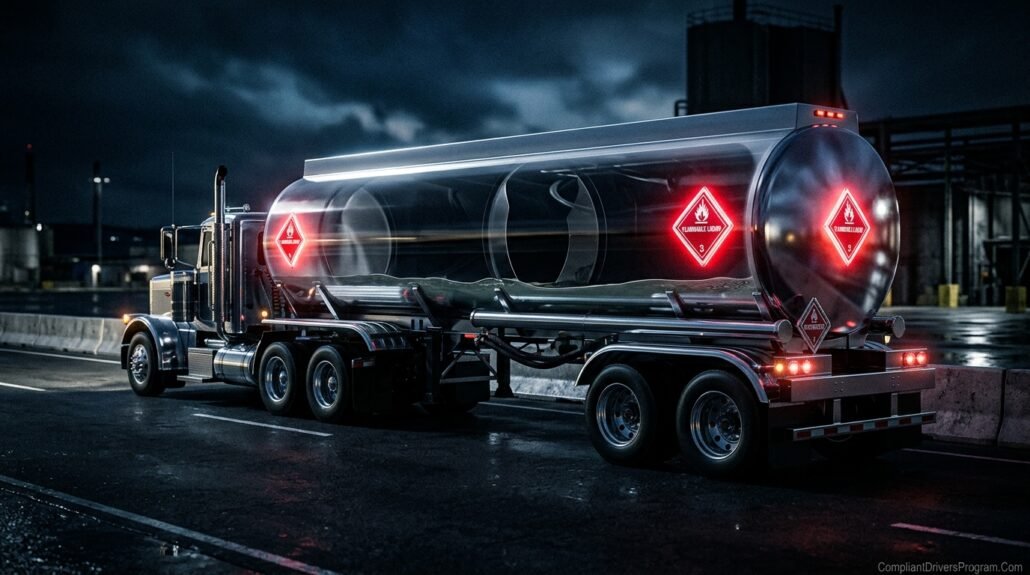
The Nine Hazard Classes and Their Placards
| Class | Hazard Type | Table |
|---|---|---|
| Class 1 | Explosives (Divisions 1.1–1.6) | Mostly Table 1 |
| Class 2 | Gases (flammable, non-flammable, poisonous) | Mixed, Division 2.3 is Table 1 |
| Class 3 | Flammable liquids | Table 2 |
| Class 4 | Flammable solids, spontaneously combustible, dangerous when wet | Mixed, Division 4.3 is Table 1 |
| Class 5 | Oxidizers and organic peroxides | Mixed |
| Class 6 | Toxic and infectious substances | Mixed, certain 6.1 zones are Table 1 |
| Class 7 | Radioactive materials | Mostly Table 1 |
| Class 8 | Corrosives | Table 2 |
| Class 9 | Miscellaneous hazardous materials | Table 2 |
Each placard corresponds to its class number, which must appear in the bottom corner of the diamond. Reviewing the full hazmat endorsement requirements is worth doing alongside this, since drivers hauling these classes need the H endorsement on their CDL before they can legally transport most of them in the required quantities.
Placard Design and Placement Rules
Placards aren’t just any diamond-shaped sign. Federal specifications are exact:
- Minimum size of 250 mm (9.84 inches) on each side, oriented as a square turned 45 degrees
- A solid-line inner border set roughly 12.5 mm inside the outer edge
- The hazard class or division number at the bottom must be at least 41 mm (1.6 inches) tall
- Placards must go on each side and each end of the vehicle, meaning four total placards for most loads
- They must be clearly visible and not obscured by ladders, tarps, or other equipment
Placards cannot be displayed unless the vehicle is actually carrying a hazardous material that matches that placard. Displaying an unused placard, or one left over from a previous load, is itself a violation, since it misrepresents what’s on the vehicle to inspectors and responders.
The DANGEROUS Placard Option
When a non-bulk load carries two or more categories of Table 2 materials that would otherwise require different placards, a single DANGEROUS placard can be used instead of placarding for each hazard class separately. This only applies to non-bulk packaging, and it doesn’t apply if 1,000 kilograms or more of any single category is loaded at one location. In that case, the specific placard for that category still has to go on the vehicle, even alongside the DANGEROUS placard.
Shipping Papers: What Must Be Included
Every hazmat shipment needs a shipping paper, and it has to include this information in the correct order:
- Proper shipping name, taken directly from the Hazardous Materials Table in 49 CFR 172.101
- Hazard class or division, shown as a number (Class 3 for flammable liquid, for example)
- UN or NA identification number, a four-digit code that pinpoints the exact material
- Packing group, shown as Roman numeral I, II, or III where applicable, indicating the degree of danger
- Total quantity, including the unit of measurement
- Number and type of packages being shipped
A 24-hour emergency response telephone number is also required on the shipping paper. This isn’t optional, and it has to connect to someone who actually has information about the hazardous material, not just a general company line that goes to voicemail after hours.
Mixed Loads and Ordering Rules
When a shipment includes both hazardous and non-hazardous materials on the same paper, the hazardous entries have to stand out. Regulations allow this to happen a few different ways: listing hazmat entries first, printing them in a contrasting color, or marking them with an “X” in a designated hazmat column. Whichever method is used, the goal is the same, an inspector or responder should be able to find the hazmat information at a glance, without reading through an entire manifest.
Where the Shipping Paper Has to Be
The shipping paper must stay within the driver’s immediate reach while the vehicle is moving, and it has to be either in a holder mounted on the driver’s door or clearly visible on the seat next to the driver. When the driver isn’t behind the wheel, it needs to be in the driver’s door pocket or clearly visible on the driver’s seat. Inspectors check this specifically, and a shipping paper buried in a glovebox or stored in the sleeper doesn’t meet the requirement.
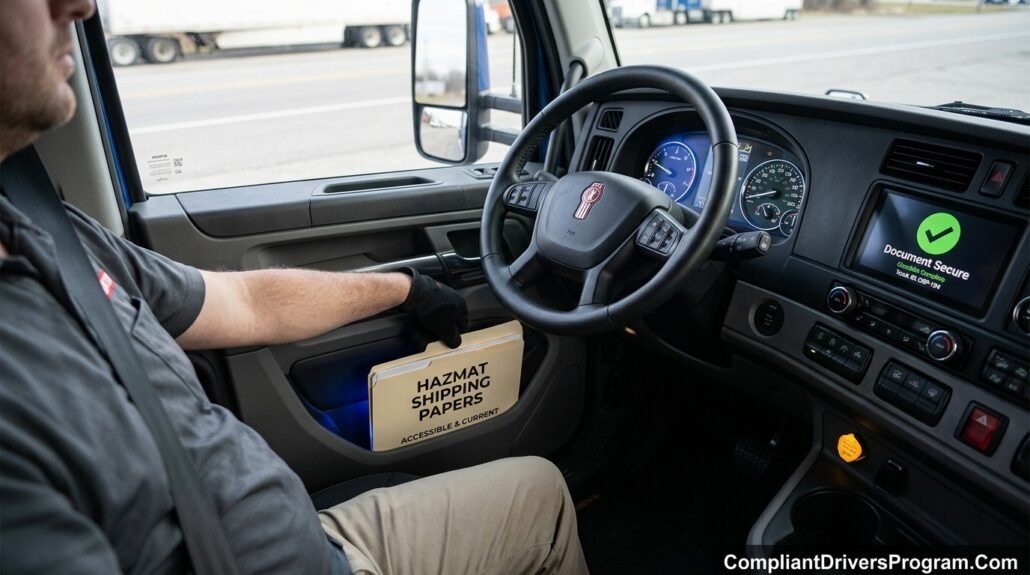
How Placards and Shipping Papers Work Together
You can’t correctly placard a vehicle without first reading the shipping papers. The paperwork tells you the proper shipping name, the hazard class, and the quantity, and that combination is what determines which placard table applies and whether the weight threshold has been crossed. Skipping straight to “what placard looks right” without checking the paperwork is how mismatches happen, and a placard that doesn’t match what’s actually being hauled is its own separate violation.
Consequences of Getting It Wrong
Placarding and shipping paper violations carry real consequences, and they compound quickly during an inspection. A vehicle placarded incorrectly, or not placarded when it should be, can be placed out of service on the spot, which means the load doesn’t move until the problem is fixed. Missing or incomplete shipping papers can trigger civil penalties independent of the placarding issue. These violations also affect a carrier’s safety scores, which can lead to more frequent inspections down the road. Reviewing how DOT inspection levels work helps explain exactly what an inspector is checking when they walk up to a hazmat load, and why placard and paperwork checks happen early in nearly every inspection level involving a hazmat placarded vehicle.
Beyond the regulatory penalties, there’s the real-world risk. A missing or wrong placard at an accident scene means first responders don’t know what they’re dealing with until it’s too late to plan around it. That’s the actual point of all this paperwork, and it’s worth remembering when a placard swap feels like a minor detail at the end of a long shift.

Common Mistakes That Cause Violations
- Leaving old placards on the vehicle from a previous, different load
- Assuming a load under 1,001 pounds never needs a placard, without checking whether it’s bulk packaging
- Placing the shipping paper somewhere other than the required door pocket or seat
- Missing the 24-hour emergency response number, or listing a number that doesn’t connect to someone with the shipment details
- Using a DANGEROUS placard on a bulk load, where it isn’t allowed
- Failing to check whether 1,000 kg or more of a single Table 2 category requires its own dedicated placard even under a DANGEROUS placard
2026 Compliance Notes
The core placarding and shipping paper framework under 49 CFR Part 172 hasn’t changed structurally, but PHMSA continues to issue routine updates to the Hazardous Materials Table and special provisions throughout the year, so drivers and carriers hauling less common materials should check current entries rather than relying on older printed charts. If your load involves cargo securement in addition to placarding, it’s worth reviewing the hazmat cargo securement requirements together, since inspectors typically check both during the same stop, and the two sets of rules are enforced side by side, not separately.
Quick Compliance Checklist
- Confirm whether your material falls under Table 1 (any quantity) or Table 2 (1,001-pound threshold)
- Remember the weight threshold does not apply to bulk packaging
- Placard each side and each end of the vehicle, using current specifications
- Remove placards from previous loads before applying new ones
- Prepare shipping papers with the proper shipping name, hazard class, ID number, packing group, and quantity in the correct order
- Include a working 24-hour emergency response number
- Keep shipping papers within the driver’s immediate reach at all times
Frequently Asked Questions
No. Table 1 materials require a placard in any quantity, but Table 2 materials only need one once the aggregate weight reaches 1,001 pounds, unless the material is in bulk packaging, in which case any quantity requires placarding.
Only for non-bulk packages carrying two or more Table 2 hazard categories, and only if no single category reaches 1,000 kilograms at one loading point. Bulk packaging can’t use this option at all.
The proper shipping name, hazard class or division, UN/NA identification number, packing group, total quantity, number and type of packages, and a 24-hour emergency response phone number.
Within the driver’s immediate reach, either in a holder on the driver’s door or visible on the seat. When the driver isn’t in the vehicle, it needs to be in the door pocket or visible on the seat.
It can be placed out of service until the issue is corrected, and the violation can carry a separate civil penalty on top of any delay to the load.







![DOT Drug Test: What You Must Know in 2026 [Full Guide]](https://compliantdriversprogram.com/wp-content/uploads/2026/03/DOT-Drug-Test-150x150.jpeg)



Leave a Reply