

Stop Risking Your Life: The Trucker’s Real Guide to Beating Distractions and Controlling Speed
Every six seconds, a truck driver looks away from the road to check a phone. That tiny glance covers the length of a football field when you’re hauling 80,000 pounds at highway speed. Distracted driving trucks accidents kill over 600 people every year in the United States alone. And when you mix phone use with poor speed management trucking habits, the results get even deadlier.
You already know the roads are tough. Long hours, tight deadlines, and a phone that never stops buzzing. But here’s what most drivers miss. The habits you think are harmless are the exact ones putting your CDL, your paycheck, and your life on the line. This guide gives you straight talk about truck driver distracted driving, real-world speed management tips for truck drivers, and smart moves you can start using on your very next run.
What Actually Counts as Distracted Driving Behind the Wheel of a Truck?
Most people picture someone texting while driving when they hear “distracted driving.” But the reality goes way deeper than that. The FMCSA breaks distractions into three clear types. Visual distractions pull your eyes off the road. Manual distractions take your hands off the wheel. Cognitive distractions steal your attention and focus from driving.
Eating a burger, adjusting your GPS, reaching for a coffee thermos, even daydreaming about home. All of these count as distractions behind the wheel. A truck driver who looks at a dispatch tablet for just five seconds at 55 mph travels 400 feet completely blind. That’s longer than most off-ramps.
Here’s what makes this worse for truckers specifically. Your vehicle weighs 20 to 30 times more than a regular car. Your stopping distance is double or triple what a sedan needs. So when truck driver distracted driving happens, the crash is bigger, the damage is worse, and the consequences hit harder. You can learn more about staying alert on the road with these truck driver safety tips.
Why Your Phone Is the Most Dangerous Thing in Your Cab
Let’s talk about the elephant in the cab. Cell phone use trucking violations are the number one distracted driving issue in the industry right now. According to the FMCSA, a trucker who dials a phone is six times more likely to be involved in a safety-critical event. That includes crashes, near-crashes, and unintentional lane departures.
The federal rules on this are crystal clear. You can’t hold a mobile phone while driving a CMV. You can’t reach for a phone in a way that takes you out of your seated position. You absolutely cannot type or read text messages. Breaking these rules can hit you with fines up to $2,750 for the first offense. Your carrier can face penalties up to $11,000.
Most drivers think hands-free devices make everything safe. They don’t. Research from the National Safety Council shows that hands-free calls still reduce brain activity related to driving by 37 percent. Your eyes might stay on the road, but your mind drifts somewhere else entirely. That cognitive distraction is invisible, and it’s sneaky. You won’t even realize your focus dropped until something goes wrong.
Pro Tip: Put your phone in the glove box or a mounted holder before you start driving. Set up all calls, texts, and navigation while you’re parked. If you need to make a call, pull over at a safe rest area first. Five minutes of waiting beats five years of regret.

The Real Cost of a Single Distraction Behind Your Wheel
Think a quick glance at your phone won’t cost you much? Let’s break down the actual numbers. A distracted driving trucks violation goes on your PSP report and stays there for five years. Insurance companies see that record every time your carrier renews their policy. One violation can raise your fleet’s premiums by 15 to 25 percent.
But money is just the start. If your distraction causes a crash, you’re looking at potential criminal charges, wrongful death lawsuits, and a permanent mark on your driving record. Many carriers have a zero-tolerance policy now. One violation means you’re looking for a new job. Good luck finding a company that wants to hire a driver with a distraction-related incident on their record.
Then there’s the human cost that nobody talks about enough. A trucker who causes a fatal accident from texting while driving carries that weight forever. PTSD, guilt, depression, and career destruction all follow one moment of lost attention. Your family depends on you coming home safe. Every other family on that highway depends on you staying focused too.
Speed Management Trucking: Why Going Faster Actually Slows You Down
Here’s something that sounds backwards but it’s absolutely true. Driving faster rarely gets you to your destination sooner. Speed management trucking is about matching your speed to conditions, not pushing the limit. A truck running 10 mph over the speed limits on a 500-mile run saves roughly 45 minutes. But that same driver increases their crash risk by over 50 percent.
Truck speeding does terrible things to your vehicle’s physics. At 65 mph, your fully loaded rig needs about 525 feet to stop on dry pavement. Bump that up to 75 mph, and you now need nearly 700 feet. That extra 175 feet could be the difference between a close call and a catastrophic pileup. Rain, snow, or ice make those numbers even scarier.
There’s also the fuel cost nobody wants to admit. Every mph over 55 costs you roughly 0.1 miles per gallon. For a truck burning through 20,000 gallons a year, that adds up to thousands of dollars in wasted fuel. Your carrier notices those numbers. Slowing down actually makes you more money over time because you burn less fuel and avoid speeding tickets that jack up insurance rates.
Loading analysis…
| Factor | Your Status | Speed Impact |
|---|
You can sharpen your overall driving approach with defensive driving for truckers techniques that work in every road condition.
Distracted Driving Laws for Truckers You Need to Know Right Now
Distracted driving laws for truckers are stricter than the rules for regular drivers. The FMCSA has federal regulations that apply no matter what state you’re driving through. You cannot use a handheld mobile phone while operating a CMV. You cannot text, email, or access the internet on any device while driving. Violations result in fines, CSA points, and potential disqualification.
State laws add another layer on top of federal rules. Currently, 29 states plus Washington D.C. have hands-free driving laws for all drivers. Some states like Georgia and Illinois have extra penalties specifically for CMV operators. If you cross state lines regularly, you need to know the strictest rules because those are the ones that’ll catch you off guard.
Here’s a detail most truckers overlook. Your carrier can also set their own internal policies that go beyond federal and state law. Many fleets now install in-cab cameras that flag any phone use while the vehicle is in motion. Some companies dock pay or terminate drivers after a single camera-caught violation. Knowing your company’s policy is just as important as knowing the law. For a broader look at keeping compliant, check out how a fleet safety program protects both you and your employer.
Comparing Distraction Types: Which Ones Hit Truckers Hardest?
| Distraction Type | Examples | Risk Level | Average Eyes-Off-Road Time | How Common Among Truckers |
|---|---|---|---|---|
| Visual | Checking GPS, reading texts, looking at billboards | Very High | 4-5 seconds | Extremely common |
| Manual | Eating, drinking, reaching for objects, adjusting radio | High | 2-4 seconds | Very common |
| Cognitive | Daydreaming, phone conversations, stress, fatigue | High | Continuous | Most common but least noticed |
| Combined (Texting) | Reading and typing messages | Extreme | 5+ seconds | Common despite bans |
This table shows you something critical. Cognitive distractions are the hardest to detect because your eyes might stay on the road while your brain checks out. That’s why fatigue and stress management matter just as much as putting your phone away.
How to Avoid Distracted Driving Truck: 9 Moves That Actually Work
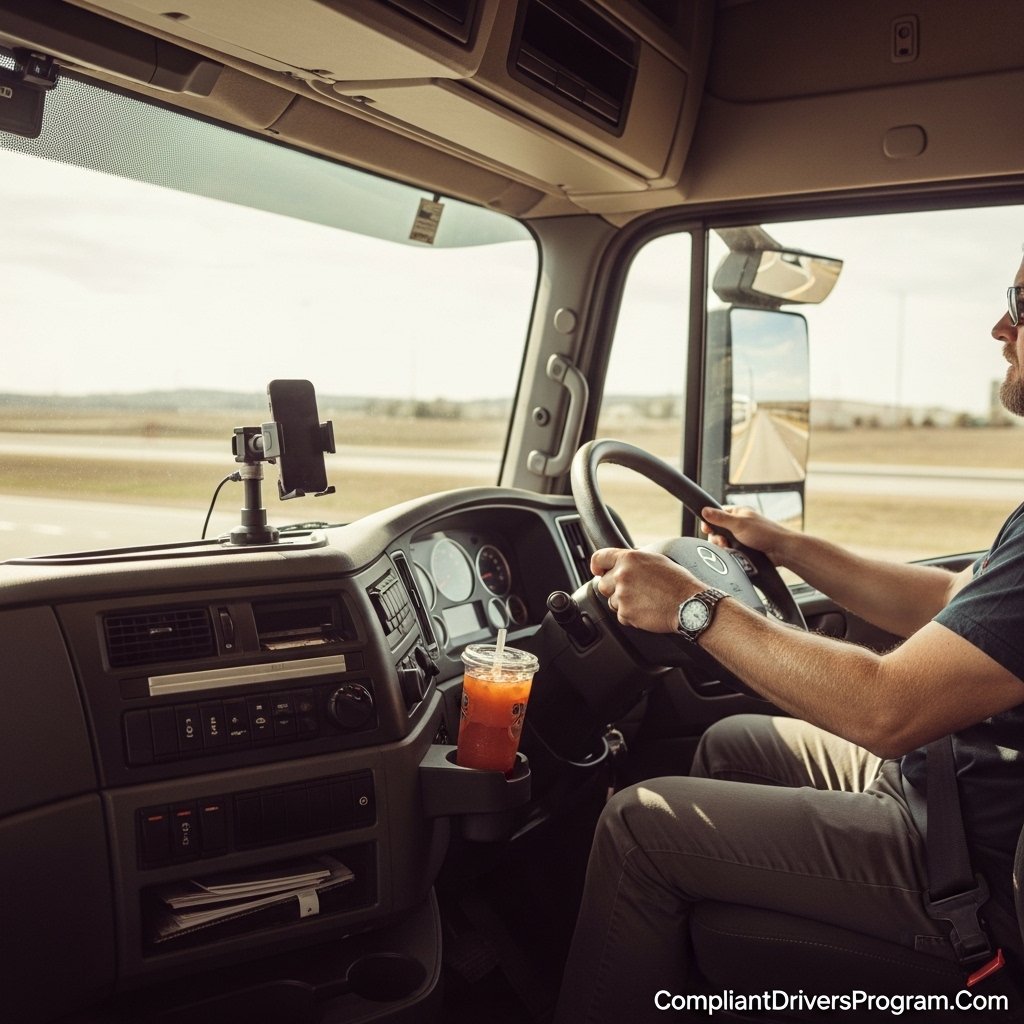
Knowing the dangers is one thing. Actually changing your habits is another. Here are nine practical strategies for how to avoid distracted driving truck situations every single day.
1. Pre-program everything before you roll.
Set your GPS, queue up your playlist, and adjust your mirrors before you leave the lot. Every adjustment you make while moving is a moment of lost focus. Take five extra minutes at the start and save yourself hours of risk.
2. Create a phone routine.
Designate specific stop times to check messages and return calls. Tell dispatch and family that you respond at fuel stops and rest breaks only. Most messages can wait 90 minutes. Setting this expectation removes the urge to grab your phone mid-drive.
3. Use a mounted phone holder.
If you must use navigation on your phone, mount it at eye level on your dashboard. This keeps your visual attention closer to the windshield. But remember, a mounted phone still creates cognitive distraction when you interact with it.
4. Eat at rest stops, not behind the wheel.
Unwrapping a sandwich, dipping fries in ketchup, and wiping your hands all take your hands off the wheel and your eyes off traffic. Plan meal breaks. Your body digests better when you’re not stressed behind the wheel anyway.
5. Manage your mental state.
Cognitive distractions from stress, arguments, or personal problems are invisible killers. If something is weighing on your mind, take a short walk at your next stop. Clear your head before you clear the next mile marker.
6. Keep your cab organized.
A messy cab creates constant temptation to reach, grab, and rummage. Use organizers, clips, and designated spots for everything you need. When items have a home, you don’t have to hunt for them at 60 mph.
7. Use the Smith System.
The Smith System driving method teaches you to aim high in steering, get the big picture, keep your eyes moving, leave yourself an out, and make sure others see you. These five principles keep your brain engaged with driving instead of drifting to distractions.
8. Take breaks before you need them.
Fatigue is the gateway to distraction. When you’re tired, you reach for your phone more. You daydream more. You eat junk food behind the wheel to stay awake. Stopping every two to three hours keeps your attention sharp and your reaction time fast.
9. Hold yourself accountable.
Track your habits for one week. Note every time you reach for something, look away from the road, or catch your mind wandering. You’ll be shocked at how often it happens. Awareness is the first step toward change.
Speed Management Tips for Truck Drivers: Drive Smarter, Not Faster
Speed management tips for truck drivers go beyond just watching your speedometer. True speed control means reading conditions and adjusting before problems show up. Here’s how to do it right.
Match your speed to traffic flow. Running significantly faster or slower than surrounding traffic creates dangerous speed differentials. If traffic moves at 60 mph, do 60. Weaving through slower traffic at 70 mph puts everyone at risk. Matching flow keeps safe speed gaps predictable for every driver around you.
Slow down before curves, not during them. Braking in a curve shifts your truck’s weight forward and to the outside. That’s exactly how rollovers happen. Reduce your speed before you enter the curve. Then maintain that safe speed through the entire turn. This approach works on highway ramps, mountain roads, and rural two-lanes alike.
Respect the weight you’re carrying. An empty trailer handles nothing like a loaded one. And a tanker with liquid slosh behaves differently than a flatbed with steel coils. Your speed limits should be personal, not just what the sign says. If your load is heavy, high-center-of-gravity, or shifting, drop your speed by 5 to 10 mph below the posted limit.
Watch weather like your life depends on it. Because it does. Rain reduces tire grip by 30 percent on average. Snow and ice can cut it by 70 percent or more. When conditions turn ugly, truck speeding becomes suicidal. Reduce speed by one-third on wet roads and by half or more on snow and ice. No load is worth dying over.
Pro Tip: Use your jake brake wisely in slippery conditions. On ice, a jake brake can lock your drive wheels and cause a jackknife. Switch it off when roads get slick and rely on gentle service brake applications instead.
Understanding how your truck interacts with the road in every condition starts with a solid pre trip inspection checklist that catches problems before they become emergencies.

The Connection Between Distractions and Speeding Most Drivers Miss
Here’s the thing most safety trainings skip over. Distracted driving trucks problems and truck speeding problems feed each other in a vicious cycle. When you’re running behind schedule, you speed up. When you speed up, stress increases. When stress increases, you reach for your phone to check the time, call dispatch, or scroll through messages. Now you’re speeding and distracted at the same time.
Breaking this cycle starts with accepting something uncomfortable. You will be late sometimes. Loads will deliver behind schedule. Appointments will get missed. And none of that is worth your life or someone else’s. The best truckers in this industry aren’t the fastest. They’re the most consistent, safest, and most reliable over time.
Fleet managers and dispatchers play a role here too. When companies pressure drivers to meet impossible timelines, they push people toward both speeding and distracted driving. If your company creates this kind of pressure, document it. Report it to the FMCSA safety hotline at 1-888-DOT-SAFT. You have whistleblower protections under federal law. For more on staying safe while navigating tight spaces and traffic, explore tips on avoiding blind spot truck accidents.
What Happens to Your Career After a Distracted Driving or Speeding Violation
Let’s get real about the career impact. A single distracted driving trucks citation puts points on your CSA record. Those points follow you from carrier to carrier. Hiring managers pull your PSP report before they even call you for an interview. Two or more violations in three years can make you virtually unhireable at top-tier carriers.
Speeding tickets work the same way. A ticket for running 15 mph over the limit is a serious violation under FMCSA rules. Two serious violations in three years trigger a 60-day CDL disqualification. Three serious violations get you a 120-day disqualification. During that time, you earn zero dollars while your bills keep stacking up.
The financial math is brutal. An average OTR driver earns about $1,200 per week. A 60-day disqualification costs you roughly $9,600 in lost wages. Add the fine itself, higher insurance premiums, and the lower-paying carrier you’ll likely end up at afterward. One reckless decision can cost you $20,000 or more over a three-year period. Protecting your record protects your wallet.
Building a Personal Safety Culture That Sticks
Reading an article is easy. Changing behavior is hard. But you can build habits that protect you without thinking about them. Start by treating your cab like a cockpit. Airline pilots don’t eat, text, or make personal calls during critical flight phases. Your entire drive is a critical phase because 80,000 pounds never stops being dangerous.
Create a pre-drive ritual. Phone silenced and stored. Navigation set. Mirrors adjusted. Seat belt fastened. Drink in the cup holder. Everything else put away. Do this every single time until it becomes automatic. Rituals turn safe choices into habits that don’t require willpower.
Find an accountability partner. Another driver, your spouse, or a mentor who checks in with you about your habits. Tell them your goals. Share your wins. Admit your slip-ups. Accountability makes the invisible visible. When someone asks about your phone habits every week, you think twice before picking it up at 65 mph. For regular safety refreshers and meeting ideas, check out these driver safety programs that keep you sharp year-round.
FAQ: Your Top Questions About Distracted Driving and Speed Management
A: The FMCSA bans handheld cell phone use trucking and all texting while operating a CMV. Fines reach $2,750 for drivers and $11,000 for carriers per violation.
A: Pre-set your navigation, silence your phone, eat at rest stops, and take breaks every two to three hours to keep your attention sharp and reduce distractions.
A: Match traffic flow while staying within posted speed limits. Reduce speed by one-third in rain and by half on snow or ice for a safe speed at all times.
A: Federal law allows single-button, hands-free devices. However, cognitive distraction still reduces your reaction time. Limit all calls to essential communication only.
A: Two serious speeding tickets within three years trigger a 60-day CDL disqualification. Three serious violations result in 120 days off the road with zero income.
A: Yes. Truck driver distracted driving violations add points to your CSA profile. High CSA scores lead to more inspections, fewer job offers, and higher insurance costs for your carrier.
A: Slow down before descents, use lower gears, and avoid riding your brakes. Speed management trucking on mountain grades requires planning speed before the grade, not during it.
Your Next Move Makes All the Difference
You now have the knowledge. What you do with it determines everything. Here’s what matters most from this guide:
- Distracted driving trucks crashes are preventable when you control your phone, your habits, and your cab environment
- Speed management trucking saves fuel, protects your CDL, and keeps you alive in bad conditions
- Federal distracted driving laws for truckers carry heavy fines and career-ending consequences
- Building a personal safety routine turns good choices into automatic habits that protect you every mile
Pick one thing from this article and start doing it on your next trip. Just one. Maybe it’s putting your phone away before you start driving. Maybe it’s slowing down five mph on your regular route. Small changes made consistently will protect your career, your income, and the people you love. Drive smart out there.







![DOT Drug Test: What You Must Know in 2026 [Full Guide]](https://compliantdriversprogram.com/wp-content/uploads/2026/03/DOT-Drug-Test-150x150.jpeg)



Leave a Reply