

Ever feel like the standard 10-hour break just doesn’t fit your schedule? Maybe you’re stuck waiting at a shipper for three hours. Or perhaps traffic killed your driving window. That’s exactly why the sleeper berth rules exist. They give you a legal way to split your rest and keep your day rolling.
Most drivers hear about the split sleeper berth option but get confused fast. The math seems tricky. The rules sound complicated. And honestly, one mistake can land you with a violation. But here’s the good news. Once you understand how split time actually works, you’ll wonder why you didn’t use it sooner.
This guide breaks down everything about the sleeper berth provision. You’ll learn the 7 3 split method, how to pause your 14-hour clock, and when splitting makes sense. Let’s dive into the details that matter for your daily grind.
What Exactly Is the Sleeper Berth Provision?
The sleeper berth provision is a special rule under DOT hours of service regulations. It allows drivers to split their required off-duty time into two separate periods. Instead of taking one continuous 10-hour break, you can break it up. This gives you flexible rest options that match real-world trucking situations.
Think about it this way. The standard rules say you need 10 consecutive hours off duty before driving again. But trucking rarely works on a perfect schedule. Loads get delayed. Weather happens. Customers make you wait for hours. The sleeper berth rules recognize this reality and give you another option.
Here’s what most people don’t know. The provision isn’t new. It’s been part of federal regulations for years. But the FMCSA updated the rules in September 2020 to make them more flexible. These changes gave drivers more combinations for splitting their rest period throughout the day.
How Does the Split Sleeper Berth Actually Work?
Let’s get into the mechanics of how split sleeper berth time functions. The basic idea is simple. You divide your required rest into two chunks instead of one. But the specific requirements matter a lot for staying compliant.
Under current regulations, you can use two different qualifying periods. At least one period must be 7 consecutive hours or more in the sleeper berth. The other period must be at least 2 consecutive hours. This second period can be spent in the sleeper berth, off duty, or a combination of both.
Here’s where the magic happens. Neither qualifying period counts against your 14-hour driving window. The time essentially pauses your clock. When you pair two qualifying periods together, they replace the standard 10-hour break requirement. This is crucial for understanding FMCSA Hours of Service Rules and staying legal.
Quick tip: Your total berth time and off-duty time must still equal at least 10 hours. You’re not getting less rest. You’re just taking it differently.
Breaking Down the Popular 7/3 Split Method
The 7 3 split sleeper berth combination is probably the most common approach drivers use. It’s straightforward once you see how the pieces fit together. Let me walk you through exactly how this works in practice.
With the 7/3 split, you take a 7-hour period in your sleeper berth first. This longer stretch gives you solid rest time. Then later, you take a 3-hour break that can be off duty or in the sleeper. Both periods together satisfy your rest requirements while giving you more scheduling control.
Many drivers love this split because it matches natural energy patterns. You grab your main sleep during quiet hours. Then you use the shorter break when shipper delays happen or traffic gets bad. According to the Federal Motor Carrier Safety Administration, this flexibility was intentionally designed to reduce driver fatigue while maintaining productivity.
Pro Tip: The 7-hour period MUST be in the sleeper berth. But your 3-hour period can be regular off-duty time. This means you could take that shorter break at a restaurant or walking around a truck stop.
Other Split Combinations You Can Use
The 7/3 split isn’t your only option. The regulations allow several different combinations that might work better for your situation. Understanding all your choices helps you maximize efficiency legally.
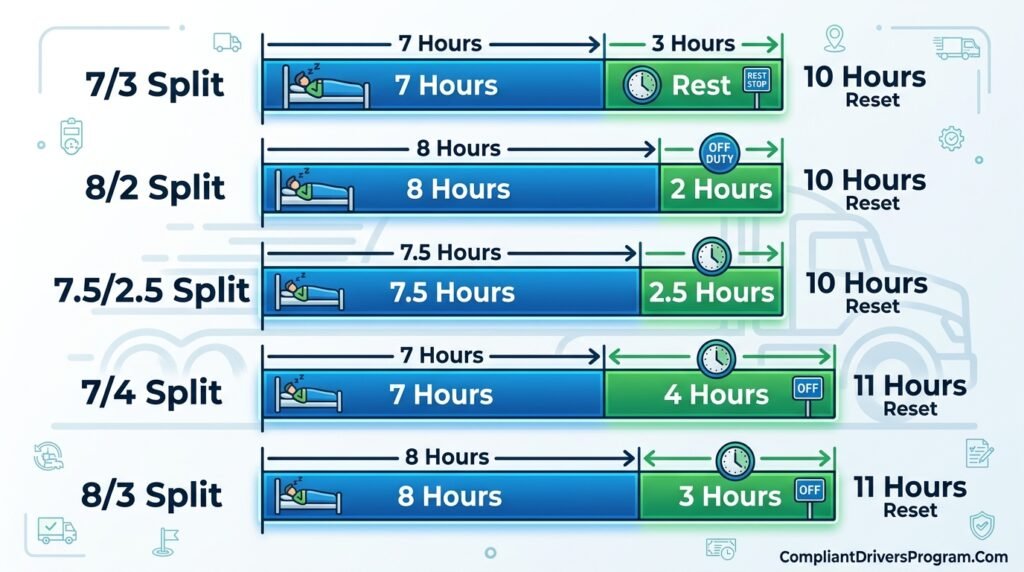
You can do an 8/2 split if that fits your schedule better. Take 8 hours in the sleeper berth, then grab a 2-hour off-duty break later. Some drivers prefer this because the longer initial rest period leaves them feeling more refreshed. The 2-hour minimum for the shorter period makes it easy to fit into loading or unloading windows.
Another option is the 7.5/2.5 split or any combination where one period hits 7+ hours and the other reaches 2+ hours. The rules give you flexibility within those minimums. Just remember that total combined time must equal at least 10 hours between your qualifying periods.
For drivers handling OTR vs Home Daily Jobs, the 7/3 split often works best. Long-haul runs give you more opportunities to use split time strategically throughout multi-day trips.
How Split Time Affects Your 14-Hour Clock
This is where things get interesting. Understanding how splits interact with the 14 Hour Rule and 11 Hour Limit can save you from violations. The clock mechanics are different than standard HOS calculations.
When you use qualifying sleeper berth provision periods, those hours don’t count against your 14-hour window. Let me explain with an example. Say you start driving at 6 AM. By noon, you’ve driven 5 hours and your 14-hour clock shows 6 hours used. You take a 3-hour off-duty break for lunch and a shipper delay.
That 3-hour break becomes a qualifying short period if you pair it with a 7+ hour sleeper period later. When you do that, the 3 hours essentially disappear from your 14-hour calculation. Your clock effectively pauses during qualifying periods.
Here’s what trips up many drivers. You need to complete BOTH qualifying periods before the split benefit kicks in. Until you finish both breaks, your ELD calculates time normally. Once you complete the second qualifying period, the system recalculates and shows your available time correctly.
Real-World Examples of Sleeper Berth Splits
Let me give you a scenario that shows sleeper berth rules for truck drivers in action. This makes the concept click for most people way faster than just reading regulations.
Picture this situation. Driver Mike starts his day at 5 AM after a full 10-hour reset. He drives until 10 AM, covering 5 hours of drive time. Then his shipper makes him wait 3 hours before loading him. Mike logs those 3 hours as off-duty time. He keeps moving after loading and drives until 4 PM, adding 4 more hours of driving.
Now Mike takes his 7-hour sleeper berth period from 5 PM to midnight. When he wakes up, his split is complete. The 3-hour waiting period and 7-hour sleeper period combine as qualifying breaks. Mike now has a fresh 14-hour window and 11 hours of available driving time.
Without the split sleeper berth option, Mike would have burned his whole 14-hour window waiting at that shipper. The split let him turn dead time into a strategic advantage. This approach works especially well when you understand all DOT Regulations for Truck Drivers.
Common Mistakes Drivers Make With Splits
Even experienced drivers mess up sleeper berth provision requirements. These errors lead to HOS violations and potential fines. Let me help you avoid the most frequent problems.
The biggest mistake is taking a short period that doesn’t hit the 2-hour minimum. If you log 1 hour and 45 minutes off duty, it won’t qualify. You need a full 2 hours minimum for the shorter period. Your ELD will calculate your time without giving split credit.
Another common error involves the 7-hour requirement. That longer period MUST be in the sleeper berth specifically. You can’t use off-duty time for this portion. Some drivers think any combination of rest works, but that’s incorrect. The sleeper berth requirement is non-negotiable for the longer period.
Drivers also forget that both periods must occur within a certain timeframe. You can’t take a 3-hour break on Monday and claim it pairs with a 7-hour sleeper period from the previous week. The splits need to happen relatively close together for compliance purposes.
Pro Tip: Review your logs carefully before and after using splits. Most Best ELD Devices will show your available hours differently once splits are completed. Understanding your specific device helps prevent confusion.
When Should You Actually Use Split Sleeper Time?
Strategic use of split time separates good drivers from great ones. Knowing when splits make sense helps you maximize efficiency without breaking rules. Let’s look at the best situations for this provision.
Shipper and receiver delays create perfect split opportunities. That 3-hour wait for loading becomes productive rest time. You’re stuck anyway, so why not log it properly and gain flexibility later? This approach works especially well during unexpected delays you couldn’t plan around.
Team driving situations sometimes benefit from modified split approaches. While team operations have their own HOS considerations, understanding splits helps when one driver needs extra rest. Coordinating breaks between partners can extend productive driving windows for the team overall.
Heavy traffic windows also make splits valuable. If you know rush hour will kill your productivity, plan a short break during those periods. Then hit the road when traffic clears and complete your longer rest period when conditions favor sleeping. This beats sitting in traffic burning your 14-hour clock.
Consider splits whenever your typical driving day doesn’t fit standard HOS patterns. The provision exists because trucking isn’t a 9-to-5 job. Real freight moves on schedules that demand flexibility. Learn to use this tool when circumstances support it.

How ELDs Track Sleeper Berth Time
Your electronic logging device handles most berth time calculations automatically. But understanding what happens behind the scenes helps you use splits effectively. Modern ELDs following the ELD Mandate Guide requirements track this data precisely.
When you log sleeper berth time, your ELD records it separately from regular off-duty time. The system knows the difference matters for split calculations. Quality devices will show your potential split scenarios and available driving time under different break combinations.
Most Trucking Log Book Apps include split calculators now. These tools let you plan breaks before taking them. You can see how different split combinations affect your available hours going forward. This planning capability prevents mistakes before they happen.
Here’s something important. ELD algorithms recalculate your available time once you complete qualifying periods. Your device might show limited hours until you finish both breaks. After completing the second qualifying period, your available time updates to reflect the split benefit. Don’t panic if numbers look wrong mid-split.
Penalties for Getting Sleeper Berth Rules Wrong
Messing up your splits leads to HOS violations with real consequences. Understanding the stakes keeps you motivated to log accurately. The fines and penalties add up quickly when you make mistakes.
Form and manner violations for incorrect logging can cost $150-$500 per offense. If your split doesn’t qualify because you were 10 minutes short on the 2-hour minimum, that’s a violation. These penalties are outlined in detail under HOS Violation Fines regulations.
More serious violations occur when incorrect splits lead to over-driving. If you thought your split was valid but it wasn’t, you might exceed your 11-hour driving limit. Driving over hours can mean $16,000+ fines and out-of-service orders. These consequences affect your safety record and carrier’s CSA scores.
Repeated violations create bigger problems. Patterns of non-compliance draw FMCSA attention. Your carrier faces audit risks. Your personal driving record suffers. Learning Log Book Violation Fines helps you appreciate why accuracy matters so much.
Tips for Using Sleeper Berth Splits Effectively
Making flexible rest work requires planning and good habits. These practical tips help you implement splits successfully in your daily routine. They come from drivers who use this provision regularly.
Plan your splits before you need them. Look at your day and identify potential break windows. If you know a shipper typically has long waits, plan to log that time properly. Reactive splitting creates more errors than proactive planning.
Set alarms to ensure you hit minimum time requirements. Missing the 2-hour or 7-hour threshold by minutes wastes the entire effort. Better to err on the side of slightly longer breaks than fall short. A few extra minutes of rest never hurt anyone anyway.
Communicate with dispatch about your split strategy. Let them know when you’re splitting and how it affects your available hours. Good fleet managers appreciate drivers who understand HOS rules. This communication prevents scheduling conflicts and unrealistic load assignments.
Review guidance on Truck Driver Fatigue Guide alongside split strategies. The goal isn’t just compliance. It’s actually getting enough rest to drive safely. Splits should enhance your rest quality, not just manipulate clock numbers.
Sleeper Berth Split Options Comparison
| Split Type | Short Period | Long Period | Total Rest | Best Use Case |
|---|---|---|---|---|
| 7/3 Split | 3 hours | 7 hours sleeper | 10 hours | Standard flexibility needs |
| 8/2 Split | 2 hours | 8 hours sleeper | 10 hours | Quick short breaks |
| 7.5/2.5 Split | 2.5 hours | 7.5 hours sleeper | 10 hours | Moderate flexibility |
| 7/4 Split | 4 hours | 7 hours sleeper | 11 hours | Extra rest needed |
| 8/3 Split | 3 hours | 8 hours sleeper | 11 hours | Maximum flexibility |
This comparison shows how different combinations serve different needs. Choose based on your specific circumstances and rest requirements.
Combining Splits With Other HOS Provisions
Sleeper berth splits work alongside other regulations you should know. Understanding how these rules interact expands your operational flexibility further. The HOS system has several connected components.
The 70 Hour Rule Trucking provision affects your weekly available hours. Splits don’t change your 70-hour limit. They just help you use daily windows more efficiently. You still need to track weekly totals separately from daily split calculations.
Using the 34 Hour Restart Rule resets everything fresh. After a proper 34-hour restart, your weekly hours clear. This can be strategic when splits alone won’t solve your timing problems. Sometimes a full restart makes more sense than trying to squeeze out extra productivity.
Certain HOS Exceptions for Trucking might apply to your operation. Short-haul exceptions, agricultural exemptions, and other provisions have their own rules. Know which exceptions you qualify for and how they interact with sleeper berth provisions.
Frequently Asked Questions
A: New drivers can use splits immediately. The rules apply equally regardless of experience level. Just ensure you meet the minimum time requirements for each period.
A: No. The longer qualifying period of 7+ hours must be logged specifically as sleeper berth time. The shorter 2+ hour period can be off-duty or sleeper berth.
A: No. Splits only affect your 14-hour driving window and 11-hour driving limit. Weekly hours continue accumulating regardless of splits taken.
A: That break won’t qualify for the split. You need a full 2 hours minimum. You’d need to take additional off-duty time to meet the requirement.
A: No. Current regulations only allow two qualifying periods. You can take additional breaks, but only two periods count for the split provision.
A: Sleeper berth provisions apply to drivers using a vehicle with a compliant sleeper berth. The berth must meet specific size and safety requirements under DOT standards.
A: There’s no specific time limit between periods. However, both must occur before you exceed other HOS limits like the 11-hour driving restriction.
Making Sleeper Berth Rules Work for You
Understanding sleeper berth rules transforms how you manage your driving day. The split sleeper berth provision exists to help you handle real-world trucking challenges. Using it properly keeps you compliant while maximizing your productivity.
Here are the key points to remember:
- The 7/3 split requires 7+ hours in the sleeper berth and 2+ hours off duty or sleeper
- Both qualifying periods must be completed before split benefits apply
- Neither qualifying period counts against your 14-hour driving window
- Your ELD recalculates available time after completing both break periods
Start practicing splits during low-pressure situations first. Get comfortable with the logging process and time calculations. Review Sleep Tips for Truck Drivers to maximize rest quality during your sleeper periods.
Your next step is simple. Look at tomorrow’s schedule and identify where a split might help. Plan your breaks intentionally instead of reactively. Once you master this provision, you’ll have a powerful tool for handling whatever the road throws at you.
Split Berth Calculator







![DOT Drug Test: What You Must Know in 2026 [Full Guide]](https://compliantdriversprogram.com/wp-content/uploads/2026/03/DOT-Drug-Test-150x150.jpeg)



Leave a Reply