

Picture this. You’ve been running loads all week, your ELD is ticking down, and you’re not sure if you can legally accept one more dispatch. Sound familiar? Most truck drivers have been in this exact spot at least once. The 70 hour rule trucking regulation is one of the most misunderstood parts of the DOT hours of service system. Drivers mix it up with daily limits, confuse it with the restart, or just wing it and hope for the best.
That approach can cost you big money in fines and put your CDL at risk. This guide breaks down exactly how the 70 hour rule for truck drivers works. You’ll learn how to calculate your cumulative hours, how recapping works, and how to squeeze every legal mile out of your weekly driving limit. Let’s get into it.
What Exactly Is the 70 Hour Rule in Trucking?
The 70 hour rule trucking regulation puts a cap on how many hours you can be on duty over a rolling 8 day cycle. Think of it as a speed limit, but for your work hours across an entire week. You can’t drive or work more than 70 hours in any 8 consecutive days. Once you hit that ceiling, you’re done until hours start falling off.
This rule comes straight from the Federal Motor Carrier Safety Administration. It applies to carriers that operate vehicles 7 days a week. The FMCSA designed this limit to prevent driver fatigue and keep roads safer for everyone. You can read the full breakdown of all the daily and weekly limits in the FMCSA Hours of Service Rules.
Here’s what trips people up. The 70 hour cap doesn’t just count driving time. It counts ALL on-duty time. That means fueling, loading, unloading, inspections, paperwork, and anything else you do while technically working. Every minute of on-duty time eats into your weekly hours.
Most people don’t know this, but the clock doesn’t reset at midnight on Sunday like a normal work week. It’s a rolling window. Every day, the oldest day drops off and a new day gets added. This rolling calculation makes tracking your hours a bit tricky, which is why understanding the math matters so much.
The 60/70 Hour Rule Explained – Which One Applies to You?
Not every driver falls under the 70 hour limit. The 60 70 hour rule actually gives two different caps depending on your carrier’s operating schedule. This distinction catches a lot of new drivers off guard. Your carrier’s schedule determines which rule you follow, not your personal preference.
If your motor carrier operates vehicles 6 days a week or fewer, you fall under the 60 hour in 7 day cycle rule. If your carrier runs trucks every day of the week, you follow the 70 hour in 8 day cycle rule. Most over-the-road carriers operate 7 days a week, so the 70 hour version applies to the majority of long-haul drivers.
Here’s a quick way to remember the 60 70 hour rule explained simply. Six days of operation means 60 hours in 7 days. Seven days of operation means 70 hours in 8 days. Your carrier picks one, and you stick with it. You can’t switch back and forth between the two based on what’s convenient that week.
Pro Tip: Not sure which cycle your company uses? Check your carrier’s DOT operating authority or ask your safety department. Getting this wrong can lead to automatic HOS violations on your record, even if you thought you were compliant.
For drivers comparing different job types, knowing your cycle matters when choosing between OTR vs Home Daily Jobs. Home daily positions often operate under the 60 hour rule since many local carriers don’t run on Sundays. OTR carriers almost always use the 8 day cycle with 70 hours.
How Does the 70 Hour Rule Actually Work? A Real Example
Let’s walk through a real-world scenario so you can see how does 70 hour rule work in practice. Numbers make everything clearer than theory. We’ll track a driver named Jake through his week so you can follow along.
Jake drives for a carrier that operates 7 days a week. He follows the 70 hour in 8 day cycle. On Day 1, Jake logs 10 hours of on-duty time. Day 2, he logs 11 hours. Day 3 brings another 10 hours. By Day 4, he’s already used 31 hours of his 70 hour bucket.
Jake keeps pushing through the week. Day 4 gives him 9 hours, Day 5 adds 10, Day 6 brings 8, and Day 7 adds another 10 hours. His total on-duty time for those 7 days hits 68 hours. On Day 8, Jake can only work 2 more hours before he maxes out his weekly driving limit of 70 hours.
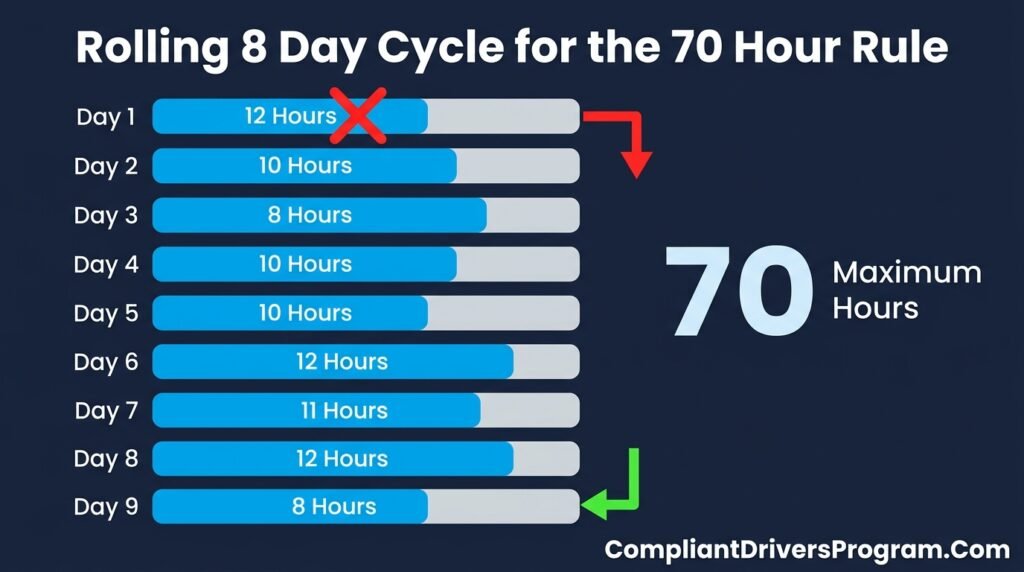
But here’s where the rolling window kicks in. When Day 9 arrives, Day 1 drops off the calculation. Those 10 hours from Day 1 disappear from his total. Jake now has 10 fresh hours available. This is the rolling nature of the cumulative hours calculation, and it’s the key to understanding the entire system.
This rolling math means you never truly “start over” unless you take a full restart. Your available hours change every single day based on what happened 8 days ago. Keeping track of this manually would be a nightmare, which is exactly why the ELD Mandate Guide exists to help drivers stay on top of their numbers automatically.
Recapping Hours – The Secret Weapon Most Drivers Overlook
Recapping hours is how experienced drivers keep rolling without ever needing a full restart. It’s one of the smartest strategies in the trucking business, and most newer drivers don’t even know it exists. Recapping lets you gain back hours as older days fall off your 8 day window.
Here’s how recapping works. Every day, the hours you worked 8 days ago drop off your running total. If you worked 12 hours exactly 8 days ago, you get 12 hours added back to your available pool today. This means if you manage your daily hours wisely, you can keep a steady flow of available time without ever stopping for a 34 hour restart.
The trick to making recapping work is keeping your daily on-duty hours consistent and moderate. If you burn 14 hours on duty one day and only 6 the next, your available hours will bounce around wildly when those days start dropping off. Steady days of 8 to 10 hours on duty give you the most predictable recap schedule.
Smart drivers plan their week around recapping. They know exactly how many hours will fall off each morning. They accept loads that fit within their available window. This kind of planning keeps them moving and earning while drivers who don’t understand recapping sit parked waiting for a restart. It makes a real difference in your Truck Driver Salary over the course of a year.
Pro Tip: Check your ELD every morning before accepting a dispatch. Look at how many hours fall off your 8 day window that day. This tells you exactly how much on-duty time you have available before you even start your engine.
The 34 Hour Restart – Your Full Reset Button
Sometimes recapping isn’t enough. Maybe you had a brutal week with heavy hours, or you just want a clean slate. That’s where the 34 Hour Restart Rule comes in. It gives you a way to completely reset your weekly hours back to zero.
To use a 34 hour restart, you need to take 34 consecutive hours off duty. You can spend this time in your sleeper berth, at home, or anywhere else as long as you log zero on-duty time. Once those 34 hours pass, your cumulative hours reset completely. You start fresh with a full 70 hours available.
The 34 hour restart works great for drivers who push hard early in the week. If you burn through 60 hours in the first 5 days, recapping won’t help much. A restart gives you a full tank of hours to work with again. Many OTR drivers time their restarts over weekends when freight slows down anyway.
One thing to keep in mind about the restart. There’s no limit on how often you can use it. The FMCSA removed the once-per-week restriction back in 2017. You can take a restart every week if your schedule allows it. Just make sure you log those 34 hours properly on your ELD to avoid any compliance headaches.
How the 70 Hour Rule Connects to Your Daily Limits
The 70 hour rule trucking regulation doesn’t exist in a vacuum. It works alongside your daily driving limits to create a complete framework. Understanding how these rules stack together keeps you out of trouble with DOT hours of service enforcement.
Your daily limits include the 11 hour driving maximum and the 14 Hour Rule and 11 Hour Limit on your duty window. These reset every time you take 10 consecutive hours off duty. But here’s the catch. Even if your daily clock shows available driving time, you can’t drive if your 70 hour weekly limit is maxed out.
Think of it like two separate fuel tanks. Your daily limits are a small tank that refills every night. Your weekly hours under the 70 hour rule are a big tank that slowly drains over 8 days. You need fuel in BOTH tanks to drive legally. Running out of either one puts you out of service.
This dual-limit system confuses a lot of drivers, especially during heavy weeks. You might wake up with 11 fresh driving hours on your daily clock but only 3 hours left on your weekly cap. In that case, you can only drive 3 hours regardless of what your daily limits show. Always check both numbers before you roll.
Common Mistakes That Get Drivers in Trouble
Even experienced drivers mess up the 70 hour rule for truck drivers from time to time. Some mistakes happen from honest confusion. Others come from trying to squeeze in one more load. Either way, the consequences hit your wallet and your driving record hard.
The biggest mistake is forgetting that ALL on-duty time counts toward your 70 hours. Drivers sometimes think only driving time matters. They spend 3 hours at a shipper loading freight and don’t realize those hours eat into their weekly driving limit too. Pre-trip inspections, fueling, and even sitting in a dock door count as on-duty time.
Another common error is miscalculating recap hours. Drivers look at yesterday’s hours instead of what happened 8 days ago. This leads them to think they have more time available than they actually do. With modern ELD devices, this mistake happens less often, but it still catches people who don’t check their logs carefully. Using one of the Best ELD Devices with clear countdown displays helps prevent this error.
Some drivers also try to manipulate their logs to squeeze in extra hours. This is a terrible idea. ELD systems track your vehicle movement, engine status, and location. Falsifying records is a serious federal violation that can end your career. The HOS Violation Fines for log falsification start at several thousand dollars and can include criminal penalties.
What Happens When You Violate the 70 Hour Rule?
Breaking the 70 hour rule trucking regulation brings real consequences. This isn’t just a slap on the wrist. DOT enforcement takes weekly hour violations seriously because fatigued driving puts everyone on the road at risk. Knowing the stakes helps you take compliance seriously.
If a roadside inspector catches you over your 70 hour weekly limit, you’ll get placed out of service immediately. That means you park your truck right there and wait until you have enough hours to legally drive again. You can’t move the truck. You can’t work. You just sit and burn time and money.
The fines add up fast. According to the FMCSA’s penalty guidelines, individual driver fines for HOS violations can reach up to $16,000 per offense. Your carrier can face penalties up to $16,000 per violation as well. Multiple violations in a single inspection compound those numbers quickly. Check the full breakdown of Log Book Violation Fines to see exactly what each type of violation costs.
Beyond fines, violations go on your PSP report and your carrier’s CSA score. A bad CSA score triggers more frequent inspections for the entire fleet. That makes your safety department very unhappy and could cost you your position. Some carriers terminate drivers after a single serious HOS violation. The risk just isn’t worth the extra miles.
Smart Strategies to Manage Your Weekly Hours
Managing your weekly hours under the 70 hour rule trucking system takes planning. The drivers who earn the most money aren’t the ones who drive the hardest. They’re the ones who plan the smartest. These strategies help you maximize your legal driving time without ever touching the red zone.
First, keep your daily on-duty hours between 8 and 10 whenever possible. This creates a steady recap pattern that gives you predictable available hours every day. Wild swings between 14 hour days and 4 hour days make your recap schedule chaotic and hard to plan around. Consistency wins the long game every time.
Second, know your loads before you accept them. Calculate whether you have enough cumulative hours to complete the delivery within your available window. Factor in drive time, loading and unloading, fuel stops, and unexpected delays. If the math is tight, talk to your dispatcher before committing. A good dispatcher understands DOT Regulations for Truck Drivers and won’t push you past your limits.
Third, use your off-duty time wisely. Quality rest leads to better driving performance, which means fewer wasted hours from fatigue-related slowdowns. Check out these Sleep Tips for Truck Drivers to make the most of your downtime. Rested drivers make better decisions about route planning and time management, which stretches their available hours further.
Pro Tip: Build a simple spreadsheet or use your ELD’s planning feature to forecast your available hours 3 days ahead. This lets you plan loads proactively instead of reacting to a ticking clock.
Special Situations and Exceptions You Should Know
The standard 70 hour rule for truck drivers applies to most situations. But the FMCSA built in some exceptions for specific circumstances. Knowing these exceptions can save you from unnecessary downtime when conditions qualify. Not every driver can use them, but the ones who can gain a real advantage.
Short-haul drivers who operate within a 150 air-mile radius get some relief from the standard HOS requirements. They don’t need an ELD and follow slightly different reporting rules. However, the 60 70 hour rule still applies to their weekly hours. The exemption affects daily tracking, not the weekly cap. You can learn about other special cases in the HOS Exceptions for Truckers guide.
Adverse driving conditions also provide some flexibility. If you encounter unexpected weather, road closures, or traffic conditions, you can extend your daily driving window by 2 hours. This extra time doesn’t add hours to your 70 hour weekly limit though. It only extends the daily window, so don’t confuse the two.
Agricultural haulers and certain oilfield operations may qualify for additional exemptions during peak seasons. These exemptions vary by state and situation. The FMCSA’s exemption page lists current active exemptions. Always verify your eligibility through your carrier’s safety department before assuming an exception applies to your situation.
How ELDs Changed the 70 Hour Rule Game
Before electronic logging devices became mandatory, tracking your cumulative hours against the weekly driving limit was mostly a paper exercise. Drivers calculated everything by hand and mistakes were common. Some were honest errors. Others were intentional. The ELD mandate changed everything about how the 70 hour rule trucking system gets enforced.
Modern ELDs automatically track every minute of your on-duty and driving time. They calculate your remaining hours under both your daily limits and your weekly cap in real time. Most devices show a countdown that tells you exactly how many hours you have left before hitting the weekly limit. This takes the guesswork out of compliance entirely.

The automation also means enforcement got a lot tighter. During roadside inspections, officers pull your ELD data and can see your entire 8 day history instantly. There’s no room for creative math or fuzzy record-keeping. Your hours are what they are, down to the minute. That transparency is why choosing reliable Trucking Log Book Apps matters for your daily operations.
ELDs also help with planning. Good devices let you see projected available hours for upcoming days based on your current cycle. This forward-looking feature helps you decide whether to accept a load, take a restart, or adjust your schedule. Drivers who learn to use these planning tools get more productive miles without risking violations.
The Connection Between Weekly Hours and Driver Fatigue
The whole reason the 70 hour rule trucking regulation exists ties back to safety. The FMCSA created the weekly limit specifically to combat the effects of Truck Driver Fatigue that builds up over multiple consecutive days of driving. Daily limits handle short-term fatigue. The weekly cap addresses the cumulative exhaustion that comes from working long hours day after day.
Research from the National Highway Traffic Safety Administration shows that drowsy driving contributes to thousands of crashes every year. Commercial vehicle crashes involving fatigued drivers tend to be more severe due to vehicle size and weight. The 70 hour rule for truck drivers forces mandatory rest periods that help reduce this risk across the entire industry.
Your body doesn’t fully recover from fatigue with just a single night’s sleep. Cumulative sleep debt builds over multiple days of restricted rest. That’s why the 8 day cycle matters so much. It ensures you can’t work unlimited hours across multiple days even if your daily limits technically allow it. The weekly cap acts as a safety net for the entire system.
Understanding this science helps you appreciate why compliance matters beyond just avoiding fines. You’re protecting yourself, other drivers, and everyone else on the road. Making smart choices about your weekly hours keeps you healthy enough to have a long, profitable career behind the wheel.
Quick Reference: 60/70 Hour Rule Comparison
| Feature | 60 Hour / 7 Day Rule | 70 Hour / 8 Day Rule |
|---|---|---|
| Maximum On-Duty Hours | 60 hours | 70 hours |
| Cycle Length | 7 consecutive days | 8 consecutive days |
| Carrier Operations | 6 days per week or fewer | 7 days per week |
| Restart Available | Yes – 34 hours off duty | Yes – 34 hours off duty |
| Recap Method | Oldest day in 7 drops off | Oldest day in 8 drops off |
| Most Common For | Local and regional drivers | OTR and long-haul drivers |
| ELD Required | Depends on exemptions | Yes for most drivers |
Frequently Asked Questions
A: You can’t work more than 70 on-duty hours in any 8 consecutive days. Hours from the oldest day drop off daily through recapping, or you can take a 34 hour restart to reset completely.
A: The 60 70 hour rule depends on your carrier’s schedule. Carriers operating 6 or fewer days weekly use 60 hours in 7 days. Carriers running 7 days weekly use 70 hours in 8 days.
A: No. Time logged in your sleeper berth counts as off-duty time. Only on-duty and driving time count toward your weekly limit. Learn more about Sleeper Berth Rules for detailed guidance.
A: No. You must wait until hours recap from 8 days ago or take a 34 hour restart. Driving past your weekly driving limit results in immediate out-of-service orders and heavy fines.
A: There’s no limit on restart frequency. You can take one every week if needed. Just make sure you log 34 consecutive off-duty hours to qualify for the full reset.
A: No. Personal conveyance is off-duty driving for personal reasons and doesn’t count toward your cumulative hours under the 70 hour rule trucking regulation.
A: Use recapping hours by letting older days fall off your 8 day cycle. Keep daily on-duty time around 8 to 10 hours for steady, predictable hour recovery each day.
Your Next Move for Staying Compliant
The 70 hour rule trucking system doesn’t have to feel overwhelming. Once you understand the rolling 8 day cycle and how recapping hours works, everything clicks into place. Here’s what to remember going forward:
- Your weekly limit of 70 hours counts ALL on-duty time across 8 consecutive days, not just driving
- Recapping hours lets you gain time back daily as older days drop off your window
- The 34 hour restart gives you a full reset whenever you need a clean slate
- Your ELD tracks everything automatically, so check your available hours every morning before you roll
Start tomorrow by looking at your ELD’s weekly summary screen. Know exactly where you stand in your cycle. Plan your next 3 days of loads based on your available hours. That one habit will keep you legal, earning, and stress-free on every trip you take.
70 Hour Calculator Tool







![DOT Drug Test: What You Must Know in 2026 [Full Guide]](https://compliantdriversprogram.com/wp-content/uploads/2026/03/DOT-Drug-Test-150x150.jpeg)



Leave a Reply