
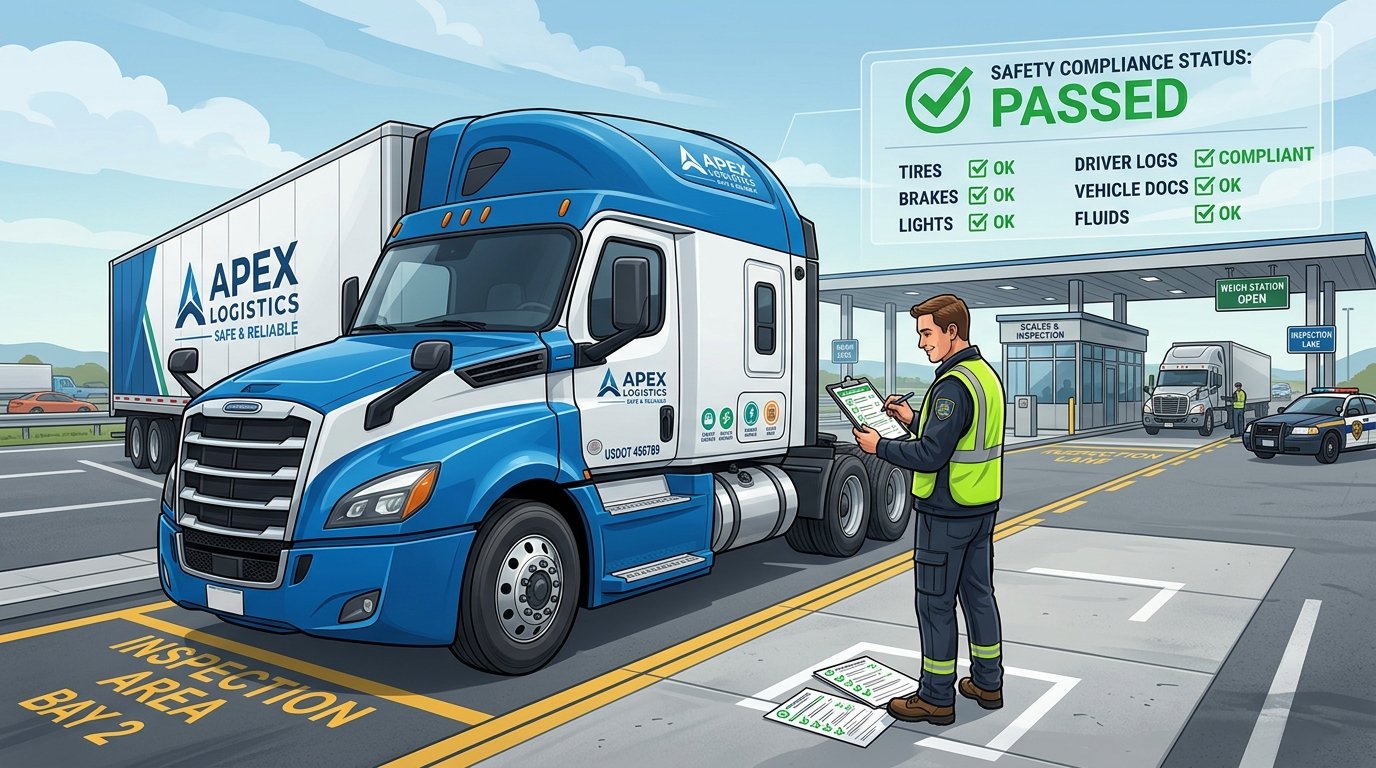
A single bad inspection can haunt your carrier for two full years. It inflates your CSA scores, puts you on FMCSA’s radar, and drives up insurance costs. The good news? You can improve DOT safety performance starting right now.
This guide gives you a clear path to clean up your safety record and keep it strong. You will learn how to review your data, challenge errors, train drivers, and use technology to stay ahead. Whether you run one truck or manage a large fleet, these strategies deliver real results.
Key Takeaways
- Your DOT safety record directly affects your operating authority, insurance rates, and contract opportunities
- CSA score trucking data comes from roadside inspections, crash reports, and audit results
- You can dispute incorrect violations for free through the FMCSA DataQs system
- A strong safety program with driver training is the fastest path to compliance improvement
- Technology like ELDs and telematics helps you prevent violations before they happen
What Does Your DOT Safety Record Include?
Your DOT safety record is a collection of data that FMCSA stores about your carrier. It shows how safely you operate on public roads. Every roadside inspection, crash report, and audit finding feeds directly into this record.
Here is what makes up your safety record:
- Roadside inspection results from all levels of DOT inspections
- Crash reports involving your commercial vehicles
- Compliance review and audit findings
- Driver fitness and licensing data
- Hazardous materials incidents (if applicable)
- Hours of service violations and patterns
FMCSA uses all of this data to calculate your CSA scores and assign your DOT safety rating. Carriers with poor records face more inspections, audits, and possible shutdowns. Understanding how your CSA score and safety rating connect is a critical first step toward fixing problems.
How FMCSA Tracks Your Safety Performance
FMCSA runs the Safety Measurement System, commonly called SMS. This online tool collects and analyzes your safety data every single month. It pulls information from state law enforcement agencies, inspection databases, and crash records across the country.
The system does not judge you in a vacuum. It compares your data against other carriers of similar size. A 5-truck fleet gets measured against other small carriers. A 500-truck operation gets compared to other large fleets. This peer-group comparison determines your percentile ranking in each safety category.
You can view your own SMS results anytime through the FMCSA Safety Measurement System. Checking your data regularly is the foundation of every effort to improve DOT safety numbers.
Why Your DOT Safety Rating Matters
Your DOT safety rating is not just a label on a government database. It carries real business consequences that hit your revenue, your costs, and your ability to operate.
Shippers and freight brokers check your safety data before giving you loads. A poor rating means lost contracts and missed opportunities. Many large shippers refuse to work with carriers who hold “Conditional” or “Unsatisfactory” ratings. They simply cannot afford the liability risk.
Insurance companies also review your safety performance closely. High CSA scores lead to higher premiums. In extreme cases, insurers drop coverage entirely. Without proper insurance, you lose your legal right to operate commercial vehicles.
Here is what each DOT safety rating level means for your business:
| DOT Safety Rating | What It Means | Business Impact |
|---|---|---|
| Satisfactory | Meets all safety management standards | Full operating authority, best insurance rates |
| Conditional | Has safety management weaknesses | Some shippers refuse loads, higher premiums |
| Unsatisfactory | Fails to meet safety requirements | Cannot operate, must cease operations |
| Unrated | No formal rating assigned yet | Limited access to premium freight contracts |
Important: An Unsatisfactory rating does give you the right to request a review. But you must correct the underlying problems first. Understanding the DOT audit process prepares you for what auditors expect.
Understanding CSA Scores in Trucking
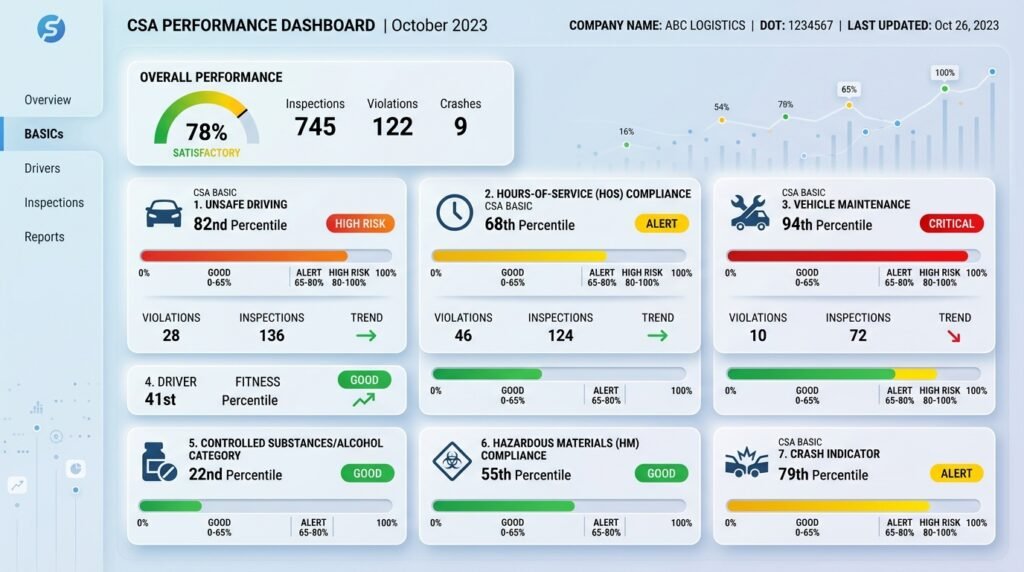
CSA score trucking data is organized into seven categories called BASICs. That stands for Behavior Analysis and Safety Improvement Categories. Each BASIC measures a different area of your commercial vehicle operation.
The 7 BASICs Categories Breakdown
Here are all seven categories and exactly what they track:
- Unsafe Driving — Speeding, reckless driving, improper lane changes, texting while driving
- Hours of Service Compliance — HOS violations, logbook errors, exceeding driving limits
- Driver Fitness — Invalid CDL, expired medical certificates, unqualified operators
- Controlled Substances and Alcohol — Drug and alcohol test failures, possession violations
- Vehicle Maintenance — Brake defects, tire problems, lighting failures, cargo securement issues
- Hazardous Materials Compliance — HazMat labeling, placarding, and handling violations
- Crash Indicator — Crash involvement history, frequency, and severity patterns
Each BASIC generates a percentile score from 0 to 100. Higher scores mean worse performance relative to your peer group. When your score crosses the intervention threshold, FMCSA may send warning letters, schedule investigations, or take enforcement action.
Here are the current intervention thresholds:
| BASIC Category | General Carrier Threshold | HazMat/Passenger Threshold |
|---|---|---|
| Unsafe Driving | 65% | 50% |
| HOS Compliance | 65% | 50% |
| Driver Fitness | 80% | 80% |
| Controlled Substances | 80% | 80% |
| Vehicle Maintenance | 80% | 75% |
| HazMat Compliance | 80% | 80% |
| Crash Indicator | 65% | 50% |
Note: These thresholds were accurate at the time of writing. Check the FMCSA Safety page for any recent updates to intervention levels.
How to Improve DOT Safety Step by Step
Now let us get into specific actions. To truly improve DOT safety, you need a structured plan that covers your data, your drivers, and your equipment.
Step 1: Review Your FMCSA Safety Data
Pull up your SMS profile and study every BASIC category. Note where your percentile scores are highest. Those problem areas deserve your attention first.
Check every inspection and violation listed in your record. Look for these issues:
- Violations that appear incorrect or unfairly coded
- Inspections listing the wrong vehicle or driver information
- Duplicate entries for the same event
- Violations that were resolved but still show as open
Many carriers discover real errors in their safety data. These mistakes inflate CSA scores and make your record look far worse than reality. You have the legal right to challenge violations that contain factual mistakes.
Step 2: File DataQs Challenges for Errors
The FMCSA DataQs system allows you to submit a Request for Data Review. You can dispute any inspection report or crash record that contains wrong information.
Common reasons to file a DataQs challenge include:
- Wrong carrier name or USDOT number on the report
- Violation coded under the incorrect BASIC category
- Driver was not actually in violation of the cited regulation
- Vehicle was not yours at the time of the event
- A crash was ruled preventable when it was not your fault
Filing a DataQs request costs nothing. But you must provide solid supporting documents. Photos, logbook records, maintenance receipts, and witness statements all strengthen your case.
DataQs processing times vary by complexity: Simple data corrections take 2-4 weeks; violation code disputes average 30-60 days; crash accountability challenges require 60-120 days. Check status anytime via the DataQs portal, and follow up if pending over 60 days.
Step 3: Address High-Priority BASICs First
Focus your energy on categories with the highest percentile scores. Those BASICs are most likely to trigger FMCSA enforcement action against your carrier.
For most carriers, the top problem areas fall into three buckets:
- Vehicle Maintenance — Fix this with better daily inspections and preventive maintenance schedules
- Unsafe Driving — Fix this with driver training, monitoring, and accountability programs
- HOS Compliance — Fix this with proper ELD compliance and thorough driver education
Each clean inspection actively helps lower your scores over time. The SMS system weights recent data more heavily than older records. Good inspections today have a bigger positive impact than old violations have a negative one.
Challenge DOT Violations Through DataQs
Knowing how to challenge DOT violations can dramatically change your safety record. Let us walk through the process in detail.
When Should You File a Challenge?
Not every violation is worth disputing. Focus your effort on violations that carry high severity weights and significantly impact your CSA scores.
File a challenge when:
- The inspection report contains factual errors
- A violation was coded under the wrong federal regulation
- You have clear proof the violation did not actually occur
- A crash was coded as preventable when evidence shows otherwise
Skip the challenge when:
- The violation is technically accurate, even if you disagree with the regulation
- You lack documentation to support your claim
- The violation carries minimal severity weight and barely affects your scores
How to File a Successful DataQs Request
Follow these steps to challenge violations effectively through the DataQs system:
- Visit the FMCSA DataQs website
- Create an account or log in with your existing credentials
- Select the type of data you want to dispute
- Enter the specific inspection or crash report number
- Write a clear, factual explanation of what is wrong with the record
- Upload all supporting documents such as photos, logs, receipts, or statements
- Submit your request and save the confirmation number for tracking
Tip: Keep organized copies of all your inspection reports from day one. The more complete your files, the easier it is to spot errors and win challenges. If a successful challenge also involves fines, check out our guide on how to appeal DOT fines.
Successful DataQs challenges can remove violation points from your record. Over time, this directly helps reduce CSA score numbers in the affected BASIC categories.
Inspection Preparation That Prevents Problems
The most effective way to improve your trucking safety rating is to stop violations before they ever get recorded. Strong inspection preparation is your best defense.
Build a Daily Pre-Trip Routine
Every driver must complete a thorough pre-trip inspection before every trip. This is not optional good practice. Federal law requires it under FMCSA regulations found in 49 CFR 396.13.
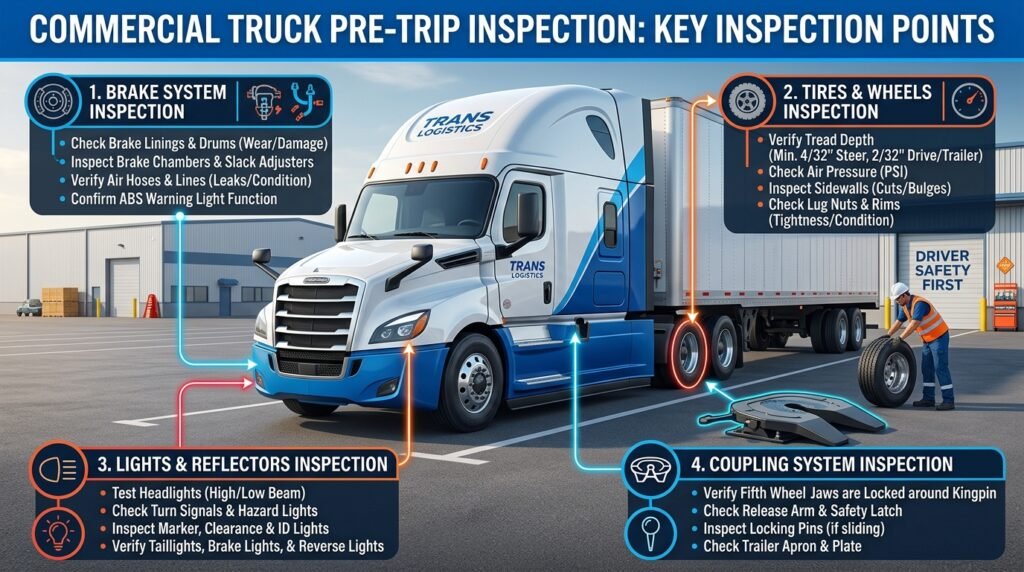
A solid pre-trip inspection covers these areas:
- Brakes — air pressure levels, slack adjuster condition, brake pad wear
- Tires — tread depth measurements, proper inflation, visible damage
- Lights — headlights, tail lights, turn signals, clearance markers
- Mirrors — clean surfaces, proper adjustment, secure mounting
- Fluid levels — engine oil, coolant, windshield washer fluid
- Coupling devices — fifth wheel engagement, pintle hook, safety chains
- Cargo securement — straps, chains, load balance, weight distribution
- Emergency equipment — fire extinguisher charge, reflective triangles, spare fuses
Use our complete pre-trip inspection checklist to make sure your drivers never miss a critical step.
What DOT Inspectors Focus On
Understanding what triggers violations helps your team prepare better. During a roadside check, officers zero in on the most common problem areas first.
The top 5 most frequently cited violations in recent inspection data include:
- Inoperable required lamps and lighting defects
- Tire tread depth below legal minimums or improper inflation
- Brake adjustment out of specification
- Form and manner errors in hours of service records
- No valid medical examiner certificate in the driver’s possession
Per CVSA 2025 International Roadcheck (latest data as of March 2026): Top 5 vehicle violations – 1. Brake systems (24.4%, 3,304 OOS), 2. Tires (21.4%, 2,899 OOS), 3. 20% defective brakes (16.7%, 2,257 OOS), 4. Lights (12.8%, 1,737 OOS), 5. Cargo securement (11.4%). Top driver violations – 1. Hours of Service (32.4%), 2. No CDL, 3. False logs/RODS (10%).
Train every driver to check these specific areas before every trip. When an inspector encounters a clean truck and a prepared, professional driver, the inspection goes smoothly and ends without violations.
Knowing the different DOT inspection levels also helps drivers understand what to expect during each type of roadside encounter.
Build a Safety Program for Lasting Results
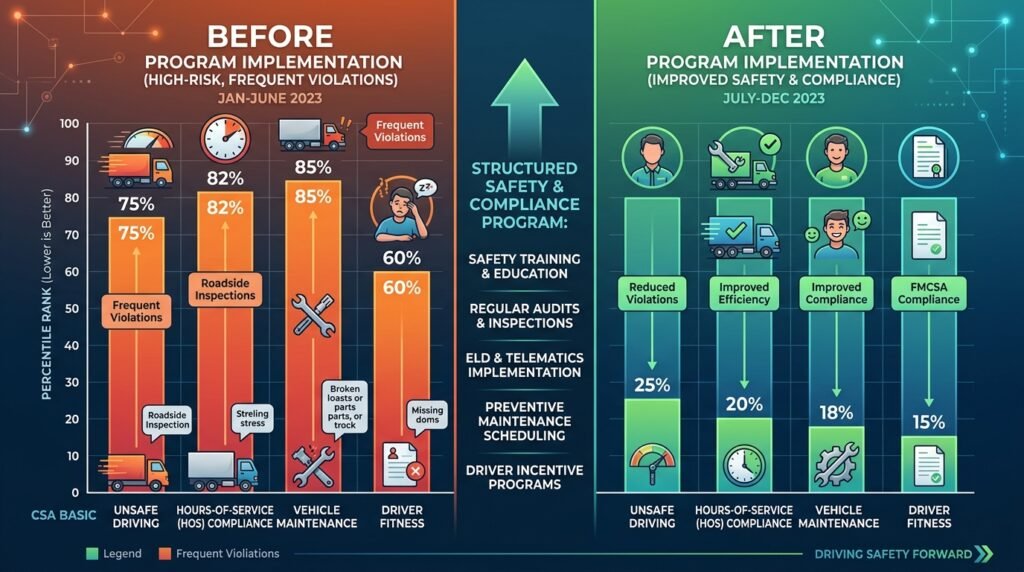
Quick fixes can help short-term. But a structured safety program creates lasting compliance improvement that holds up year after year. The carriers with the strongest safety records invest in culture, training, and systems.
Driver Training and Accountability
Your drivers represent the front line of your safety record. Their behavior behind the wheel and during inspections directly shapes your CSA scores and DOT safety rating.
Effective driver training should cover these core areas:
- Defensive driving techniques — Teaching drivers to scan ahead, anticipate hazards, and maintain safe following distances
- Current HOS rules — Making sure every driver understands their daily and weekly limits under current regulations
- Hands-on vehicle inspection skills — Real practice finding and documenting defects before they become violations
- Professional conduct during inspections — How to interact with officers calmly and cooperatively
- Documentation habits — Keeping accurate, organized records at all times
Build a system that tracks each driver’s individual violation history. Identify patterns and repeat issues early. Provide targeted coaching before small problems become serious violations. Some carriers use a point-based accountability system to keep drivers engaged with safety goals.
For proven behind-the-wheel training methods, explore our guide on defensive driving strategies for truckers. These techniques directly reduce unsafe driving violations, which is one of the hardest BASICs to manage.
Create a Written Safety Policy
Every carrier needs a written fleet safety management policy. This document outlines your company’s expectations, standard procedures, and consequences for non-compliance.
Your safety policy should include these sections:
- Company safety mission statement and leadership commitment
- Driver hiring standards including background checks and PSP reports
- Drug and alcohol testing program procedures
- Vehicle maintenance schedules and preventive maintenance protocols
- Accident reporting and investigation procedures
- Progressive disciplinary actions for safety violations
- Annual and ongoing training requirements for all drivers
A written policy demonstrates to FMCSA auditors that you take safety improvement seriously. It also provides legal protection if a driver causes an accident. For a complete framework you can follow, visit our fleet safety program guide.
Technology Tools That Improve DOT Safety Compliance
Modern technology makes DOT compliance far easier to manage and maintain. The right tools help you spot problems early, keep accurate records, and hold everyone accountable.
ELD Compliance and Hours of Service
ELD compliance is mandatory for most commercial motor vehicle drivers in the United States. Electronic logging devices automatically record driving time and duty status. They eliminate the manual logbook errors that create so many HOS violations.
Benefits of ELDs for your safety record include:
- Accurate HOS tracking — Eliminates form and manner violations from manual logs
- Automatic driver alerts — Warnings trigger before drivers exceed legal limits
- Audit-ready records — Clean, digital data ready for inspectors and auditors
- Fewer violation points — Reduced HOS violations mean lower CSA scores in that BASIC
Choosing the right device matters. If you are shopping for a solution, check our comparison of the best ELD devices available on the market today.
Fleet Tracking and Telematics
GPS fleet tracking and telematics systems go far beyond basic location monitoring. They capture real-time driver behavior data that directly relates to your safety performance.
Modern telematics platforms can track:
- Hard braking events and frequency
- Rapid acceleration patterns
- Speeding incidents with location and duration
- Harsh cornering and lane departure events
- Excessive idle time
- Route compliance and unauthorized stops
This data lets you identify risky drivers before they cause recordable violations. You can coach them proactively based on real evidence rather than waiting for a roadside inspection to reveal the problem.
Maintenance Management Software
Keeping vehicles in peak condition prevents the most common inspection failures. Maintenance management tools help you:
- Schedule preventive maintenance based on mileage, engine hours, or calendar intervals
- Track complete repair history for every vehicle in your fleet
- Set up automatic reminders before inspections or services come due
- Store digital maintenance records for instant auditor access
- Monitor parts inventory and control maintenance costs
Carriers who use dedicated maintenance software consistently see fewer Vehicle Maintenance BASIC violations. That directly helps reduce CSA score percentiles in one of the most commonly flagged categories.
Mistakes That Damage Your Safety Record
Knowing what to avoid is just as valuable as knowing what to do. These common mistakes keep carriers trapped with high CSA scores and weak safety ratings.
Ignoring your SMS data. Many carriers never look at their safety scores until an audit letter arrives. By that point, violations have been stacking up for months or years. Check your SMS profile every single month.
Skipping pre-trip inspections. When drivers rush through or completely skip their pre-trip routine, small mechanical issues turn into roadside violations. Every skipped inspection is a risk you cannot afford.
Failing to challenge data errors. Incorrect information stays on your record unless you file a dispute. Errors in your safety data can inflate your scores for up to 24 months before they age off naturally. Use DataQs to correct them now.
Hiring without proper screening. Putting an unqualified or high-risk driver behind the wheel is a fast track to violations and crashes. Always check Pre-employment Screening Program reports and motor vehicle records before making hiring decisions.
Being reactive instead of proactive. Fixing problems after violations hit your record is expensive, slow, and stressful. Prevention through consistent training, maintenance, and monitoring always costs less and delivers better outcomes.
Keeping poor records. Missing documentation during a compliance audit triggers violations even when your actual operations run safely. Keep every file organized, current, and easy to access. For a full breakdown of what you need to maintain, read our guide on DOT compliance for trucking.
Frequently Asked Questions
Start by reviewing your SMS data on the FMCSA website. Identify your worst-performing BASIC categories and prioritize those areas. Challenge violations that contain errors through the DataQs system. Then build a consistent safety program that includes driver training, daily pre-trip inspections, and preventive vehicle maintenance. Clean inspections over time will steadily bring your scores down.
Most violations remain on your record for 24 months. However, the SMS system applies greater weight to data from the most recent 12 months. Older violations gradually lose impact. This means that clean inspections and safe operations today will start improving your percentile scores relatively quickly.
You cannot simply delete a legitimate violation. However, you can dispute it through DataQs if the report contains factual errors. If the reviewing state agency agrees the data is incorrect, they will correct or remove it. Accurate violations cannot be removed early, but they will automatically age off your record after 24 months.
Lower percentiles are always better. Keeping all BASIC categories below 50% puts you in a strong competitive position. Scores above the intervention threshold – 65% for most categories and 80% for others – can trigger FMCSA warning letters, targeted inspections, or formal investigations. Aim to keep every category as low as possible through consistent safe operations.
Yes, clean inspections make a real difference. They add to your total inspection count without adding any violation severity points. The more clean inspections you accumulate relative to violations, the lower your percentile ranking becomes. Encourage your drivers to stay prepared and welcome inspections with confidence.
FMCSA refreshes SMS data once per month. New inspection results, crash reports, and investigation findings get incorporated during each monthly update cycle. Improvements you make today typically start appearing in your scores within 30 to 60 days as fresh data enters the system.
Conclusion
Your DOT safety record does not have to hold your business back. With a structured, consistent approach, you can improve DOT safety performance across every area of your operation and see measurable results.
Start with the fundamentals. Review your SMS data monthly and correct errors through DataQs. Train your drivers on proper inspection preparation, safe driving habits, and professional conduct during roadside checks. Invest in technology like ELDs and telematics that keep you ahead of violations before they happen.
Every clean inspection pushes your scores in the right direction. Every well-trained driver reduces your risk exposure. Every properly maintained truck keeps your fleet off the violation list.
The carriers who thrive long-term treat safety improvement as an ongoing daily commitment, not a one-time project. They do not wait for problems to force their hand. They prevent those problems from ever appearing.
Take your first step today. Pull up your FMCSA SMS profile, review your BASIC scores, and begin working through the strategies in this guide. Your safety record, your insurance rates, and your business growth will all benefit from the effort you put in now to improve DOT safety across your operation.
DataQs Challenge Guide







![DOT Drug Test: What You Must Know in 2026 [Full Guide]](https://compliantdriversprogram.com/wp-content/uploads/2026/03/DOT-Drug-Test-150x150.jpeg)



Leave a Reply