
Ever been stuck in traffic, watching your 14 hour rule tick away, knowing you can’t make your delivery on time? You’re not alone. Thousands of truckers face this exact problem every single day. But here’s something many drivers miss completely. The FMCSA built several HOS exceptions trucking rules that can save your run and keep you legal.
Most drivers only know about one or two exceptions. They leave money on the table because they don’t understand all their options. This guide covers every single exception available to commercial drivers right now. You’ll learn exactly when you qualify, how to use each exception properly, and which ones apply to your specific situation. Whether you haul livestock, work in the oilfield, or drive local routes, there’s probably an exception designed just for you.
What Are HOS Exceptions and Why Do They Exist
The hours of service rules exist to keep everyone safe on the road. The FMCSA knows that tired drivers cause accidents. But they also understand that trucking isn’t a one-size-fits-all industry. Different operations face different challenges that standard rules can’t always address.
That’s exactly why DOT HOS exemptions exist. These exceptions give drivers flexibility when specific situations call for it. They recognize that a driver hauling perishable goods faces different time pressures than someone moving dry freight across the country. Understanding FMCSA Hours of Service Rules is the foundation, but knowing the exceptions is what separates struggling drivers from thriving ones.
Here’s the thing most people don’t realize. Using these exceptions correctly won’t just keep you compliant. It can actually make you more money by maximizing your available driving time. Fleet managers and owner-operators who master these rules consistently outperform those who don’t.
The Short Haul Exception Explained in Detail
The short haul exception is probably the most commonly used exemption in the trucking industry. It’s designed specifically for drivers who work close to home and return to their starting point each day. If you qualify, you don’t need to keep a detailed record of duty status.
To qualify for this exception, you must operate within a 150 air mile radius of your normal work reporting location. You must also return to that same location within 14 hours and take at least 10 consecutive hours off duty before your next shift. Your employer must maintain accurate time records showing when you started and ended each shift.
This exception works perfectly for Local Truck Driving Jobs where drivers make multiple stops close to their home terminal. Delivery drivers, construction material haulers, and regional pickup and delivery operations use this exception constantly. The big benefit here is freedom from the ELD requirement, which saves companies money and reduces paperwork headaches.
Pro Tip: Even with the short haul exception, you still must follow the 11 hour limit and 14 hour window. The exception only removes the ELD and detailed logging requirements. It doesn’t extend your available driving time.
The 16 Hour Exception for Tough Days
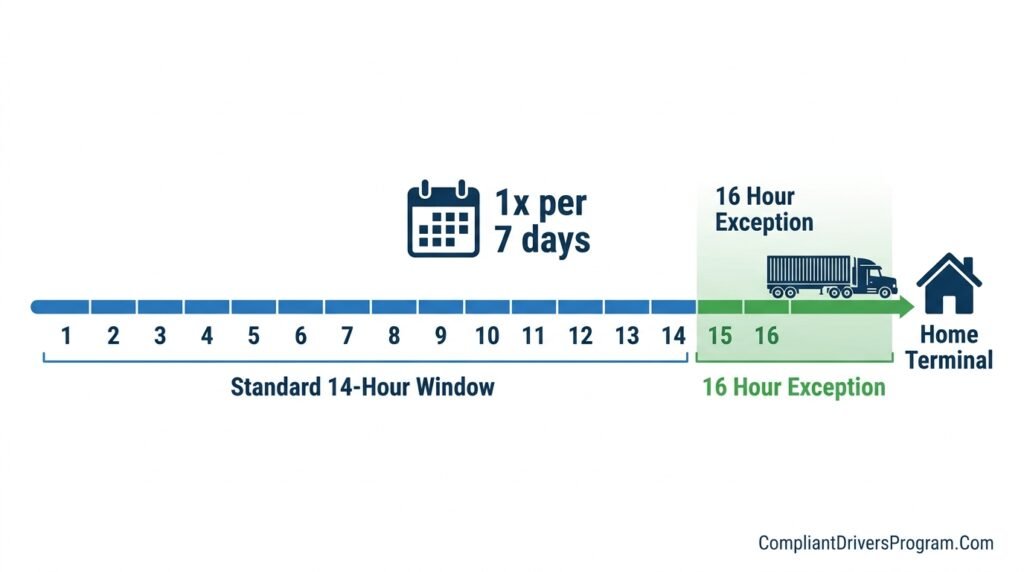
Sometimes one extra day in your week throws everything off. The 16 hour exception was created for exactly this situation. It gives you two extra hours once per week to get home or back to your terminal without violating HOS rules.
Here’s how it works in practice. Your 14 hour driving window expands to 16 hours, but your actual driving time stays at 11 hours maximum. You can only use this exception once every seven consecutive days. You must return to your normal work reporting location or home terminal for that shift. This isn’t an exception you can claim while running over the road.
Most drivers use the 16 hour exception on their last day before a restart. Maybe traffic was terrible, or your last customer took forever to unload. Instead of parking and waiting overnight, you can push through those final miles home. The 34 Hour Restart Rule resets everything, so using your 16 hour exception right before makes perfect sense.
This exception also works great for Home Daily Trucking Jobs where drivers value getting back to their families. Nobody wants to park an hour from home because of a technicality. The FMCSA understands this reality.
Adverse Driving Conditions Exception
Weather happens. Traffic accidents create massive delays. Construction zones appear out of nowhere. The adverse driving conditions exception exists because the FMCSA knows you can’t predict everything when you start your shift.
This exception allows you to add two extra hours to your driving time and your 14 hour window. That means you can drive up to 13 hours and work up to 16 hours total when adverse conditions hit. The key requirement is that you couldn’t have reasonably known about these conditions before starting your trip.
What qualifies as adverse driving conditions? Snow, ice, sleet, fog, and other weather events definitely count. Unexpected traffic from an accident or road closure also qualifies. But here’s what many drivers get wrong. Routine rush hour traffic doesn’t count. Road construction you knew about in advance doesn’t count either.
You must document the conditions you encountered in your remarks section or ELD notes. This protects you during an inspection or audit. Simply writing “bad weather” isn’t enough detail. Describe the specific conditions, location, and how they affected your travel time. According to the FMCSA, proper documentation is essential for claiming any exception.
Agricultural Exemption Details
Farmers and drivers hauling farm products enjoy some of the broadest HOS exceptions trucking regulations offer. The agricultural exemption recognizes that farming operates on nature’s schedule, not a logbook’s schedule. When crops are ready for harvest, they need to move quickly.
During planting and harvest seasons, drivers moving agricultural commodities within a 150 air mile radius from the source don’t need to follow standard HOS rules at all. This applies to livestock, feed, farm supplies, and raw agricultural products. The exemption covers the full planting and harvesting seasons as determined by each state’s department of agriculture.
But the exemption gets even broader during the first and last segments of any agricultural load. You’re exempt during the first 150 air miles from the source of the commodity. You’re also exempt during the last 150 air miles to the final delivery destination. This applies regardless of what season it is.
Understanding DOT Regulations for Truck Drivers helps you stay compliant while maximizing agricultural exemptions. Many livestock haulers use this exception daily, especially during auction seasons when timing is critical.
Emergency Exception for Critical Situations
When disasters strike, truck drivers become essential responders. The emergency exception removes HOS restrictions for drivers providing direct assistance during declared emergencies. This could be natural disasters, disease outbreaks, or other events requiring immediate transportation support.
The FMCSA can issue national or regional emergency declarations that trigger this exception. State governors can also declare emergencies that qualify. Once active, drivers hauling relief supplies, essential goods, or equipment don’t need to follow standard hours of service rules. The exception stays in effect until the emergency declaration ends or until 30 days pass.
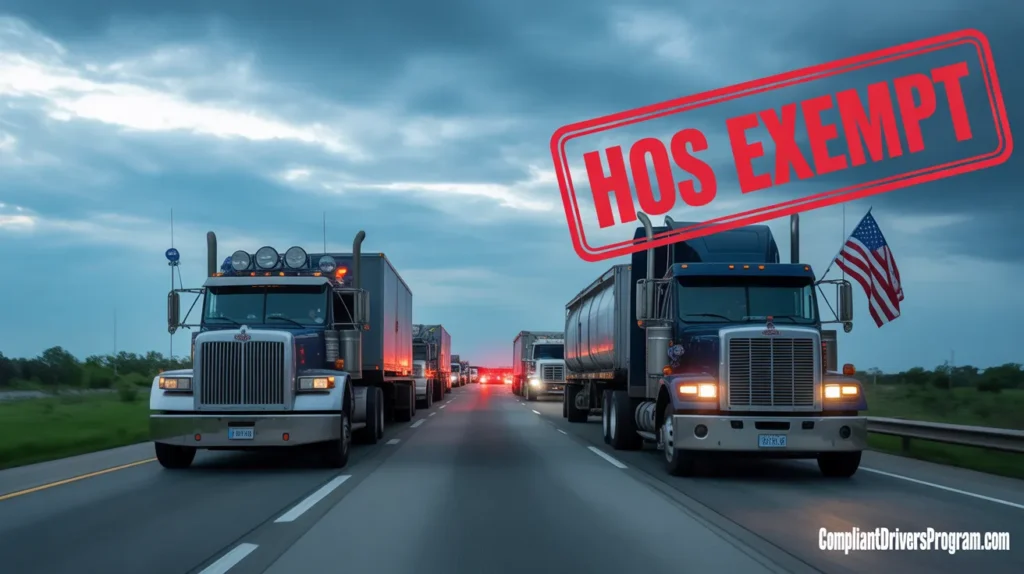
Here’s something important to remember. This exception only covers loads directly related to the emergency response. You can’t claim it for your regular freight just because an emergency exists somewhere in the country. The load you’re hauling must directly support emergency relief efforts.
During major hurricanes, snowstorms, and other disasters, you’ll see these declarations issued quickly. Fuel haulers, food transporters, and utility equipment operators use this exception most often. The U.S. Department of Transportation maintains current emergency declarations on their website.
Oilfield Exception for Specialized Operations
The oilfield exception addresses the unique challenges of the oil and gas industry. Drilling operations run around the clock, and the distances involved create scheduling problems that standard HOS rules can’t accommodate.
Under this exception, waiting time at a well site doesn’t count against your 14 hour window. You can pause your clock while waiting for servicing or repairs at the oil or gas well. This recognizes that oilfield drivers often travel to remote locations and wait for extended periods before performing actual work.
The exception also allows 24 hour restart periods instead of the standard 34 hours. This is huge for oilfield operations that need maximum flexibility. Your 70 Hour Rule Trucking limit still applies, but the restart requirement drops significantly.
To qualify for the oilfield exception, you must operate a commercial motor vehicle specifically for transporting oilfield equipment or servicing oil and gas wells. Your operations must be within a 150 air mile radius of your reporting location. The exemption doesn’t cover long-haul oilfield equipment transport across multiple states.
Utility Service Vehicle Exception
Utility companies keep our power on, water flowing, and communications working. When emergencies hit, utility workers need to respond immediately. The utility service vehicle exception makes this possible.
Drivers operating utility service vehicles don’t need to follow standard HOS rules when responding to power outages, pipeline breaks, or communication failures. The exception covers vehicles used primarily to restore or maintain utility services. This includes electric, water, gas, telephone, and cable television services.
This exception works similarly to the emergency exception but doesn’t require an official declaration. A bad thunderstorm knocking out power in your service area automatically triggers the exception for utility response. The focus is on restoring essential services to customers as quickly as possible.
Utility companies must ensure their drivers don’t operate while impaired by fatigue. The exception provides flexibility, not an excuse to push drivers past safe limits. Most utility companies have internal policies that add safety restrictions even when the federal exception applies.
Motion Picture Production Exception
Hollywood runs on tight schedules and unpredictable hours. The motion picture production exception recognizes that film and television production doesn’t follow normal business hours. Drivers hauling equipment for movie productions face unique scheduling challenges.
This exception allows production drivers to use the 16 hour driving window without the once-per-week limitation. Film shoots might run late multiple days in a row, and equipment needs to move between locations quickly. The standard 16 hour exception simply doesn’t provide enough flexibility.
To qualify, you must be transporting equipment, materials, or supplies to or from a motion picture or television production site. The exception covers theatrical films, television shows, commercials, and documentary productions. Personal vehicles hauling small equipment don’t qualify since they’re not commercial motor vehicles.
Ground Water Well Drilling Exception
Drivers transporting drilling rigs for ground water wells enjoy their own specific exception. Water well drilling often happens in rural areas with limited lodging options. The work itself is unpredictable, depending on geological conditions underground.
This exception allows the 24 hour restart period instead of 34 hours. It also allows waiting time at the well site to pause your 14 hour window. These provisions mirror the oilfield exception because the operations face similar challenges.
You must be transporting water well drilling rigs or related equipment to qualify. The exception covers the specialized nature of this work and the remote locations involved. Most water well drilling operations happen within regional areas, making the 150 air mile radius provision workable for most companies.
HOS Exceptions Comparison Table
| Exception Type | Extra Driving Time | Restart Required | Who Qualifies | Documentation Needed |
|---|---|---|---|---|
| Short Haul | None | 10 hours off | Local drivers within 150 miles | Employer time records |
| 16 Hour | None (2 hour window) | Standard | Any driver once weekly | ELD annotation |
| Adverse Driving | 2 extra hours | Standard | Any driver facing conditions | Detailed notes required |
| Agricultural | Exempt within 150 miles | Varies | Farm product haulers | Load documentation |
| Emergency | Exempt during emergency | None during event | Relief supply drivers | Emergency declaration |
| Oilfield | Waiting time off-duty | 24 hours | Oilfield service drivers | Well site records |
| Utility Service | Exempt during response | None during response | Utility company drivers | Work orders |
How ELD Exemptions Connect to HOS Exceptions
Understanding ELD Exemptions Guide helps you see the bigger picture. Some HOS exceptions automatically include ELD exemptions, while others still require electronic logging. The short haul exception is the clearest example since qualifying drivers don’t need ELDs at all.
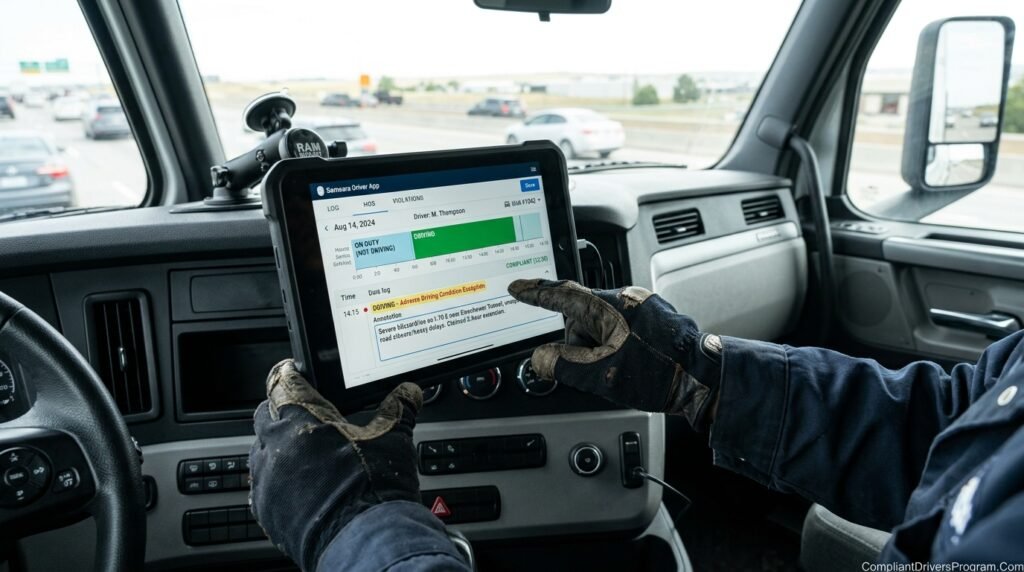
The ELD Mandate Guide covers which drivers must use electronic logging devices. But exceptions like adverse driving and the 16 hour rule still require ELD documentation. You simply add annotation notes explaining which exception you’re claiming.
Your ELD should have an option to record exception claims directly. Most modern systems include dropdown menus for common exceptions. Using these features correctly creates a clear paper trail during inspections. DOT officers check these annotations regularly, so accuracy matters.
Common Mistakes When Claiming HOS Exceptions
Most drivers who get violations for improperly claiming exceptions make the same basic errors. Learning from these mistakes helps you stay compliant and avoid costly citations.
The biggest mistake is claiming adverse driving conditions for predictable delays. Rush hour traffic in Atlanta happens every single day. You can’t claim adverse conditions just because I-285 was congested during evening commute. The conditions must be unexpected based on information available when you started driving.
Another common error involves the 16 hour exception frequency. You can only use it once per seven days, period. Using it twice in one week creates a violation even if circumstances seemed to justify it. Track your usage carefully to avoid this trap.
Drivers also mess up the short haul exception by exceeding the 150 air mile radius. Remember that air miles are measured as straight lines, not road miles. A route that’s 180 road miles might only be 140 air miles. Use mapping software that calculates air mile distances to stay compliant.
Who Is Exempt From HOS Rules Entirely
The HOS exceptions list for truckers includes some complete exemptions beyond the situational exceptions covered above. Certain drivers and vehicles are exempt from all HOS requirements under specific circumstances.
Drivers operating within their state who qualify for intrastate exemptions may have different rules depending on state law. However, anyone operating in interstate commerce must follow federal standards. The Sleeper Berth Rules still apply to most drivers even when other exceptions are in effect.
Vehicles with a GVWR under 10,001 pounds generally don’t fall under federal HOS rules. Farm vehicles not crossing state lines may also be exempt. School bus drivers operating under school bus rules have separate requirements. Always verify your specific situation against current regulations.
Frequently Asked Questions
A: The main exceptions include short haul, 16 hour, adverse driving, agricultural, emergency, and oilfield provisions. Each has specific requirements for eligibility.
A: No. Federal regulations strictly limit this exception to once every seven consecutive days regardless of circumstances.
A: Not completely. Your employer must maintain time records showing when shifts start and end. You just don’t need detailed duty status records.
A: You need ELD annotations or logbook notes describing specific conditions, location, and impact on your trip. Generic notes aren’t sufficient.
A: Drivers hauling livestock, farm supplies, feed, or raw agricultural products within 150 air miles of the source during planting and harvest seasons.
A: Emergency exceptions last until the declaration ends or 30 days pass, whichever comes first.
A: Most exceptions only affect the 14 hour window and 11 hour driving limit. The 70 hour weekly limit generally still applies.
Putting These Exceptions to Work
Understanding DOT hours of service exceptions gives you real advantages on the road. Here are the key points to remember from everything covered above.
- The short haul exception works for local drivers within 150 air mile radius who return daily
- Adverse driving adds two hours but requires unexpected conditions and proper documentation
- Agricultural exemptions provide the broadest flexibility during planting and harvest seasons
- The 16 hour exception saves your day once per week when you need to get home
- Emergency, oilfield, and utility exceptions serve specialized industry needs
Your next step is reviewing which exceptions apply to your specific operation. Talk with your dispatcher or safety department about proper documentation procedures. Check your ELD system to learn how it records exception annotations.
Knowing these rules puts you ahead of drivers who operate in the dark. Stay compliant, maximize your available time, and keep moving freight efficiently. That’s what separates professional drivers from everyone else.
HOS Exception Checker







![DOT Drug Test: What You Must Know in 2026 [Full Guide]](https://compliantdriversprogram.com/wp-content/uploads/2026/03/DOT-Drug-Test-150x150.jpeg)



Leave a Reply