
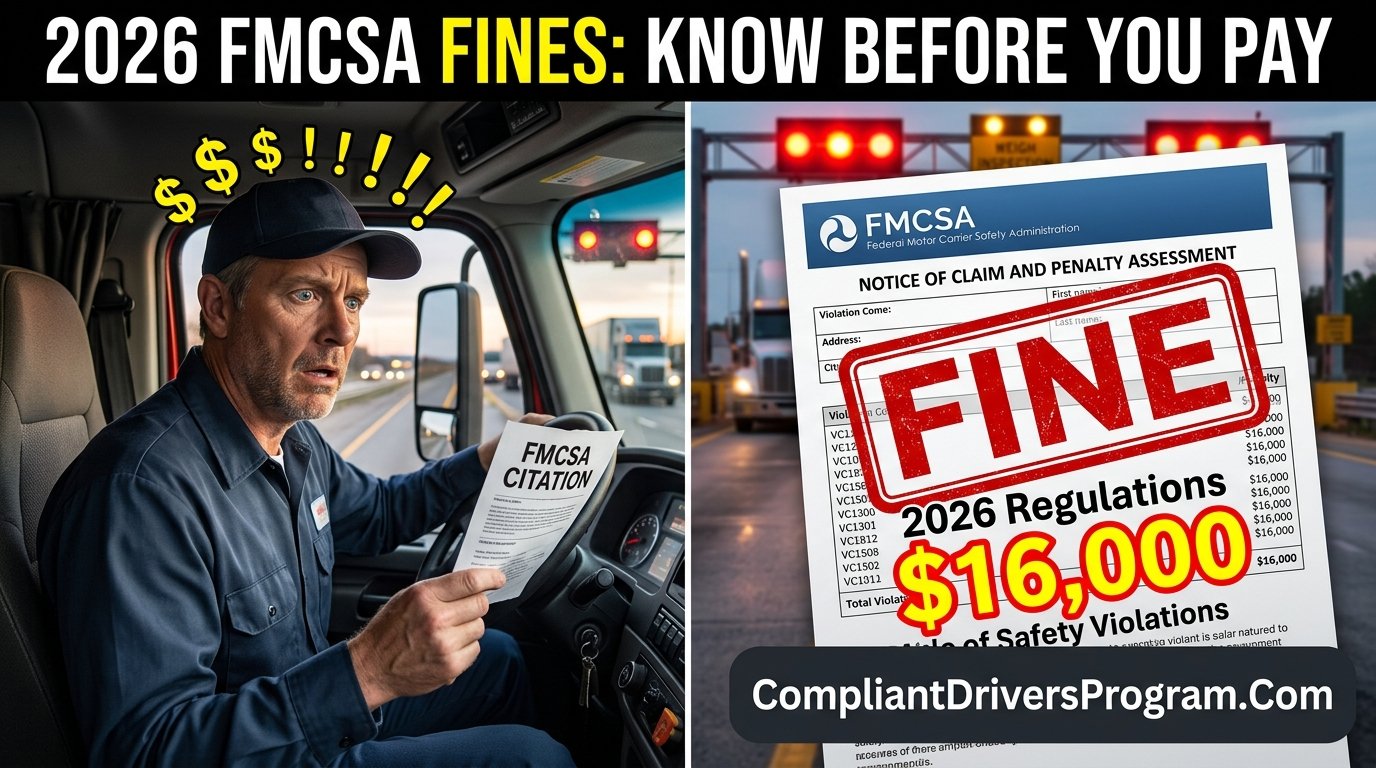
FMCSA Fines and Penalties: The Complete 2026 Cost Breakdown Every Trucker Needs
You just got pulled over at a weigh station. The inspector found something wrong. Now you’re staring at a citation wondering how much this mistake will cost you. Sound familiar? You’re definitely not alone in this situation.
FMCSA fines can drain your wallet faster than a fuel stop in California. A single violation might cost you $500. But stack up a few mistakes, and you could face penalties reaching $16,000 or more per violation. That’s not pocket change for any driver or carrier out there.
Here’s what makes this tricky. The fine amounts change regularly. What cost $1,000 last year might cost $1,500 today. Plus, different violations carry wildly different penalty amounts. Some get you a warning. Others put you completely out of service and shut down your operation.
This guide breaks down every major FMCSA fine you need to know for 2026. You’ll learn exact DOT violation fines, what triggers them, and most importantly, how to avoid them. Let’s protect your CDL and your bank account at the same time.
Why FMCSA Penalty Amounts Keep Climbing Every Year
Most people don’t know this: FMCSA penalties increase automatically each year. The Federal Civil Penalties Inflation Adjustment Act requires this adjustment. Congress passed this law to keep fines meaningful over time. What seemed like a big penalty in 2010 wouldn’t hurt much in 2026 without these updates.
The adjustment happens every January. The Department of Transportation calculates new amounts based on inflation rates. This means the fine schedule you memorized last year is already outdated. Carriers who don’t stay current often get surprised by higher-than-expected citations during inspections.
Let’s look at the numbers. Back in 2015, the maximum DOT fines for most violations topped out around $11,000. Today, those same violations can exceed $16,000 per offense. That’s nearly a 50% increase in just a decade. The trend will continue climbing into 2026 and beyond.
The good news? Knowing these amounts helps you make smart decisions. You can calculate whether that corner-cutting really saves money. Spoiler alert: it usually doesn’t when you factor in potential trucking fines and enforcement actions.
Understanding How FMCSA Calculates Your Fine Amount
The FMCSA doesn’t just pull numbers from thin air. They use a specific formula to determine your violation costs. Several factors influence whether you pay the minimum or maximum penalty. Understanding this system helps you prepare for what’s coming.
First, they look at violation severity. Did someone get hurt? Was there property damage? These situations automatically push penalties toward the maximum. A paperwork error costs less than a brake failure that caused an accident. The agency weighs public safety impact heavily in every decision.
Your compliance history matters tremendously here. First-time offenders typically receive lower fines than repeat violators. The FMCSA tracks everything in their database. Three DOT violations in two years? Expect them to throw the book at you this time around.
Company size also plays a role in penalty calculations. A small owner-operator might pay less than a mega-carrier for identical violations. The FMCSA considers ability to pay when setting final amounts. However, don’t assume being small gives you a free pass on serious safety violations.
Pro Tip: Document your safety efforts thoroughly. Showing inspectors your compliance training records and maintenance logs can influence how they report violations. This documentation helps during any appeals process too.
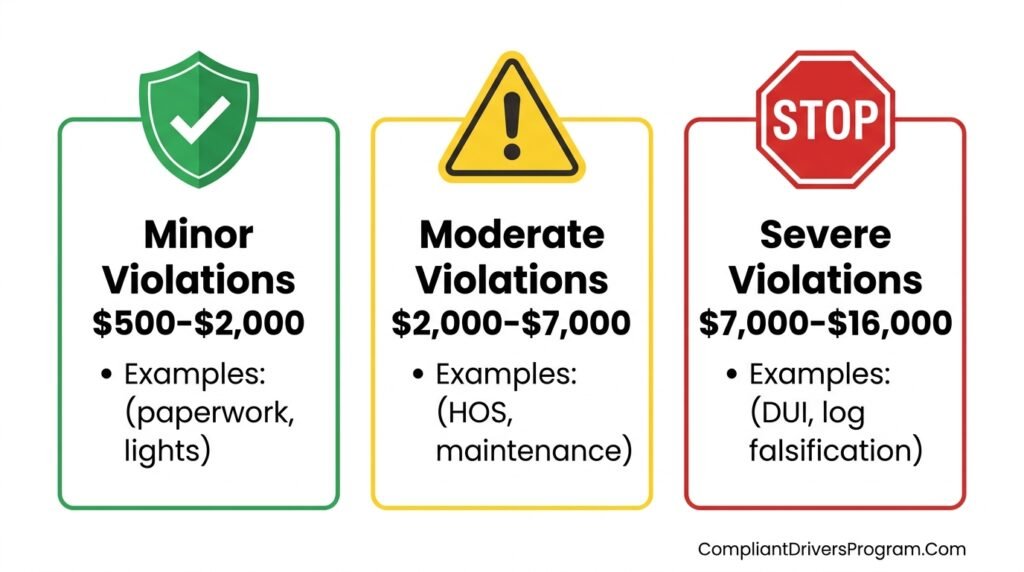
Hours of Service Violations: The Most Common FMCSA Fines
Let’s talk about the violations that hit truckers most often. FMCSA Hours of Service Rules violations account for a huge percentage of DOT fines issued each year. These rules exist because tired drivers cause accidents. The FMCSA takes them extremely seriously.
Driving beyond your 11-hour limit carries fines starting around $750. But that’s just the beginning. Each additional hour counts as a separate violation. Drive 14 hours straight? You might face multiple citations stacking up quickly. The math gets ugly fast when you’re exhausted.
Falsifying your logs brings much steeper penalties. We’re talking potential fines up to $16,000 per violation here. The FMCSA views log falsification as intentional deception. They punish it accordingly with maximum penalty amounts almost every time they catch it.
The 34-hour restart violation catches many drivers off guard. You must include two 1am to 5am periods in your restart. Miss this requirement and you’re violating HOS rules from your very first mile. Check out ELD & HOS Violation Fines for detailed cost breakdowns on these specific situations.
ELD Violations and Electronic Logging Fines for 2026
Electronic logging devices changed the game for HOS compliance. But they also created an entirely new category of FMCSA fines. You can’t just have an ELD anymore. It must work properly, be registered correctly, and you need to know how to use it right.
Operating without a required ELD puts you out of service immediately. The fine starts around $1,000 for the first offense. Repeat violations escalate quickly to $5,000 or more. Some carriers face penalties exceeding $10,000 for systematic ELD non-compliance across their fleet.
Malfunctioning ELD situations require specific responses. You get 8 days to fix or replace a broken device. During that time, you must keep paper logs. Fail to maintain those backup logs? That’s another violation with its own violation costs attached to it.
Here’s something interesting about ELD tampering. The FMCSA treats this like log falsification. Circumventing your ELD carries those maximum $16,000 penalties. Don’t think apps that “help” your logs go unnoticed either. Investigators know these tricks exist and look for them specifically. Learn more about Log Book Violation Fines to avoid these costly mistakes.
Vehicle Inspection and Maintenance Violation Costs
Your truck’s condition affects your wallet in two ways. First, breakdowns cost money directly. Second, inspection violations add trucking fines on top of those repair expenses. Staying ahead of maintenance pays dividends at every weigh station.
Brake system violations carry some of the heaviest penalties. Brakes out of adjustment can mean fines around $3,000 to $7,000. Brake violations also trigger immediate out of service orders. You’re not going anywhere until certified repairs happen right there.
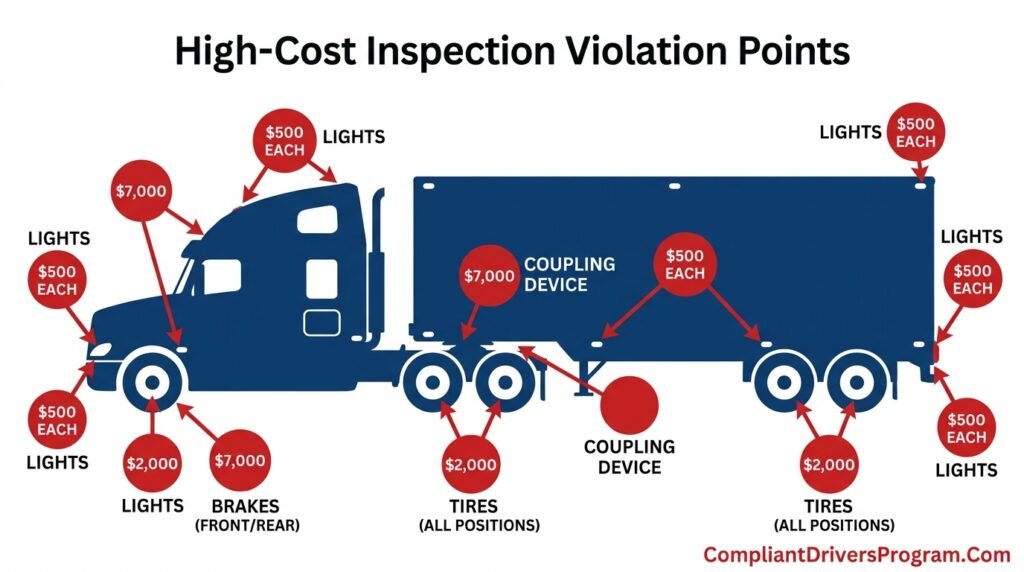
Lighting violations seem minor but add up fast. Each light that’s out or malfunctioning counts separately. Five broken marker lights? That’s potentially five separate citations written on one inspection. The fine schedule treats each deficiency as its own violation.
Tire violations follow similar patterns. Worn tread, improper inflation, or damage all carry individual penalties. A set of worn tires might generate four violations in one stop. Suddenly that $400 tire replacement looks cheap compared to $2,000 in fines plus the tire cost.
Understanding DOT Truck Inspection requirements helps you stay compliant. Know what inspectors look for before they find problems.
Drug and Alcohol Testing Penalty Breakdown
The FMCSA maintains zero tolerance for substance abuse violations. These DOT fines rank among the highest in the entire fine schedule. Your career and freedom can disappear with one positive test or refusal.
Refusing a drug test carries the same consequences as failing one. Fines start around $5,000 and climb rapidly for carriers who allow non-compliant drivers. Individual drivers face CDL disqualification on top of monetary penalties. The combination devastates careers.
Carriers face separate penalties for testing program failures. Not maintaining a proper testing program brings fines up to $16,000 per violation. Missing random testing percentages adds more penalties. Each gap in your program creates another potential citation during audits.
The DOT Drug Test Guide explains exactly what’s required. Following these rules protects everyone involved from devastating consequences.
Pro Tip: Keep meticulous records of all drug testing activities. During a DOT Audit, missing documentation creates violations even if you actually conducted the tests.
Driver Qualification File Violations and Costs
Paperwork violations don’t seem dangerous. But the FMCSA disagrees strongly with that view. Your driver qualification file must contain specific documents. Missing items trigger FMCSA penalties that surprise many carriers during audits.
Missing medical certificates cost between $1,000 and $5,000 per driver. Every driver needs a valid medical card. Every carrier must have copies on file. Letting either requirement slip creates immediate violations during any inspection.
Road test documentation gaps carry similar penalties. Before a driver operates CMVs for you, you need proof they can handle the equipment. Missing road test certificates or equivalents generate their own DOT violation fines during compliance reviews.
Motor vehicle record checks must happen annually. Missing MVRs for any driver creates violations. The FMCSA wants proof you’re monitoring your drivers’ records. Skip this requirement and expect fines during your next audit.
DOT Compliance For Trucking covers all documentation requirements in detail. Following these guidelines keeps your files audit-ready at all times.
Complete FMCSA Fine Schedule Comparison Table
| Violation Category | Minimum Fine | Maximum Fine | Out of Service? | Affects CSA? |
|---|---|---|---|---|
| HOS – Driving Over Limit | $750 | $16,000 | Sometimes | Yes |
| Log Falsification | $2,500 | $16,000 | Yes | Yes |
| ELD Not Present | $1,000 | $5,000 | Yes | Yes |
| Brake Violations | $1,000 | $7,000 | Usually | Yes |
| Drug/Alcohol Violations | $5,000 | $16,000 | Yes | Yes |
| Missing Medical Card | $500 | $5,000 | Yes | Yes |
| Speeding (15+ over) | $1,000 | $11,000 | Possible | Yes |
| Texting While Driving | $2,750 | $16,000 | No | Yes |
| No CDL in Possession | $500 | $2,500 | Yes | Yes |
| Hazmat Documentation | $1,000 | $10,000 | Sometimes | Yes |
This table shows ranges because exact amounts depend on circumstances. Severity, history, and other factors push fines toward minimum or maximum ends.
Serious Traffic Violations and Their Consequences
Traffic violations in a CMV carry extra weight compared to regular vehicles. Speeding & Reckless Driving CDL violations affect both your wallet and your driving privileges. The stakes run much higher than simple traffic tickets.
Speeding 15 mph or more over the limit triggers serious FMCSA fines. First offenses might cost $1,000 to $2,500. Second serious violations within three years bring CDL disqualification for 60 days. The financial and career impacts compound quickly.
Reckless driving sits near the top of serious violations. Fines reach $11,000 or higher depending on circumstances. This violation also counts toward disqualification thresholds. Two reckless driving convictions equal a lengthy CDL suspension.
DUI with CDL carries the harshest penalties of all. First offense means one-year CDL disqualification minimum. A second DUI conviction brings lifetime disqualification. Fines easily exceed $10,000 plus criminal penalties in most states.
These violations appear on your CSA Score for years. Poor scores affect employment opportunities long after you pay the fines.
Out of Service Orders: When Fines Become the Least of Your Problems
Getting placed out of service hurts worse than any fine. You can’t move the truck. You can’t complete the load. Time-sensitive freight might spoil or miss deadlines. The ripple effects cost far more than the paperwork penalty.
Driver OOS orders require immediate action. You cannot operate any CMV until the condition clears. Medical card expired? You’re sitting until you get a new one. HOS violation? You’re stuck until you accumulate enough off-duty time legally.
Vehicle OOS orders work differently. The truck stays put until repairs happen and get verified. You might need to call mobile repair services to the inspection site. Those emergency service calls cost premium rates on top of parts and labor.
Carrier OOS orders represent the nuclear option. The FMCSA can shut down entire companies for systematic violations. This happens when patterns show complete disregard for safety rules. Review Out of Service Violations to understand what triggers these serious actions.
Understanding DOT Inspection Levels helps you prepare for what inspectors might check during any stop.
How to Reduce or Avoid FMCSA Penalties
Here’s the thing: most FMCSA fines are completely avoidable. Prevention costs far less than penalties. Building compliance into your daily routine protects your money and your career simultaneously.
Pre-trip inspections catch problems before inspectors do. Spend 15 minutes checking your vehicle thoroughly. Finding a burned-out light in your yard beats finding it at a weigh station. This simple habit prevents countless citations annually.
Stay current on regulation changes. The rules evolve constantly. What was acceptable last year might violate current standards. Subscribe to FMCSA updates and read industry publications regularly.
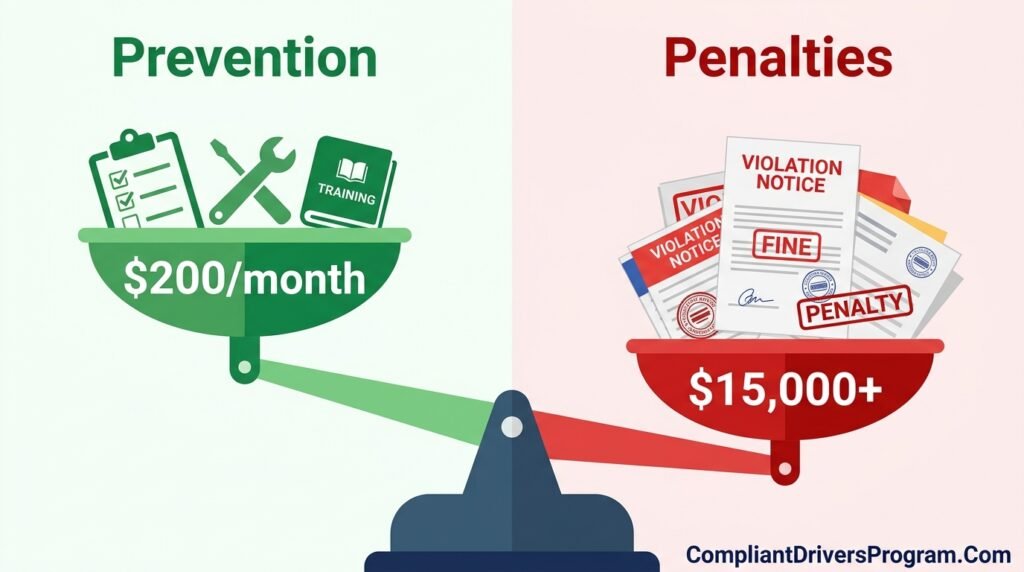
When violations do happen, know your appeal rights. How to Appeal DOT Fines explains the process step by step. Successful appeals can reduce penalties significantly or eliminate them entirely in some cases.
Pro Tip: Attend compliance training annually even if not required. Documentation showing voluntary training efforts helps during enforcement proceedings. It demonstrates good faith commitment to safety.
Frequently Asked Questions About FMCSA Fines
A: First-time DOT fines typically fall at the lower end of penalty ranges. Minor violations might cost $500-$1,000 while serious safety violations still reach maximum amounts regardless of history.
A: Yes, you can request settlement conferences or formal hearings. Many carriers successfully negotiate reduced penalty amounts by demonstrating corrective actions and compliance improvements.
A: Most inspection-related violations affect your CSA score. However, some paperwork violations found during audits don’t appear in roadside inspection data.
A: FMCSA penalties remain on carrier records permanently. However, CSA scores only include the most recent 24 months of inspection data for scoring purposes.
A: Maximum fines reach $16,000 per violation for most serious offenses. Hazmat violations can exceed $80,000 in extreme cases involving willful conduct.
A: Generally yes, unless you received an out of service order. The appeal process doesn’t automatically pause penalty payment deadlines though.
A: Federal FMCSA fines apply uniformly nationwide. However, states can add their own penalties for violations of state-specific regulations.
Protecting Your Career and Your Wallet
Understanding CDL Violations and their costs helps you make smart decisions daily. Every choice behind the wheel carries potential consequences. Knowing the FMCSA fines and penalties list gives you power over your career.
The DOT Regulations for Truck Drivers exist for good reasons. They protect you, other motorists, and the public. Compliance isn’t just about avoiding fines. It’s about going home safely to your family every night.
For a comprehensive overview, check out the DOT Fines Complete Guide. This resource covers additional situations not detailed here.
Key takeaways to remember:
- FMCSA fines increase annually due to inflation adjustments
- Serious violations like log falsification can cost up to $16,000 per offense
- Out of service orders cost more than fines through lost productivity
- Prevention through inspections and training beats paying penalties every time
Your next step? Review your compliance procedures this week. Check driver files, inspect vehicles thoroughly, and verify your ELD works properly. The hour you invest now saves thousands in potential DOT violation fines down the road.
This article provides general information about FMCSA regulations and penalties. Specific fines vary based on circumstances. Consult with a transportation attorney for advice on your particular situation.
Fine Calculator Tool







![DOT Drug Test: What You Must Know in 2026 [Full Guide]](https://compliantdriversprogram.com/wp-content/uploads/2026/03/DOT-Drug-Test-150x150.jpeg)



Leave a Reply