
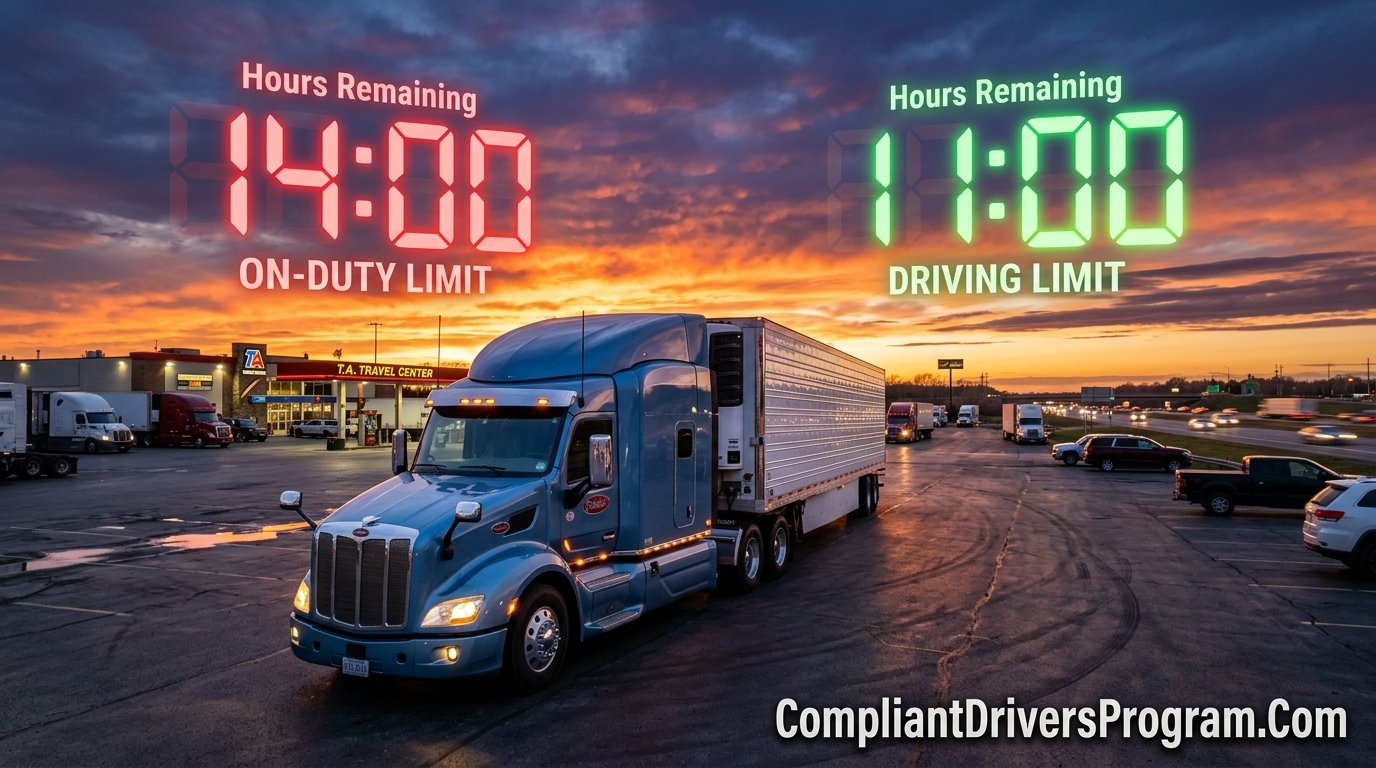
The New 14 Hour Rule for Truck Drivers and the 11 Hour Driving Limit: Everything You Need to Know (Without the Confusion)
Picture this. You just picked up a load at 6 AM, and now you’re staring at your ELD wondering if you have enough time to make delivery. Your clock is ticking, and one wrong move could land you a fat violation fine. Sound familiar? You’re definitely not alone because the 14 hour duty window and the 11 hour driving rule confuse even seasoned drivers every single day.
Here’s the good news. You’re about to get a clear, no-nonsense breakdown of the new 14-hour rule for truck drivers and the 11 hour driving limit DOT enforces. By the time you finish reading, you’ll know exactly how these clocks work, when they start, when they stop, and how to squeeze every legal minute out of your work day limit. Let’s dig in.
What Exactly Is the 14 Hour Duty Window?
The DOT 14 hour rule is one of the core Hours of Service regulations that every commercial driver must follow. In simple terms, once you start your duty period after a qualifying off-duty break, a 14-hour clock begins counting down. You must complete all your driving within that 14-hour window. After 14 consecutive hours, you cannot drive again until you take another 10 hours off duty.
Now, here’s the part that trips people up. The 14-hour clock does not pause. It doesn’t matter if you take a 2-hour lunch break or sit at a shipper for 4 hours waiting to get loaded. That clock keeps running no matter what you do. The only thing that matters is when you first went on duty or started driving.
Think of it like a stopwatch that someone hits the moment you start your day. Whether you’re driving, fueling, doing a pre-trip inspection, or sitting in a dock door, those hours are burning. The 14 hour rule for truck drivers explained in one sentence is this: you get a 14-hour window from start to finish, and driving must happen inside that window.
Many drivers confuse the 14 hour duty window with actual driving time, and that mistake can cost you big. Your 14 hours is your total on duty time window, not just the time behind the wheel. Understanding this difference is the first step toward staying compliant and avoiding HOS violation fines that can reach hundreds or even thousands of dollars.
The 11 Hour Driving Limit: Your Time Behind the Wheel
So if 14 hours is your total window, what about actual driving? That’s where the 11 hour driving rule comes in. Within your 14 hour duty window, you can spend a maximum of 11 hours actually driving. Not 11 hours and 5 minutes. Not 11 hours and 1 minute. Exactly 11 hours is your daily driving limit.
These 11 hours don’t have to be used all at once. You can break them up throughout your day however you want. Maybe you drive 4 hours, take a break to get loaded, then drive another 7 hours. That’s perfectly fine as long as you stay within both the 11-hour driving cap and the 14-hour overall window.
Here’s something most people don’t know. You can actually be on duty for more than 11 hours total in a day. The 11 hour driving limit DOT sets only applies to drive time. You could spend 3 hours on non-driving duties like loading, unloading, fueling, or paperwork and still use all 11 driving hours. That would put you at 14 hours total on duty, which maxes out both clocks perfectly.
Pro Tip: Always plan your day so your driving hours fit inside the 14-hour window. If you waste too many hours on non-driving tasks early in the day, you might run out of your driving window before you use all 11 driving hours. That’s wasted earning potential.
How Does the 14 Hour Rule Work in a Real Day?
Let’s walk through a real-world example so you can see exactly how does 14 hour rule work in practice. This is the kind of scenario that plays out thousands of times every day on American highways.
Say you wake up at 5:00 AM and go on duty at 5:30 AM to do your pre-trip inspection. Your 14-hour clock starts at 5:30 AM. That means your driving window closes at 7:30 PM, no matter what happens during the day. You start driving at 6:00 AM and roll until 10:00 AM. That’s 4 hours of drive time used.
You arrive at your shipper at 10:00 AM and sit in the dock until 1:00 PM. Those 3 hours count against your 14-hour window, even though you weren’t driving. You get loaded and hit the road again at 1:00 PM. You now have 7 hours of driving left and 6.5 hours remaining on your 14-hour clock. See the problem? You can’t use all 7 remaining drive hours because your 14-hour window closes at 7:30 PM.
This is exactly why experienced drivers protect their 14-hour clock so aggressively. Every minute you spend waiting at a dock or doing non-driving work eats into your available driving window. Smart drivers learn to manage both clocks at the same time, and that skill separates profitable drivers from frustrated ones.

The 14 Hour Clock vs. The 11 Hour Clock: Side by Side
Understanding the relationship between these two clocks is critical. Let’s break it down in a comparison table so you can see the differences clearly.
| Feature | 14 Hour Duty Window | 11 Hour Driving Limit |
|---|---|---|
| What it covers | Total on-duty period from start of day | Actual drive time only |
| Can it be paused? | No (with one exception) | Yes, by going off duty or on-duty not driving |
| Maximum hours | 14 consecutive hours | 11 hours total driving |
| Includes non-driving work? | Yes | No |
| Reset requirement | 10 consecutive hours off duty | 10 consecutive hours off duty |
| Penalty for violation | Up to $16,000 per offense | Up to $16,000 per offense |
| Tracked by | ELD automatically | ELD automatically |
Both clocks reset after you take 10 consecutive hours off duty. That’s the standard daily restart that gives you fresh 14 and 11 hour clocks. For a deeper dive into all the Hours of Service rules, check out this guide on FMCSA Hours of Service Rules.
The 30 Minute Break Rule and How It Fits
You can’t talk about the new 14-hour rule for truck drivers without mentioning the 30-minute break requirement. Here’s how it works. Before you hit 8 cumulative hours of driving, you must take at least a 30-minute break. This break can be off-duty time, sleeper berth time, or on-duty not driving time.
Quick tip: the 30-minute break does NOT pause your 14-hour clock. Many drivers think taking a break somehow extends their window. It doesn’t. Your 14-hour countdown keeps going even while you’re on break. The only purpose of the 30-minute break is to combat truck driver fatigue and keep you alert behind the wheel.
The smartest approach is to plan your 30-minute break around natural stopping points like fueling, meals, or shipper wait times. That way you’re not burning extra time just to satisfy the break requirement. If you’re sitting at a dock anyway, mark 30 minutes as on-duty not driving and you’ve knocked out the requirement without losing any extra time.
One thing that changed with recent HOS updates is that on-duty not driving time now counts toward the 30-minute break. This was a huge win for drivers who previously had to go completely off duty. Now if you’re doing a post-trip inspection or fueling your truck, that time can satisfy your break as long as it’s at least 30 minutes.
Can You Pause the 14 Hour Clock? The Split Sleeper Berth Option
Here’s the thing that most articles won’t tell you clearly. There is actually one way to effectively pause your 14 hour duty window, and it involves the split sleeper berth provision. This option gives drivers more flexibility, but it comes with specific rules you must follow exactly.
Under the sleeper berth rules, you can split your required 10-hour off-duty period into two separate periods. One period must be at least 7 consecutive hours in the sleeper berth. The other period must be at least 2 consecutive hours either in the sleeper berth or off duty. Together these two periods must add up to at least 10 hours.
Here’s the magic part. Neither of these split periods counts against your 14-hour driving window. So if you take a 7-hour sleeper berth break in the middle of your day, those 7 hours essentially pause your 14-hour clock. When you come back on duty, you calculate your remaining time based on the hours you’ve already used before the break.
This split sleeper berth option is a game-changer for OTR drivers who deal with unpredictable schedules and long wait times. It lets you break up your day in ways that match real-world trucking instead of forcing you into a rigid 14-hours-on, 10-hours-off pattern.
Pro Tip: The split sleeper berth math can get tricky. Use a reliable ELD device that automatically calculates your remaining hours under split sleeper berth rules. Trying to figure it out manually is a recipe for violations.
What Happens When You Violate the 14 Hour or 11 Hour Rule?
Let’s talk about what’s at stake because the penalties are no joke. Violating the DOT 14 hour rule or the 11 hour driving rule can hit you in multiple ways. The consequences go beyond just a fine at a weigh station.

First, there’s the financial hit. According to FMCSA enforcement data, fines for HOS violations can range from $1,200 to $16,000 per offense depending on the severity. If an officer catches you driving past your 14-hour window or beyond 11 hours of drive time, you’ll get placed out of service on the spot. That means you can’t move your truck until you’ve taken the required off-duty time.
Second, violations go on your PSP record and your carrier’s SMS scores. Too many violations can make it hard to find good jobs. Carriers check your record, and they don’t want drivers who rack up HOS violations. Your CSA scores follow you around the industry like a shadow. For a full breakdown of potential fines, take a look at this article on log book violation fines.
Third, and most importantly, these rules exist because driving fatigued kills people. The daily driving limit isn’t just bureaucratic red tape. Studies from the National Highway Traffic Safety Administration show that drowsy driving causes thousands of crashes every year. Staying within your hours keeps you safe, keeps other drivers safe, and keeps you employed.
Smart Strategies to Maximize Your Legal Driving Time
Now that you understand the rules, let’s talk about how to make the most of them. Experienced drivers have developed strategies over the years that squeeze maximum productivity out of every duty period without breaking any rules.
Strategy 1: Start driving immediately. The biggest clock killer is non-driving work at the start of your day. If you can do your pre-trip in 15 minutes and start rolling, you’re already ahead. Every minute you spend on non-driving tasks at the beginning of your day is a minute stolen from your driving window at the end.
Strategy 2: Use your off-duty time wisely at shippers and receivers. If you know you’re going to wait 3 hours at a shipper, go off duty if your carrier allows it. While off-duty time still counts against your 14-hour clock, it doesn’t add to your on-duty hours for the 60/70-hour rule. Check the current 70 hour rule to understand how this helps you long-term.
Strategy 3: Plan fuel stops and breaks together. Don’t take separate stops for fuel, food, and your 30-minute break. Combine them into one stop. This minimizes total time off the road and gives you more driving hours within your 14-hour window. Time management is everything in trucking.
Strategy 4: Know your route and plan for traffic. If you know a certain city gets congested between 4 and 6 PM, plan to be past it before traffic hits or stop and take your break during rush hour. Sitting in traffic burns drive time and 14-hour clock time with almost zero miles gained. That’s the worst combination in trucking.
The 34 Hour Restart and How It Resets Everything
Sometimes your weekly hours get tight, and you need a full reset. That’s where the 34-hour restart rule comes into play. After taking 34 consecutive hours off duty, your 60 or 70-hour weekly clock resets completely. You get a fresh start.
The 34-hour restart also gives you brand-new 14-hour and 11-hour daily clocks, just like a regular 10-hour break does. But the real benefit is resetting your weekly hours. If you’ve been running hard all week and you’re close to your 60 or 70-hour limit, a 34-hour restart puts you back at zero.
Most drivers use weekends for their 34-hour restart. If you go off duty Friday evening and stay off duty through Sunday morning, you’ve easily covered the 34-hour requirement. Then Monday morning you start completely fresh with full daily and weekly hours available.
One thing to keep in mind is that you don’t have to use the 34-hour restart. It’s optional. Some drivers prefer to manage their weekly hours without taking a full 34 hours off. It depends on your schedule, your freight, and your personal preference. There’s no one-size-fits-all approach.
Common Mistakes Drivers Make with the 14 Hour and 11 Hour Rules
Even experienced drivers make mistakes with these rules. Here are the most common ones you should watch out for so you don’t fall into the same traps.
Mistake 1: Forgetting that the 14-hour clock never pauses. This is the number one mistake. Drivers take a long break and assume they’ve paused their 14-hour window. Unless you’re using the split sleeper berth provision, your 14-hour clock runs non-stop from the moment you start your day.
Mistake 2: Not tracking on-duty not driving time accurately. Loading, unloading, fueling, inspections, and paperwork all count as on-duty time. Some drivers forget to log these activities properly, which creates ELD discrepancies. Accurate logging protects you during inspections and audits. Using reliable trucking log book apps can help you stay accurate.
Mistake 3: Ignoring the interaction between daily and weekly limits. You might have a full 14 hours and 11 hours available today, but if you’re close to your 60 or 70-hour weekly limit, you might not be able to use them all. Always check both your daily and weekly clocks before you start driving.
Mistake 4: Not understanding exceptions that could help you. There are several HOS exceptions that apply in specific situations. Short-haul exceptions, adverse driving conditions, and the 16-hour exception can all provide extra flexibility when you need it. Most drivers don’t take advantage of these because they don’t know about them.
What’s Different About the New 14-Hour Rule Updates?
The new 14-hour rule for truck drivers has seen some adjustments in recent years that make life a bit easier. The FMCSA has listened to driver feedback and made changes that provide more flexibility while maintaining safety standards.
The biggest change was allowing on-duty not driving time to count toward the 30-minute break requirement. Before this update, drivers had to go fully off duty for their break. Now you can satisfy the break while fueling, doing paperwork, or waiting at a dock. This single change saves drivers significant time every day.
Another important update improved the split sleeper berth provision. The FMCSA now allows a 7/3 split in addition to other combinations, giving drivers more options for breaking up their required rest period. This change benefits long-haul drivers who deal with irregular schedules and unpredictable delivery windows.
The FMCSA also expanded the short-haul exception, increasing the duty period from 12 hours to 14 hours and extending the driving radius from 100 to 150 air miles. This change helped local and regional drivers who operate close to home and don’t need a full ELD setup. For full details on current DOT regulations for truck drivers, you can review the latest guidelines.
Rest and Recovery: Why These Limits Actually Help You
Let’s be honest for a moment. Most drivers see the 14-hour and 11-hour rules as obstacles. But these limits exist because driving a 40-ton vehicle while exhausted is incredibly dangerous. Your reaction time drops, your judgment suffers, and your risk of a serious crash skyrockets after too many hours behind the wheel.
Research shows that being awake for 18 hours produces impairment similar to having a blood alcohol concentration of 0.05%. After 24 hours without sleep, impairment equals a BAC of 0.10%, which is above the legal limit for any driver. The daily driving limit of 11 hours and the 14-hour duty period cap are designed to prevent you from reaching that danger zone.
Getting quality sleep during your off-duty time is just as important as managing your clocks. If you’re spending 10 hours off duty but only sleeping 4 hours, you’re not really resting. Check out these sleep tips for truck drivers to make the most of your downtime. Your body needs real recovery, not just time off the clock.

Taking care of yourself isn’t just about safety. Well-rested drivers make better decisions, drive more efficiently, and earn more money over time. Fatigue leads to poor fuel economy, missed turns, and mistakes that cost you hours. The rules might feel restrictive, but they actually protect your ability to earn a living.
FAQ Section
A: Your 14-hour clock starts when you first go on duty. You must finish all driving within 14 consecutive hours. The clock doesn’t pause for breaks or waiting time.
A: No. Once your 14 hour duty window expires, you cannot drive again until you take at least 10 consecutive hours off duty for a full reset.
A: The 11 hour driving rule limits your actual drive time to 11 hours within your 14-hour window. You need 10 consecutive hours off duty before driving again.
A: No. The 14-hour clock runs continuously from when you start your day. Only the split sleeper berth provision can effectively pause it.
A: Fines range from $1,200 to $16,000 per offense. You’ll also be placed out of service and the violation goes on your driving record.
A: Yes. By splitting your 10-hour rest into qualifying periods (like 7 and 3 hours), the time in the sleeper berth doesn’t count against your driving window.
A: The 34-hour restart is optional. You only need it when you want to reset your 60 or 70-hour weekly clock back to zero.
Wrapping It Up
Understanding the new 14-hour rule for truck drivers and the 11 hour driving limit doesn’t have to be complicated. Here’s what you need to remember:
- Your 14-hour clock starts when you go on duty and never pauses unless you use the split sleeper berth provision
- You get 11 hours of actual drive time inside that 14-hour window
- Take your 30-minute break before hitting 8 cumulative hours of driving
- A 10-hour off-duty period resets your daily clocks, while a 34-hour restart resets your weekly hours
Your next step is simple. Before your next trip, sit down and plan your day with both clocks in mind. Know when your 14-hour window closes and work backward to make sure you can use all 11 driving hours. That one habit will keep you compliant, keep you safe, and keep more money in your pocket.
14 Hour Clock Calculator







![DOT Drug Test: What You Must Know in 2026 [Full Guide]](https://compliantdriversprogram.com/wp-content/uploads/2026/03/DOT-Drug-Test-150x150.jpeg)



Leave a Reply