
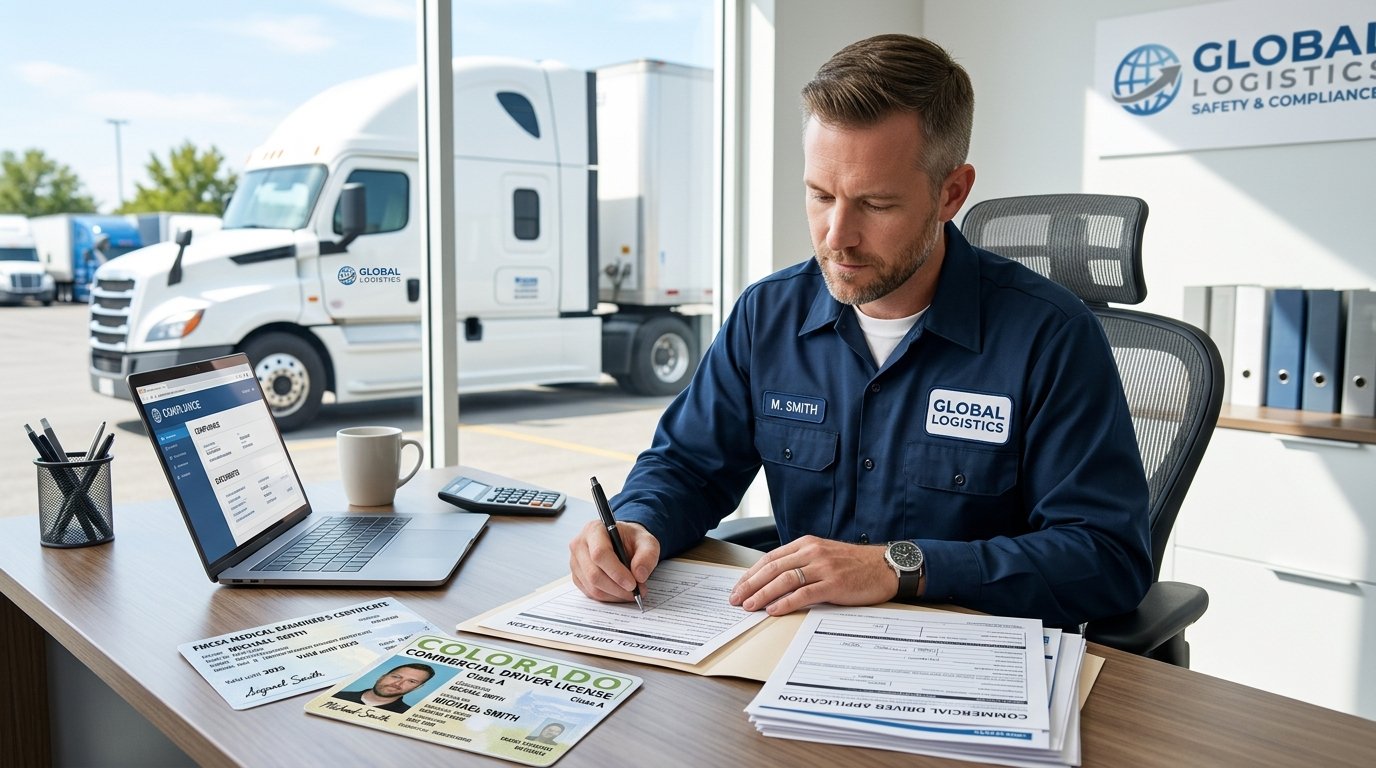
You just found your dream trucking job. The pay is great. The routes work for your schedule. But then you see it: “Must meet all DOT driver application requirements.”
What does that even mean? What forms do you need? How do you prove you are qualified?
A driver application DOT process can feel overwhelming. Missing one document could cost you the job. Worse, it could delay your career for weeks or months.
This guide breaks down everything you need to know. You will learn what employers require, what forms to complete, and how to pass every step of the process.
Key Takeaways
- Every commercial driver must complete a DOT employment application with 10 years of work history
- Employers must verify your driving record through MVR checks and previous employer contacts
- A valid CDL medical card is required before you can drive commercially
- Road test certificates prove you can safely operate commercial vehicles
- All documents become part of your permanent driver qualification file
- Missing or incomplete paperwork can disqualify you from employment
What Is a DOT Driver Application?
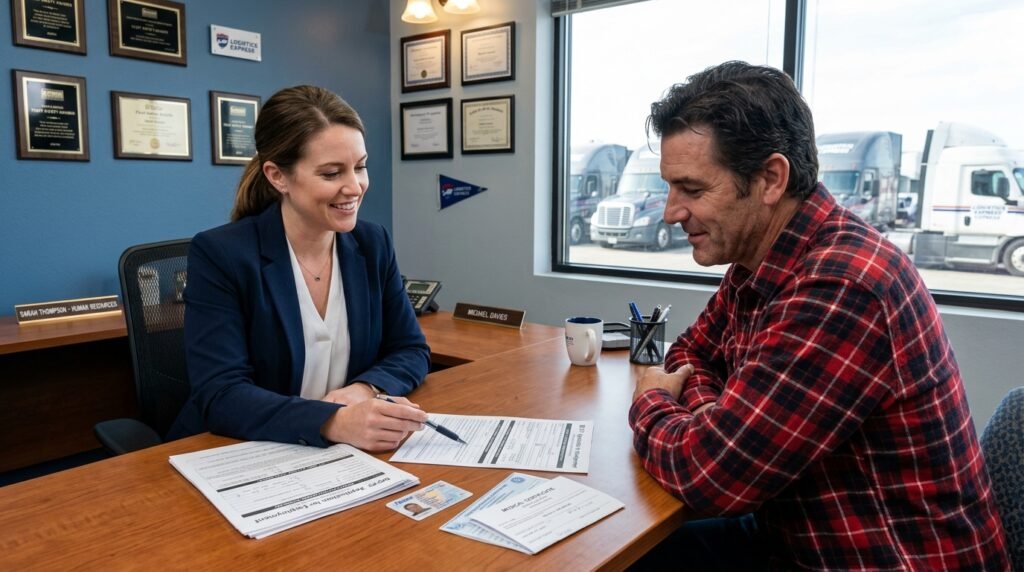
A DOT driver application is a standardized employment application for commercial drivers. The Federal Motor Carrier Safety Administration (FMCSA) requires it for all drivers operating commercial motor vehicles (CMVs).
This application form collects critical information about your background. It includes your driving history, employment history, and safety record.
The application is not just a formality. It protects motor carriers from hiring unqualified drivers. It also protects you by creating a clear record of your qualifications.
Why the DOT Requires This Application
The FMCSA created these requirements under 49 CFR Part 391. The goal is simple: keep unsafe drivers off the road.
Motor carriers must verify that every driver meets minimum standards. The DOT commercial driver application process helps them do this systematically.
Without proper documentation, carriers face serious penalties. Fines can reach thousands of dollars per violation. This is why employers take the application process seriously.
What Makes It Different From Regular Job Applications
A standard job application asks basic questions. Name, address, work experience. That is usually enough.
A DOT employment application goes much deeper. You must provide:
- 10 years of employment history (not just 3-5 years)
- 3 years of driving history
- All accidents from the past 3 years
- All traffic violations from the past 3 years
- Any CDL suspensions or revocations
This level of detail helps employers assess your risk level. It also creates a complete record for your driver qualification file.
Who Needs to Complete a DOT Driver Application?
Not every driver needs to complete this application. The requirements apply to specific types of vehicles and operations.
Drivers Who Must Complete the Application
You need a DOT driver employment application if you drive:
- Vehicles weighing 10,001 pounds or more (GVWR)
- Vehicles designed to transport 16+ passengers (including driver)
- Vehicles transporting hazardous materials requiring placards
- Combination vehicles meeting weight thresholds
This includes most tractor-trailers, buses, and large delivery trucks. Even some larger pickup trucks with trailers may qualify.
Interstate vs. Intrastate Drivers
Interstate drivers cross state lines during their routes. They must always follow FMCSA regulations.
Intrastate drivers stay within one state. However, most states adopt FMCSA standards for intrastate commercial drivers too.
Check with your state DMV if you only drive locally. You may still need to complete the full CDL driver application process.
Owner-Operators and Self-Employed Drivers
Owner-operators face the same requirements. If you operate under your own authority, you must maintain your own driver qualification file.
This means keeping all application documents on file for yourself. You are both the driver and the motor carrier in this situation.
Learn more about compliance requirements in our guide to DOT compliance for trucking.
Required Documents for Your DOT Driver Application
Gathering your documents before applying saves time. Missing paperwork is the top reason applications get delayed.
Essential Documents Checklist
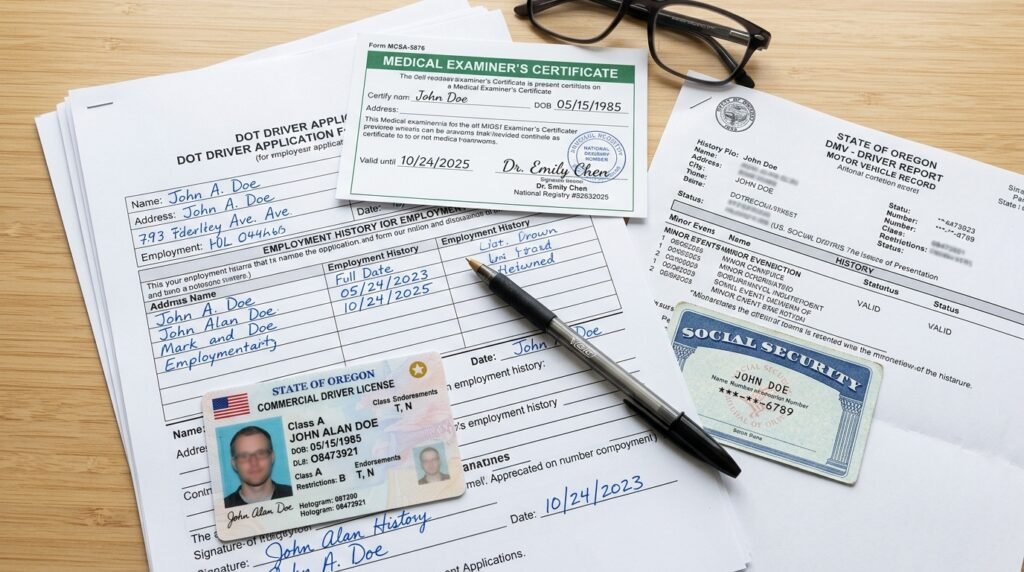
| Document | Purpose | Where to Get It |
|---|---|---|
| Valid CDL | Proves licensure | State DMV |
| DOT Medical Card | Proves physical fitness | Certified Medical Examiner |
| MVR (Motor Vehicle Record) | Shows driving history | State DMV |
| Social Security Card | Identity verification | SSA |
| Employment History | Background verification | Personal records |
| Road Test Certificate | Proves driving skills | Previous employer or new employer |
Your Commercial Driver License
Your CDL must be valid and current. It should show the proper class and endorsements for the job.
Class A covers combination vehicles over 26,001 pounds. Class B covers single vehicles over 26,001 pounds. Class C covers hazmat and passenger vehicles under 26,001 pounds.
Check our complete guide on CDL license requirements for more details.
Supporting Documentation
You may also need:
- Proof of citizenship or work authorization
- DD-214 if you have military driving experience
- Training certificates from CDL schools
- Hazmat endorsement documentation
- TWIC card for port access (if applicable)
Gather these documents early. Some take weeks to obtain if you need replacements.
DOT Employment Application Form Explained
The DOT employment application form requirements are specific. Understanding each section helps you complete it accurately.
Personal Information Section
This section covers basic identification:
- Full legal name
- Date of birth
- Social Security number
- Current address
- Contact information
Use your name exactly as it appears on your CDL. Mismatches cause verification delays.
Employment History Section (10-Year Requirement)
This is where most drivers struggle. You must list every employer from the past 10 years.
For each employer, provide:
- Company name and address
- Position held
- Dates of employment
- Reason for leaving
- Supervisor name and contact
Important: Include all employers, not just driving jobs. Gaps in employment must be explained.
If you cannot remember exact dates, estimate and note it. Writing “approximately” is better than leaving blanks.
Driving Experience Section
List all commercial driving experience here. Include:
- Types of equipment operated
- Class of vehicles
- Approximate miles driven
- Dates of experience
Be honest about your experience level. Employers will verify this information. Exaggerating can disqualify you permanently.
Accident and Violation History
You must disclose all accidents from the past 3 years. This includes accidents that were not your fault.
Also list all moving violations:
- Speeding tickets
- Logbook violations
- Out-of-service orders
- Any CDL-related citations
Employers will check your MVR record. Hidden violations always surface during verification.
Certifications and Signatures
The application includes several certifications. Your signature confirms:
- All information is true and complete
- You authorize background checks
- You understand disqualification rules
- You agree to drug and alcohol testing
Read these sections carefully before signing. False statements can result in permanent disqualification.
Road Test Certificate Requirements
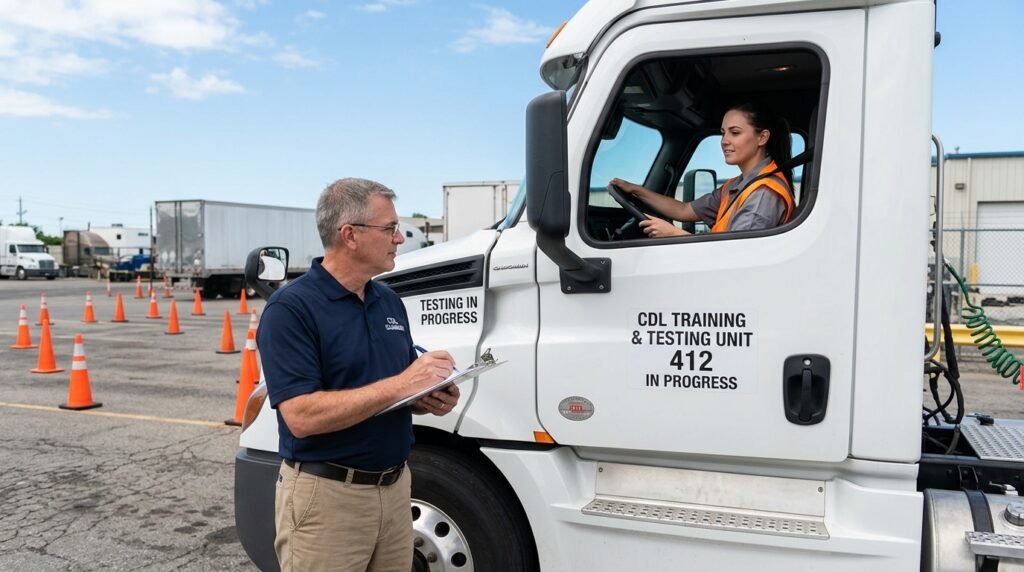
A road test certificate DOT proves you can safely operate commercial vehicles. Every driver must have one on file.
What Is a Road Test Certificate?
The certificate of road test documents that you passed a skills test. It shows you demonstrated safe operation of a CMV.
The certificate must be issued by a qualified examiner. This is typically a company driver trainer or safety manager.
Skills Test Components
The road test evaluates several areas:
Pre-Trip Inspection
- Identify vehicle components
- Check safety systems
- Detect obvious defects
Basic Control Skills
- Straight-line backing
- Offset backing
- Parallel parking (where applicable)
On-Road Driving
- Lane changes
- Turns and intersections
- Highway merging
- Speed management
For detailed guidance, see our CDL road test guide.
Road Test Certificate Requirements DOT
The certificate must include specific information:
- Driver name and signature
- Examiner name and signature
- Date of test
- Type of vehicle used
- Statement that driver passed
Motor carriers must keep this document in your driver qualification file. It remains valid unless you fail to operate a CMV for 12+ months.
Using Your State CDL Skills Test
Here is good news: if you already have a CDL, you may not need another road test.
Your state CDL skills test counts as a road test. The employer just needs a copy of your valid license as proof.
However, some employers require company-specific road tests anyway. This helps them verify you can handle their equipment.
DOT Physical Exam and Medical Card
The DOT physical exam confirms you are medically fit to drive. Without a valid medical card, you cannot operate a CMV.
DOT Physical Requirements for Truck Drivers
The commercial driver medical exam checks several health areas:
| System Checked | What Examiner Evaluates |
|---|---|
| Vision | 20/40 acuity, color recognition, peripheral vision |
| Hearing | Whispered voice test or audiometric test |
| Blood Pressure | Must be under 140/90 for 2-year certification |
| Cardiovascular | Heart rhythm, history of heart disease |
| Respiratory | Lung function, sleep apnea risk |
| Neurological | Seizure history, balance, reflexes |
| Musculoskeletal | Grip strength, range of motion |
The exam also includes a urinalysis. This tests for underlying health conditions, not drugs.
What Does a DOT Physical Consist Of?
Your CDL physical exam appointment typically takes 30-60 minutes. Here is what to expect:
- Complete medical history form
- Vision and hearing tests
- Blood pressure and pulse check
- Urinalysis (in private restroom)
- Physical examination
- Review of results and certification
Bring all current medications to your appointment. Also bring glasses or hearing aids if you use them.
Medical Card Certification Periods
Your CDL medical card validity depends on your health:
- 2 years: Excellent health, no concerns
- 1 year: Controlled conditions like mild hypertension
- Less than 1 year: Conditions requiring monitoring
Some drivers need annual or even more frequent exams. Your examiner determines the certification period.
How to Find a DOT Medical Examiner
Only certified medical examiners can perform DOT physicals. The FMCSA National Registry lists all qualified examiners.
Search by zip code to find a DOT physical near me. Urgent care clinics, occupational health centers, and some primary care offices offer these exams.
Current average cost of DOT physical exam (March 2026) ranges from $75 to $150 across the U.S., with low-cost clinics at $60–$90, average providers at $90–$130, and specialized services up to $200+ depending on location, additional tests, and examiner type.
Can I Update My CDL Medical Card Online in Florida?
Many drivers ask: can I update my CDL medical card online in Florida?
You cannot complete the actual physical exam online. However, Florida allows online submission of your medical certificate to the DMV.
After passing your FMCSA physical, the examiner uploads results to the National Registry. Florida DMV then updates your record.
You can check your certification status through Florida’s online portal. But the exam itself must always be in person.
Learn more about medical requirements in our DOT physical exam guide.
Driver Qualification File Basics
Every document from your application goes into a driver qualification file. This file follows you throughout your driving career.
What Goes in the DQ File?
Motor carriers must maintain these documents:
Required at Hire:
- Completed application form
- MVR from issuing state
- Previous employer verifications
- Road test certificate (or CDL copy)
- Medical examiner certificate
Required Annually:
- Updated MVR review
- Certification of violations
Required Ongoing:
- Drug and alcohol test results
- Annual driver review documentation
How Long Records Must Be Kept
Different documents have different retention periods:
| Document Type | Retention Period |
|---|---|
| Application | 3 years after employment ends |
| MVR | 3 years |
| Medical certificate | 3 years |
| Drug test results | 5 years (positives), 1 year (negatives) |
| Road test certificate | 3 years after employment ends |
Carriers face fines for missing or incomplete files. This is why they are strict about collecting documents.
For complete details, read our Driver Qualification File Guide.
Pre-Employment Drug Testing Requirements
Drug testing is mandatory for all CDL driver application processes. You cannot start work until you pass.
Types of Pre-Employment Tests
Motor carriers must conduct:
Urine Drug Test:
Tests for marijuana, cocaine, amphetamines, opioids, and PCP.
Drug and Alcohol Clearinghouse Query:
Checks for violations from previous employers.
Some carriers also conduct hair follicle tests. These detect drug use over longer periods.
Learn what to expect in our pre-employment drug test CDL guide.
What Happens If You Fail a DOT Physical Drug Test?
What happens if you fail a DOT physical drug test is serious. The consequences include:
- Immediate disqualification from safety-sensitive duties
- Report to FMCSA Drug and Alcohol Clearinghouse
- Required completion of SAP (Substance Abuse Professional) program
- Return-to-duty testing requirements
- Follow-up testing for up to 5 years
A positive result stays in the Clearinghouse. All future employers will see it during pre-employment queries.
This is not the same as failing for health reasons. A failed drug test has career-long implications.
For complete testing information, see our DOT drug test guide.
How to Prepare for Drug Testing
The best preparation is simple: do not use prohibited substances.
If you take prescription medications, bring documentation. Some prescriptions require a Medical Review Officer (MRO) review.
Stay hydrated before your test. Dehydration can make sample collection difficult.
Common Application Mistakes to Avoid
Small errors cause big delays. Avoid these common mistakes on your DOT employment application.
Employment History Gaps
Unexplained gaps raise red flags. Employers must investigate gaps of 30+ days.
If you were unemployed, write “unemployed” and explain why. Common acceptable reasons include:
- Attended school or training
- Medical leave
- Family responsibilities
- Seasonal layoff
Incomplete Previous Employer Information
You need complete contact information for all previous employers. This includes:
- Full company legal name
- Complete address
- Working phone number
- Supervisor name
If a previous employer closed, note this on your application. Provide any documentation you have.
Forgetting to Disclose Violations
Some drivers “forget” minor violations. This is a mistake.
Employers run MVR checks. They will find violations you did not disclose. This creates a honesty concern that often disqualifies applicants.
Disclose everything. A minor speeding ticket rarely disqualifies you. Lying about it often does.
Not Signing All Required Sections
Applications have multiple signature lines. Missing one makes the application incomplete.
Review every page before submitting. Look for signature lines and initial boxes.
Using Incorrect Dates
Double-check all dates on your application. Common errors include:
- Wrong employment start/end dates
- Incorrect violation dates
- Wrong accident dates
Inaccurate dates complicate verification. They may also suggest dishonesty.
Step-by-Step CDL Driver Application Process
Here is your complete CDL driver application process roadmap.
Step 1: Gather Your Documents
Before applying, collect:
- Valid CDL with proper endorsements
- Current DOT medical card
- Social Security card
- 10 years of employment history
- 3 years of address history
Create digital copies of everything. Many employers accept online applications with uploaded documents.
Step 2: Obtain Your MVR
Request your motor vehicle record from your state DMV. Some employers accept self-requested MVRs initially.
Your MVR shows:
- License status and class
- Endorsements and restrictions
- Accident history
- Moving violations
- Suspensions or revocations
Review it for accuracy before applying. Dispute errors with your DMV immediately.
Our MVR record check for CDL guide explains this process in detail.
Step 3: Complete the Application Form
Fill out every section of the dot driver employment application. Use black ink if completing a paper form.
Tips for accuracy:
- Print clearly
- Use full legal names
- Include area codes on phone numbers
- Explain all employment gaps
Review everything before signing. Errors are harder to correct after submission.
Step 4: Complete Pre-Employment Testing
After submitting your application, the carrier schedules testing:
Drug Test:
Usually within 24-48 hours of conditional job offer. Must be negative to proceed.
Road Test (if required):
Scheduled with company trainer or safety manager. Demonstrates your driving skills.
Some carriers combine these with orientation. Others require completion before your first day.
Step 5: Verification Period
The carrier verifies your information:
- Contacts previous employers
- Reviews Clearinghouse records
- Confirms education and training
- Validates licenses and certifications
This takes 5-30 days depending on employer response times.
Step 6: Receive Hiring Decision
Once verification completes, you receive a decision. Successful applicants proceed to:
- Equipment assignment
- Route training
- Company orientation
If not hired, you can request the reason. Understanding why helps you improve future applications.
Step 7: Start Your New Position
Your documents now form your driver qualification file. The carrier maintains this file throughout your employment.
You can start your career with confidence. All DOT requirements are satisfied.
Looking for opportunities? Check out our guides on CDL jobs and best trucking companies.
Frequently Asked Questions
The DOT urine test checks for health conditions, not drugs. The separate drug test screens for substances. To pass the health urinalysis, stay hydrated and avoid excessive sugar before your appointment. The test checks for protein, blood, and glucose levels that might indicate kidney disease or diabetes. If you have diabetes, bring documentation of your treatment plan.
Managing diabetes requires documentation. Bring records showing your condition is well-controlled. Your A1C should typically be under 8% for certification. Bring your glucose logs from the past 3 months. The examiner may certify you for 1 year instead of 2 years. Insulin-dependent drivers need additional exemption paperwork from FMCSA.
Blood pressure must be under 140/90 for a 2-year certification. If your reading is 140-159 over 90-99, you qualify for 1-year certification. Readings above 180/110 disqualify you until controlled. Take your medication as prescribed before the exam. Avoid caffeine and tobacco for several hours before your appointment. Arrive early and relax to avoid white coat syndrome.
Several conditions can cause failure: uncontrolled high blood pressure (180/110+), vision worse than 20/40 (even with correction), hearing loss below minimum standards, uncontrolled diabetes with insulin, certain heart conditions, epilepsy or seizure disorders, and respiratory conditions affecting driving ability. Positive drug tests also result in failure. Many conditions can be treated or accommodated with proper documentation.
The complete process typically takes 2-4 weeks. The application itself takes 30-60 minutes to complete. Drug testing results return within 24-72 hours. Previous employer verification takes 5-30 days depending on response times. Some carriers expedite the process for experienced drivers. Having all documents ready speeds up the timeline significantly.
Not always. If you have a valid CDL, your state skills test satisfies the road test requirement. Employers can accept your CDL as proof. However, many carriers require their own road test anyway. This helps them evaluate your skills on their specific equipment. Keep copies of any road test certificates from previous employers.
Yes, but only through proper channels. The FMCSA Drug and Alcohol Clearinghouse contains violation records. Previous employers must report positive tests and refusals. New employers must query the Clearinghouse before hiring you. They cannot see negative test results, only violations. This system helps keep unsafe drivers off the road.
Document your attempts to contact them. Keep records of phone calls, emails, and returned mail. The carrier must show they made a good faith effort to verify your employment. Alternative verification methods include W-2 forms, pay stubs, or tax records. Written statements explaining the situation also help. Most carriers understand this challenge and work with you.
Conclusion
Completing a driver application DOT process requires preparation and attention to detail. You now understand every step from gathering documents to passing your physical exam.
The key requirements include:
- Complete 10-year employment history
- Valid CDL and medical card
- Road test certificate documentation
- Clean drug test results
- Proper driver qualification file
Missing any element delays your start date. Inaccurate information can disqualify you entirely.
Start gathering your documents today. Request your MVR now to avoid last-minute delays. Schedule your DOT physical exam if your current medical card expires soon.
Ready to launch your trucking career? Learn how to get a CDL or explore trucking companies hiring with no experience.
Your path to the road starts with proper documentation. Complete your DOT driver application correctly the first time, and you will be hauling freight before you know it.
Application Checklist Generator






![DOT Drug Test: What You Must Know in 2026 [Full Guide]](https://compliantdriversprogram.com/wp-content/uploads/2026/03/DOT-Drug-Test-150x150.jpeg)



Leave a Reply